
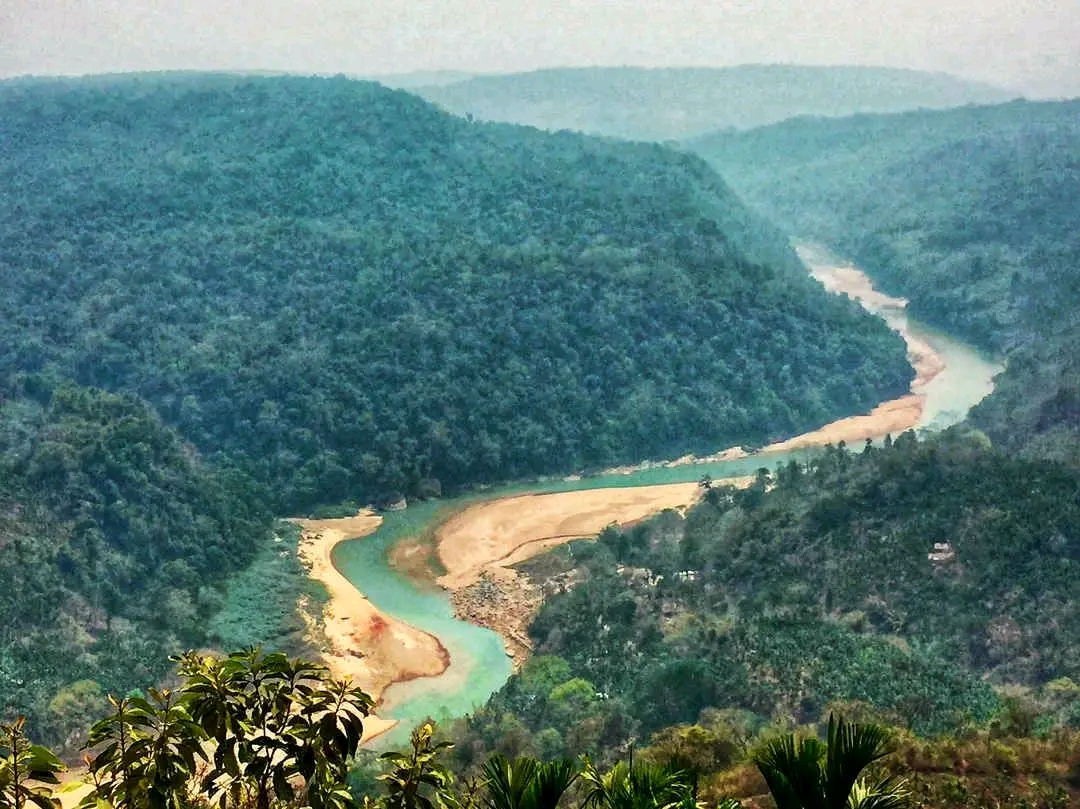
Rising from the misty heights of the Nokrek Range in Meghalaya’s East Garo Hills, the Simsang River flows quietly yet powerfully—shaping landscapes, sustaining livelihoods, and carrying centuries of culture along its course.Often regarded as the most prominent river of the Garo Hills, the Simsang passes through some of the region’s richest ecological and cultural zones before crossing into Bangladesh, where it is known as the Someshwari River.
A River of Many Lands
The Simsang originates in the Nokrek Biosphere Reserve, a dense and biodiverse region known for its sacred groves and unique wildlife. From there, it flows eastward through Williamnagar, before turning south past the limestone caves of Siju, the riverine settlements of Rewak, and the town of Baghmara in South Garo Hills.Along its journey, the river is fed by several tributaries, including the Chibok, Rongdik, Ringdi, and Rompa. Together, these waterways form a fertile ecosystem that supports a wide variety of plant and animal life.Eventually, the Simsang crosses into Bangladesh, continuing through the Netrokona district, where it plays an important role in agriculture and inland fisheries.
Stretching Across Borders
Within Meghalaya, the Simsang is estimated to stretch over 100 kilometres. Including its course through Bangladesh, the river’s total length is believed to reach between 200 and 220 kilometres.This makes it one of the most significant transboundary rivers in the eastern part of the Indian subcontinent, and the longest river in the Garo Hills region.
A Lifeline for Communities
For communities across the Garo Hills, the Simsang is more than just a river—it is a lifeline. Its waters irrigate farmland, sustain fisheries, and provide drinking water to villages along its banks.Traditional fishing and riverbank farming continue to be practiced, particularly in areas such as Siju and Baghmara, where the river remains central to daily life.In recent years, local communities, supported by conservation groups, have taken steps to protect indigenous fish species like the mahseer. Community-managed no-fishing zones and river sanctuaries have been introduced in several stretches, showing encouraging ecological recovery.
Culture and Spirit
Beyond its ecological importance, the Simsang holds deep cultural and spiritual significance for the Garo people. The river features in traditional songs, oral histories, and seasonal festivals.In many villages, it is regarded as sacred, with offerings still made during planting and harvest seasons. Locals often describe the river as something that “divides the Garo Hills and unites the Garo people”—a reflection of its role in connecting communities across the region.
The Need for Recognition
Despite its importance, experts say the Simsang River remains largely underrepresented in national water resource discussions. With increasing development pressures and the impacts of climate change, concerns are growing about the river’s long-term health.“The Simsang is not just a Garo Hills river—it is a transboundary system that deserves coordinated attention between India and Bangladesh,” said a researcher from NEHU’s Department of Environmental Studies.
A River That Flows Beyond BordersThe story of the Simsang River is one of continuity across landscapes, cultures, and generations. It carves valleys, shapes traditions, and supports communities on both sides of the border.As it flows from Meghalaya’s cloud-covered highlands to the plains of Bangladesh, the Simsang carries more than water—it carries history, identity, and the quiet strength of nature.