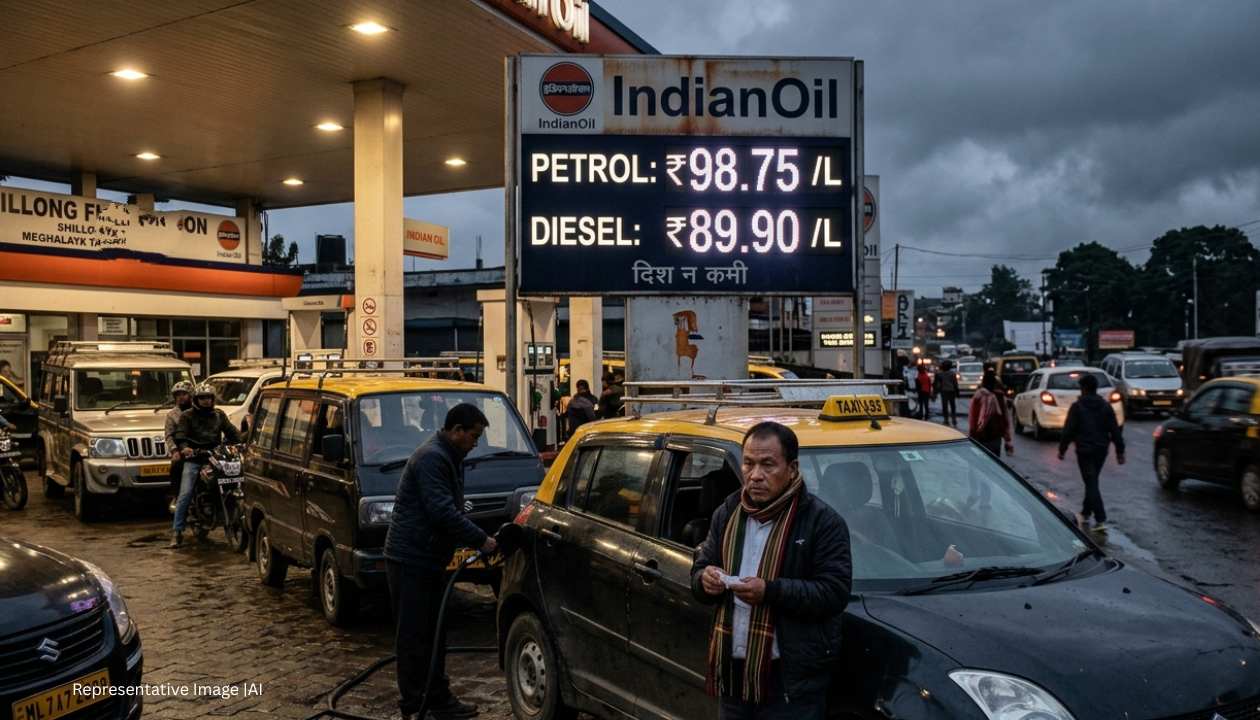
Shillong continues to struggle with traffic congestion, overcrowding, poor drainage, water shortages and unplanned urban growth.
During monsoon season, damaged roads and landslides continue to affect movement across several districts. In many rural areas, connectivity itself still becomes uncertain during heavy rain.

Meghalaya today looks like a State caught between promise and frustration. Every year, new projects are announced. Bigger budgets are presented. Tourism numbers rise. IT parks are inaugurated. Government advertisements speak about growth, investment and opportunities.
Yet across the State, many ordinary people still ask the same question: if Meghalaya is developing, why does daily life still feel so difficult?
That question is no longer coming only from opposition parties or activists. It is coming from unemployed graduates, struggling families, small business owners, frustrated commuters, and young people slowly losing confidence that they can build a stable future at home.
On paper, Meghalaya’s economy is growing. The State’s economy is projected to touch nearly ₹53,000 crore in 2024-25.Government spending continues to rise.
Tourism has become one of the State’s strongest sectors. Shillong is expanding rapidly. New roads, sports infrastructure, digital projects and urban schemes are regularly announced. But for many people, development is not measured through presentations or speeches. It is measured through the road outside their home, whether there is reliable water supply, whether jobs exist after graduation, and whether basic public services actually work. And that is where the gap between statistics and reality becomes difficult to ignore.
A large section of Meghalaya’s population still depends on agriculture and small informal work to survive. Outside government jobs, stable employment opportunities remain limited. Every year, thousands of young people leave the State for cities like Bengaluru, Delhi, Hyderabad, Pune and Guwahati because they simply do not see enough opportunities here.
Even the State government has admitted the scale of the challenge. Chief Minister Conrad K. Sangma recently acknowledged that around 70,000 young people enter the job market every year, while government vacancies remain only a small fraction of that number.
That single number explains the anxiety many families now feel. For decades, government employment has remained the safest dream for many households in Meghalaya. But a State cannot build its future only around government jobs, transfers and schemes. At some point, the private economy must grow strongly enough to absorb its own youth population. That transition still feels painfully slow. Infrastructure remains another reminder of Meghalaya’s unfinished development story.
The uncomfortable reality is that while Meghalaya’s economy may be growing, the experience of development still feels deeply uneven. Some parts of Shillong and East Khasi Hills have expanded rapidly over the years, but many remote districts continue to move at a much slower pace. This imbalance has quietly created frustration, especially among younger generations who now compare Meghalaya not with the past, but with other states they see online every day. And perhaps that is what has changed most.
Today’s generation is more educated, more connected and less willing to wait endlessly for promises to become reality. Young people are no longer impressed only by announcements, festivals or foundation stones. They want visible outcomes — jobs, functioning infrastructure, reliable public services and economic opportunities that allow them to stay in their own State with dignity.
This is not to say Meghalaya has failed completely. The State has made real progress in tourism, sports, entrepreneurship, music, digital connectivity and national visibility over the past two decades. Meghalaya today is far more visible nationally than it once was. But visibility alone cannot replace structural growth.
The larger concern now is whether Meghalaya is building an economy strong enough to sustain its future population, or whether it is slowly becoming a State where the brightest young people continue to leave while development moves in slow motion.
Meghalaya does not lack talent. It does not lack natural beauty. It does not lack potential.
What it increasingly appears to lack is speed, execution and the ability to convert opportunity into systems that ordinary people can actually feel in their daily lives. Because after more than fifty years of statehood, people are no longer asking whether Meghalaya has potential.
They are asking why that potential still feels permanently unfinished.!