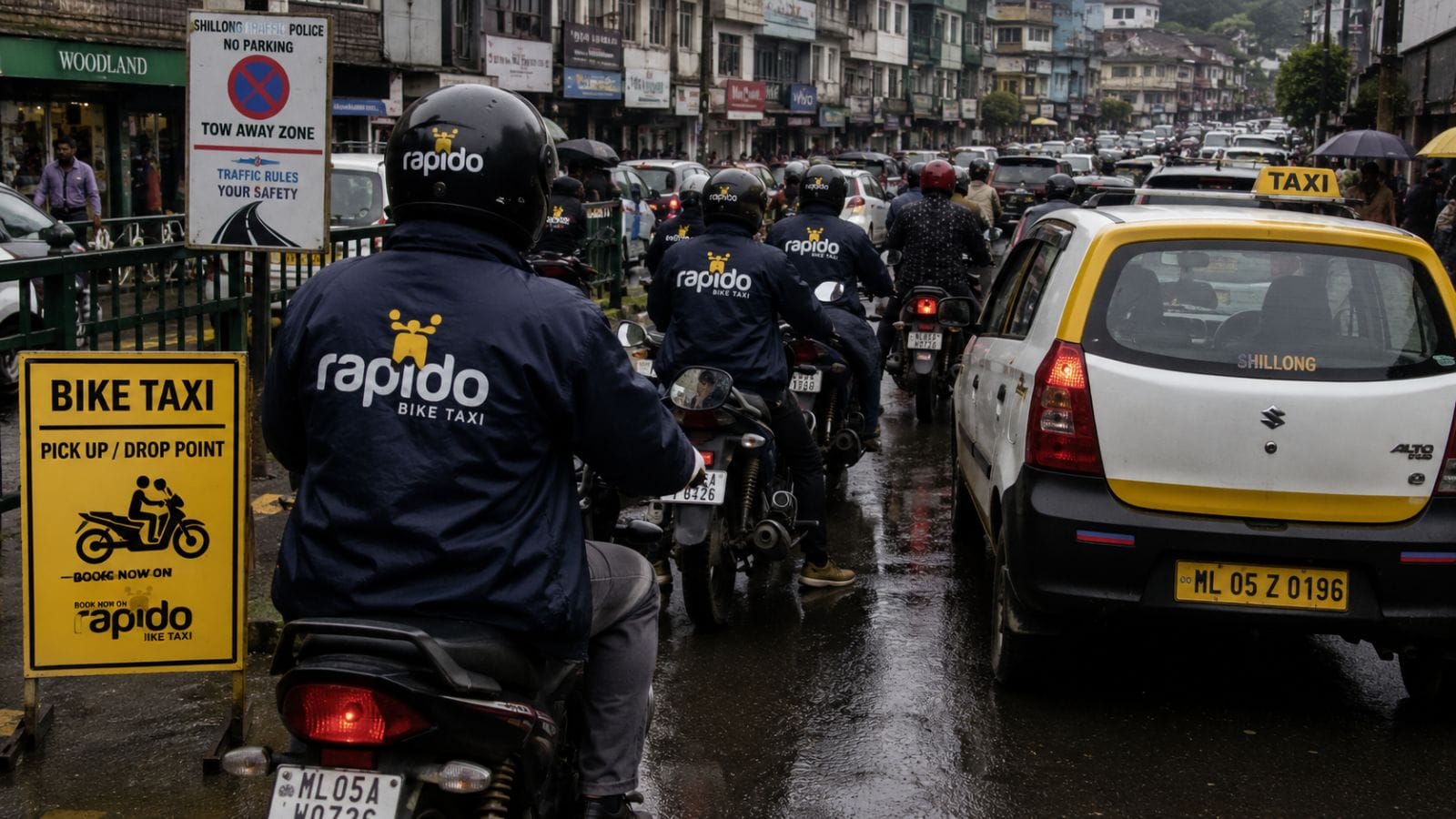
SHILLONG :The Meghalaya government’s latest warning against unauthorised bike taxi operations has once again brought app-based transport services such as Rapido into the spotlight. But the issue did not emerge overnight.
For nearly five years, Shillong’s bike taxi debate has resurfaced repeatedly through enforcement drives, protests, transport department warnings and growing public arguments over legality, traffic congestion and livelihoods. Despite periodic crackdowns, bike taxi services never fully disappeared from the city’s roads.
Now, with the Transport Department signalling stricter enforcement in 2026, the issue has returned once again to the centre of public discussion.
How bike taxis expanded in Shillong
Bike taxi services began gaining popularity in Shillong around 2019 and 2020 as app-based mobility platforms expanded into smaller cities across India. The timing coincided with worsening traffic congestion in Shillong, limited parking space and increasing pressure on the city’s transport system.
For many office-goers, students and daily commuters, bike taxis quickly became a faster and cheaper alternative during peak traffic hours. The sector also created earning opportunities for unemployed youths and part-time riders, especially after the economic disruptions caused by the COVID-19 pandemic.
As demand increased, more riders joined app-based platforms operating across Shillong’s urban areas. But from the beginning, questions remained over whether private motorcycles could legally be used for commercial passenger transport in Meghalaya.
Why local taxi groups objected
The controversy escalated between 2021 and 2022 after local taxi associations and transport groups began openly opposing app-based bike taxi operations. Their objections went beyond competition alone.
Traditional taxi operators argued that commercial transport services were being allowed to function without following the same regulatory requirements imposed on local taxi owners.
Questions were repeatedly raised over:
- Commercial permits
- Taxation
- Vehicle registration
- Insurance
- Passenger safety.
Several taxi groups also alleged that outside aggregators were entering Meghalaya’s transport market without complying with existing transport regulations. As tensions increased, the issue gradually evolved into a wider conflict between conventional transport systems and digital mobility platforms.
Read Also : Commercial bike permit holders seek crackdown on unauthorised bike-taxi operators in Shillong
Legal confusion across India
The Meghalaya controversy unfolded during a period when bike taxi services were also facing legal disputes in several Indian states.
Between 2020 and 2024, app-based bike taxi platforms faced restrictions, court battles or enforcement action in states including Karnataka, Maharashtra, Tamil Nadu and Assam over licensing and permit-related issues.
That national uncertainty added to confusion in Meghalaya, where transport authorities were still attempting to define how bike aggregators should operate under local regulations.
Crackdowns and enforcement drives
The conflict intensified sharply in 2024 after local groups reportedly shut down Rapido’s office in Shillong, alleging that the company was operating without proper permissions.
Around the same period, enforcement drives were launched against bike taxi riders in different parts of the city.
Several riders claimed they were fined during inspections and argued that many depended on bike taxi services as a source of livelihood.
Yet even during crackdowns, demand for bike taxis remained strong among commuters struggling with Shillong’s worsening traffic congestion.
The ‘offline ride’ problemTransport officials have also repeatedly raised concerns over so-called “offline rides”.
According to authorities, some riders allegedly accepted private cash trips after cancelling rides booked through mobile apps, allowing journeys to continue outside digital tracking systems. Officials argued that such practices reduced accountability and complicated passenger safety monitoring.
Authorities have maintained that commercial passenger transport cannot operate outside approved legal frameworks, regardless of public demand.
Government signals stricter regulation
The latest statements issued by Meghalaya’s Transport Department suggest authorities are now preparing for stricter enforcement against unauthorised operators. Transport Commissioner and Secretary Sanjay Goyal recently warned that action could continue against riders and aggregators operating without legal approval.
Officials have also pointed out that Meghalaya already has notified rules governing:commercial transport operations,rent-a-bike services,and bike aggregators. Authorities are now encouraging operators to register formally under approved transport frameworks instead of functioning informally.
A debate larger than Rapido
What began as a dispute over one app-based platform has now grown into a larger conversation about Shillong’s changing urban transport system. The controversy now touches on:
- traffic congestion
- youth employment
- commuter convenience
- transport regulation and
- the survival of traditional taxi operators.
Many commuters continue relying on bike taxis because the rides are often faster during peak traffic hours despite the fact it cost them a bit. Taxi groups and transport authorities, however, maintain that commercial passenger services cannot operate without permits, verification and regulatory oversight.
Must Read : Meghalaya govt announces up to 90% penalty waiver for commercial vehicles