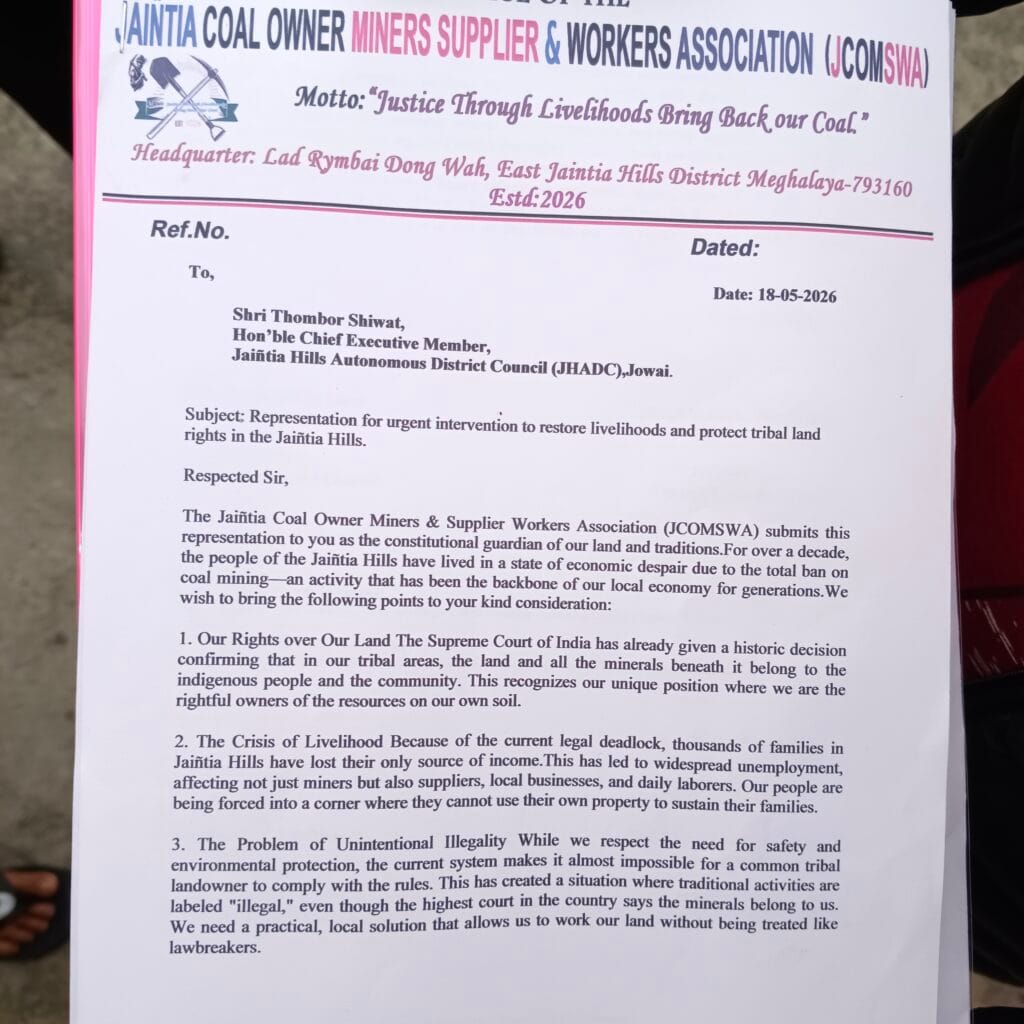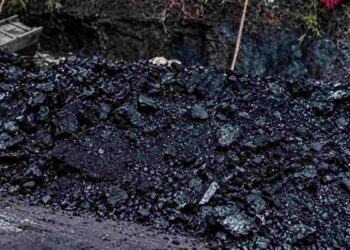
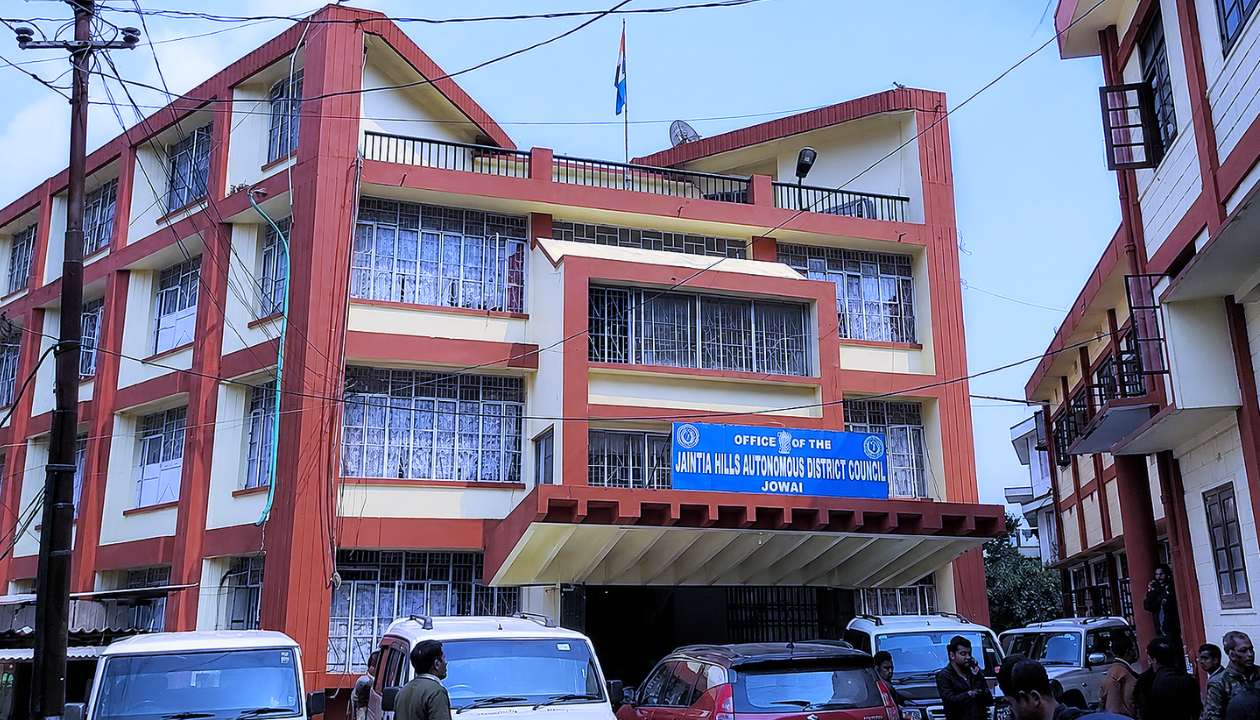
Jowai, May 18: The Jaintia Coal Owner Miners & Supplier Workers Association (JCOMSWA) has appealed to the Jaintia Hills Autonomous District Council (JHADC) to intervene in what it described as a prolonged livelihood crisis caused by the continued restrictions and legal uncertainty surrounding coal mining in the region.
In a representation submitted to JHADC Chief Executive Member Thombor Shiwat on Monday , the association stated that thousands of families in Jaintia Hills have faced economic hardship since coal mining activities were halted following legal and environmental restrictions imposed over the years.
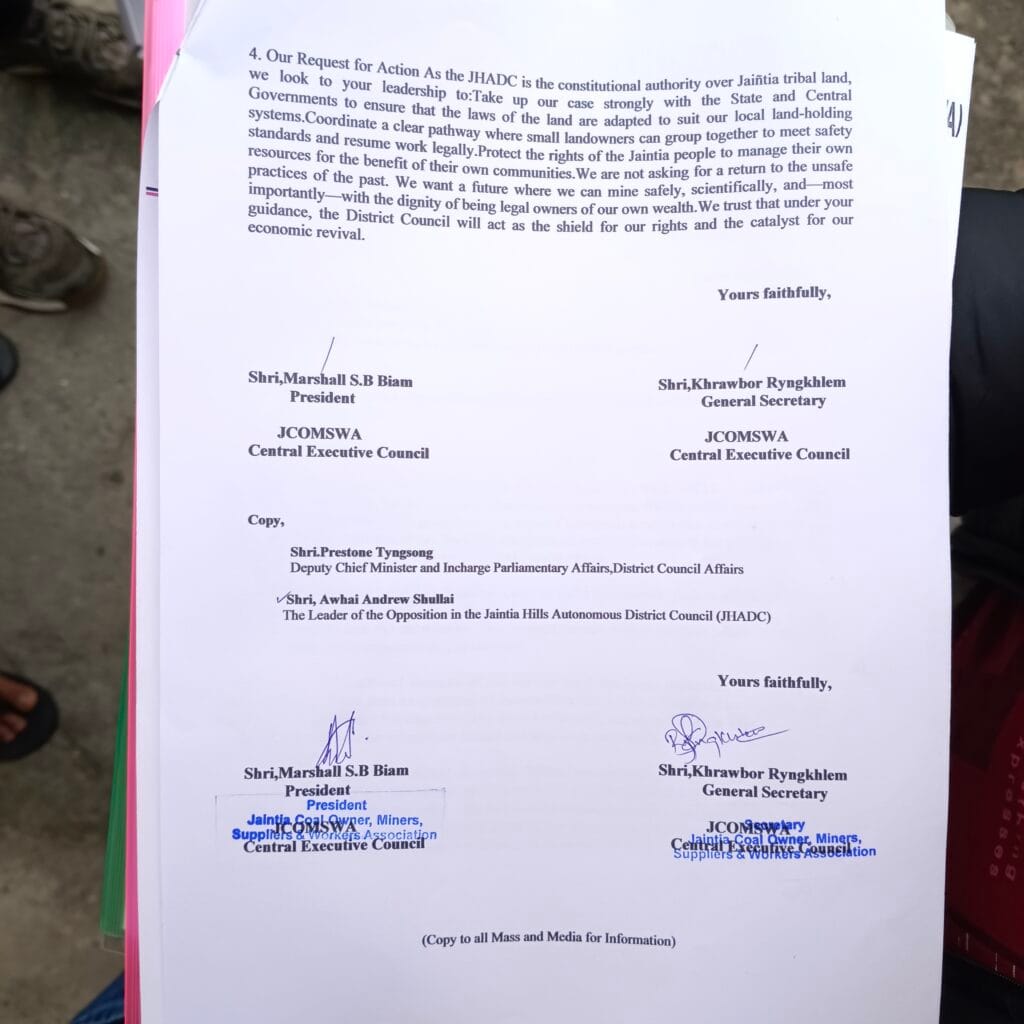
The representation was submitted by JCOMSWA president Marshall S.B. Biam and general secretary Khrawbor Ryngkhlem.
Related : ‘Not Easy to Make State-Specific Laws’: CM on Coal Mining Issue
The association argued that coal mining had traditionally remained one of the main economic activities in the region and claimed that the prolonged deadlock has affected not only miners, but also transporters, suppliers, labourers, and local businesses dependent on the sector.
“For over a decade, the people of the Jaintia Hills have lived in a state of economic despair due to the total ban on coal mining — an activity that has been the backbone of our local economy for generations,” the representation stated.
JCOMSWA also referred to constitutional protections over tribal land and resources, arguing that indigenous communities in the Sixth Schedule areas have traditional rights over land and minerals.
“The land and minerals beneath it belong to the indigenous people and the community,” the association stated while urging authorities to recognise the rights of local landowners. At the same time, the association said it was not seeking a return to unsafe or illegal mining practices, but instead demanded a “practical and legal pathway” that would allow coal extraction under scientific and regulated systems.
“We are not asking for a return to unsafe practices of the past. We want a future where we can mine safely, scientifically and legally,” the representation stated. The association further claimed that existing regulations and compliance mechanisms remain difficult for small tribal landowners to navigate, resulting in many traditional mining-related activities being pushed into legal uncertainty.
Read Also. : Kyrmen Shylla says Party that resumes Coal mining will gain major support in 2028 polls
JCOMSWA urged the JHADC to take up the matter with both the State and Central governments and called for policies adapted to the realities of local landholding systems in the region.The body also stressed the need to protect livelihood opportunities for local communities while balancing environmental safeguards and legal requirements.
Coal mining in Meghalaya has remained a politically and economically sensitive issue since the National Green Tribunal (NGT) imposed a ban on rat-hole mining in 2014 over environmental and safety concerns. Since then, debates have continued over regulation, scientific mining, tribal land rights, environmental protection, and economic dependence on the coal sector in several parts of the State.