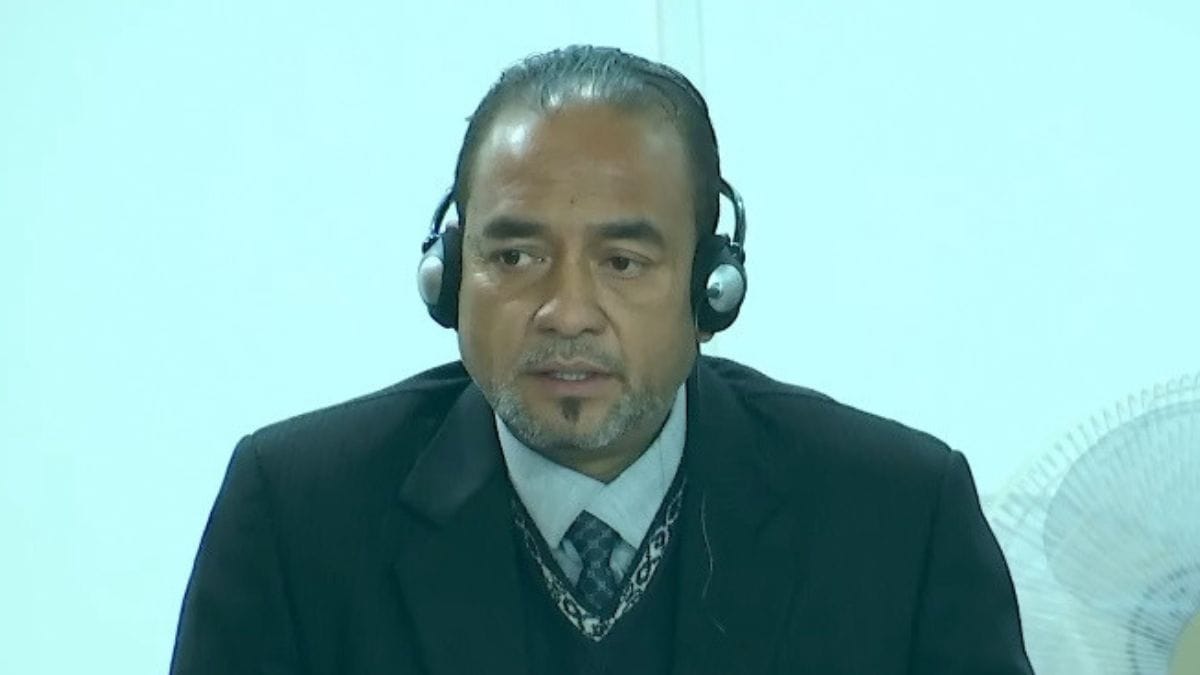
SHILLONG : North Shillong MLA Adelbert Nongrum has written to Assembly Speaker Thomas Sangma, asking him to reconsider his refusal to admit a resolution opposing mandatory singing of Vande Mataram beyond the first two stanzas, ahead of the Assembly’s upcoming Autumn Session.
Nongrum had submitted the resolution under Rule 115 of the Assembly’s Rules of Procedure and Conduct of Business, worded simply: “This House do resolve to object to mandatory singing of Vande Mataram beyond 2 (two) stanzas.”
Assembly Deputy Secretary Raja Kharpuri informed him on August 18 that the Speaker had declined to admit it, citing two grounds, that the resolution violated Rule 117(g), which bars resolutions on matters outside the state government’s primary concern, and that Parliament’s newly passed Prevention of Insults to National Honour (Amendment) Act, 2026 already makes singing all six stanzas mandatory.
Nongrum disputes both grounds. On jurisdiction, he says the issue is directly Meghalaya’s concern given the state’s Christian-majority population, and that mandatory singing of the later stanzas could conflict with the religious beliefs of many residents. He argues that even when a directive comes from the Centre, the state government still has a duty to protect its citizens’ fundamental rights, including freedom of conscience and the right to freely profess and practise religion under Article 25 of the Constitution.
To support his claim that such matters do fall within the Assembly’s scope despite touching central subjects, he points to earlier resolutions the House admitted on the Inner Line Permit system and the inclusion of Khasi and Garo in the Eighth Schedule, both areas that likewise sit with the Centre, and notes that a resolution opposing uranium mining is expected to be admitted in the coming session too, even though atomic energy falls under the Union List.
On the legal question, Nongrum says he examined the amended Act himself and found nothing in it that explicitly requires all six stanzas to be sung. He argues the legislation doesn’t define the complete six-stanza version as the national song for purposes of compulsory singing, and therefore shouldn’t be read as imposing that requirement.
He points out that the Constituent Assembly accepted Vande Mataram as the national song in January 1950, and that only the first two stanzas have actually been in use for decades since. Changing that now, he says, would break from both the country’s historical practice and its constitutional ideals.
Nongrum closed his letter with a direct appeal: “I once again request you to kindly admit the resolution submitted to be moved by me under Rule 115 during the upcoming Autumn Session 2026, and accord the powers and privileges due to me under Article 194 of the Constitution.”