The Arunachal Pradesh Freedom of Religion Act remained largely dormant for decades. Today, it sits at the heart of a growing debate over religious freedom, indigenous identity and cultural preservation.
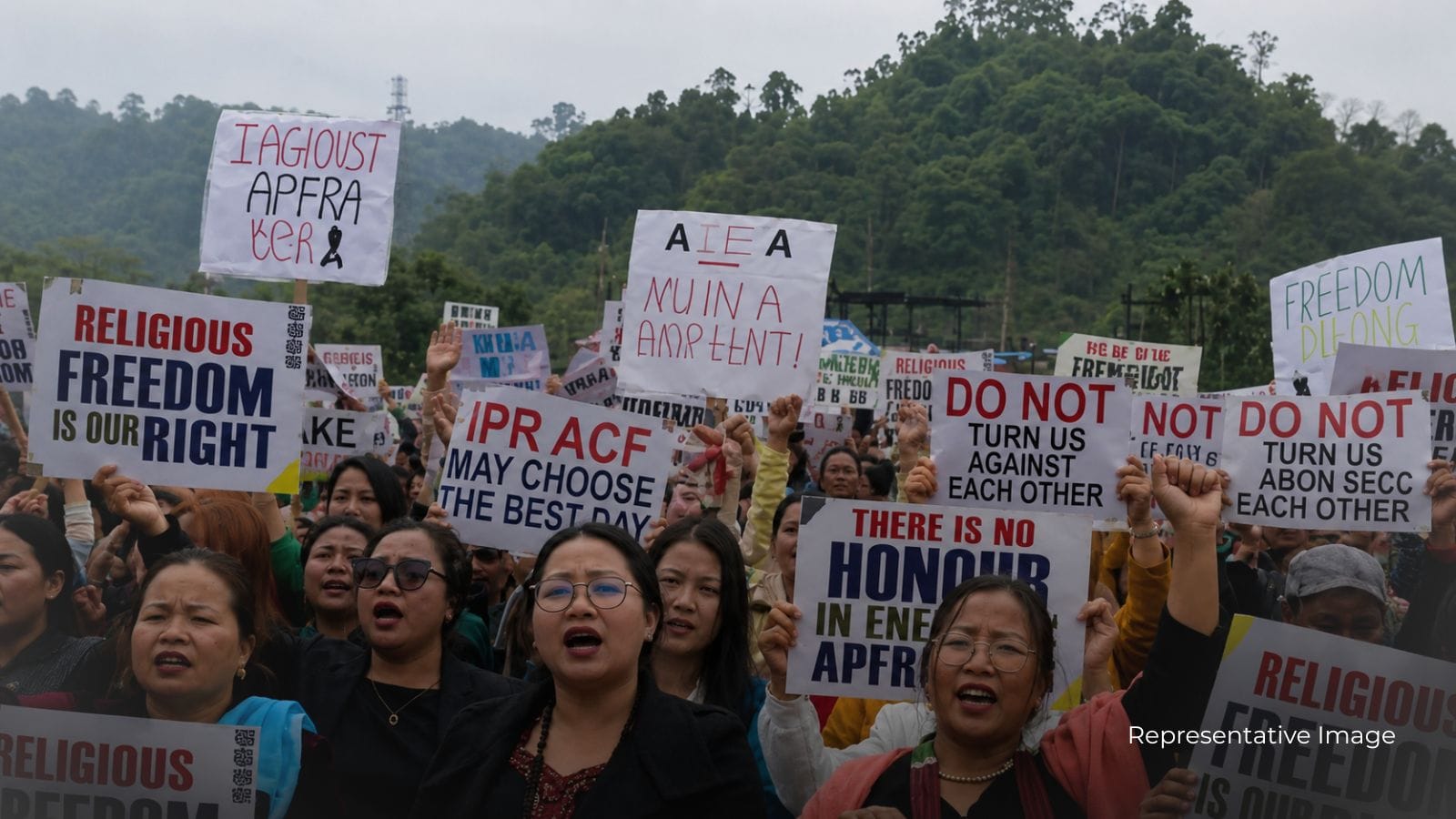
A law passed nearly half a century ago has suddenly become one of the most debated issues in Arunachal Pradesh. The Arunachal Pradesh Freedom of Religion Act (APFRA), enacted in 1978, has sparked widespread protests, public meetings, memorandums and sharp exchanges between Christian organisations and indigenous faith groups.
What was once a largely forgotten piece of legislation has now become the centre of a broader conversation about religious freedom, tribal identity, cultural preservation and constitutional rights. The controversy is no longer confined to courtrooms or government offices. It has reached villages, churches, community organisations and social media platforms across the state.
At the heart of the debate lies a simple but difficult question:
Can a state protect indigenous belief systems without restricting an individual’s right to choose their faith?
An old law returns to the spotlight
The APFRA was passed by the Arunachal Pradesh Legislative Assembly in 1978, long before many of today’s protesters were born. Its stated objective was to prohibit religious conversions carried out through force, fraud or inducement. The law provides penalties for anyone found guilty of converting a person through such means.
For decades, however, the legislation remained largely dormant. While the Act existed on paper, the government never framed the detailed rules required for its implementation.
As a result, it attracted little public attention and rarely featured in political debates. That changed when the issue returned to the spotlight following legal developments that pushed the state government to begin drafting implementation rules.
Suddenly, a law that had spent decades in the background became one of the most contentious issues in Arunachal Pradesh.
Why Christian groups are pushing back
The strongest opposition has come from the Arunachal Christian Forum (ACF), which represents a significant section of the Christian community in the state. The organisation argues that implementing the Act could undermine religious freedom and create uncertainty around the constitutional right to practise, profess and propagate one’s faith.
Christian groups insist that faith is a deeply personal matter and that individuals should be free to change their religion without fear of scrutiny or administrative intervention. Many within the community worry that the implementation of APFRA could create an environment where legitimate religious choices become subject to suspicion.
The ACF has organised protests across the state and recently issued an ultimatum to the government, demanding that the process of framing implementation rules be halted.
For many Christians, the concern is not merely legal. It is also emotional. Christianity has become an important part of the social fabric of Arunachal Pradesh over the past several decades. Churches operate schools, social institutions and community programmes throughout the state.
Majority of believers view the current debate as a challenge to rights they have exercised for generations. Their position is straightforward: the Constitution already protects religious freedom, and any additional regulation risks creating unnecessary barriers.
Why indigenous faith groups support the law
If one listens only to national headlines, it is easy to assume the debate is simply about Christians opposing a law. The reality is far more complex. Several indigenous faith organisations strongly support APFRA and have been urging the government to implement it.
Groups representing traditional belief systems such as Donyi-Polo argue that the legislation is necessary to preserve indigenous culture, customs and spiritual traditions. For them, the debate is not primarily about Christianity. It is about survival.
Many of the indigenous leaders fear that traditional belief systems, some of which have existed for centuries, are gradually losing followers. They argue that cultural practices, rituals and traditional knowledge are closely linked to these faith traditions. As communities modernise and religious demographics evolve, some indigenous groups worry that parts of their cultural heritage could disappear.
Those who back the APFRA insist that the law does not prohibit religious conversion. Instead, they argue that it only seeks to prevent conversions achieved through force, deception or material inducements. In their view, protecting indigenous traditions and respecting religious freedom are not mutually exclusive goals.
How Arunachal’s religious landscape has changed
Understanding the controversy requires looking beyond the law itself. Arunachal Pradesh has undergone significant religious transformation over the past several decades. At the time APFRA was enacted in 1978, indigenous belief systems occupied a much larger share of the state’s religious landscape.
Over the years, Christianity experienced substantial growth across many parts of Arunachal Pradesh. This transformation has altered the social and cultural composition of numerous communities. For some residents, this change reflects freedom of choice and the natural evolution of society. For others, it raises concerns about the future of indigenous traditions.
The disagreement over APFRA is therefore rooted in more than legal language. It reflects differing views about identity, heritage and the direction in which society is moving.
The court order that reignited the issue
For decades, APFRA remained largely inactive. Many people rarely discussed it. That changed when legal proceedings brought the matter back into focus.
The government found itself under pressure to frame rules necessary for implementation. Once the process began, organisations on both sides mobilised quickly. Christian groups viewed the move as a potential threat to religious liberty. Indigenous faith organisations saw it as a long-overdue step towards protecting traditional cultures.
What followed was a clash of competing concerns, both of which carry significant weight in a democratic society.
Why the debate goes beyond the law
The debate is often presented as a disagreement over one law.In reality, it is much bigger than that. Questions surrounding APFRA touch on issues that extend far beyond religion. They involve:
- Individual rights
- Tribal identity
- Cultural preservation
- Constitutional protections
- Community autonomy
- Social change
This is one reason the issue has generated such strong emotions. People are not merely debating legal provisions. They are debating how they see themselves and how they want future generations to live.
What the government is saying
Chief Minister Pema Khandu has repeatedly stated that APFRA is not aimed at any particular religious community. The government has maintained that its actions are linked to legal obligations and court directions rather than an attempt to target any faith group. Officials have also sought to reassure citizens that the objective is to preserve social harmony while addressing concerns raised by different sections of society.
Nevertheless, suspicion remains high. Both supporters and opponents of the law continue to monitor developments closely.
Can both sides find common ground?
One of the striking features of the debate is that both sides claim to be defending fundamental rights. Christian organisations say they are protecting religious freedom while indigenous faith groups say they are protecting cultural survival. Neither concern can be dismissed easily.
A democratic society must find ways to protect personal liberty while also safeguarding cultural heritage. The challenge lies in balancing these priorities without creating new tensions. Whether such a balance can be achieved remains uncertain.
A conversation unfolding beyond Arunachal
Although the controversy is unfolding in Arunachal Pradesh, the issues involved resonate far beyond the state’s borders. Across India, discussions continue over religious conversion, indigenous traditions, minority rights and cultural preservation.
Arunachal’s debate reflects many of those larger national conversations, it also highlights the unique realities of the Northeast, where questions of identity are often closely tied to language, tribe, culture and faith.
The outcome of the APFRA debate may therefore be watched carefully by communities well beyond Arunachal Pradesh.
The unresolved balance between faith and identity
Nearly five decades after it was passed, APFRA has returned to the centre of public discussion. Whether the law ultimately satisfies either side may be less important than what the debate has already revealed that questions of faith, identity and cultural preservation remain deeply intertwined in Arunachal Pradesh.
And perhaps that is because the real issue is no longer the law itself. The real issue is how a diverse society balances freedom of belief with the desire to preserve the traditions that define its history.