When Nagaland recently ordered a halt to new dhabas, eateries and commercial structures within the Right of Way of its National Highways, the reaction was swift — and largely off the mark. Headlines and social media posts framed it as a blanket ban on roadside food stalls, sparking worry among small business owners and confusion among travellers who rely on these stops during long journeys. Within hours, the announcement had become one of the more debated pieces of policy news in the state, with truckers, shop owners and commuters all trying to work out exactly what had changed and what it meant for them.
The reality, once you dig into the actual order, is far more limited than the panic suggested.
What “Right of Way” actually means
Making sense of this properly means unpacking a term that sounds bureaucratic but carries real weight here: Right of Way. This isn’t simply the tarred surface vehicles drive on. It’s a much broader strip of land legally reserved for the highway’s present and future use covering shoulders, drainage channels, utility lines, visibility zones, and space set aside for widening or emergency repairs down the line.
Depending on the classification of the highway, this protected corridor can stretch well beyond what most people would visually associate with “the road.” Its width isn’t fixed either; it shifts depending on whether a stretch is a two-lane, four-lane or planned expansion corridor, and highway authorities keep official records marking exactly where this boundary falls for any given section.
A dhaba standing close to a highway isn’t automatically breaking any rule; what makes it unauthorised is whether it physically sits inside this protected corridor without approval from the highway authority. A shop built on private land just outside that boundary, even one within arm’s reach of the tarmac, isn’t touched by this order at all.
That distinction carries real weight in a hill state like Nagaland, where terrain often forces roads, settlements and small businesses into close proximity out of sheer geographic necessity. Flat land is scarce, and over the years, many roadside structures have gone up wherever space was available near the highway, sometimes with proper clearances and sometimes without anyone checking too closely.
Along many stretches, dhabas and small shops sprang up organically alongside expanding traffic, often before Right of Way boundaries were even clearly marked or enforced in that particular area. It’s this second category — structures built without clearance, often years before anyone raised objections — that the current order specifically targets.
Why the Supreme Court is behind this push
The pressure behind this crackdown traces back to the Supreme Court which has repeatedly raised alarm over how National Highways, despite making up only a sliver of India’s total road network, account for a disproportionate share of the country’s fatal accidents. The court has, across several rulings connected to road safety and highway encroachment cases, directed state governments and highway authorities to keep National Highway land free of encroachments that compromise safety or obstruct future infrastructure work.
Vehicles braking suddenly to pull into roadside stalls, trucks parked haphazardly along shoulders, and customers dashing across high-speed lanes to reach a tea stall on the other side have all been flagged repeatedly as hazards authorities want cleared from highway corridors nationwide. In several of these rulings, the court has also pointed to encroachments as a factor that delays road-widening and safety-improvement projects, since construction crews often cannot proceed until disputed structures are cleared, adding years to work meant to reduce accident rates in the first place.
That judicial pressure has since filtered down through the Ministry of Road Transport and Highways to individual state governments, Nagaland included. What’s unfolding in the state right now is essentially the local rollout of a much larger, nationwide compliance exercise, rather than a standalone decision dreamed up by the state administration on its own.
District authorities have reportedly been tasked with surveying highway stretches, cross-checking existing structures against official Right of Way maps, and flagging discrepancies before any notices go out a process that, in practice, can take considerable time given how many structures may need individual verification.
Nagaland isn’t acting in isolation, and it isn’t even the first in the region to move on this front. In neighbouring Meghalaya’s East Khasi Hills district, the Deputy Commissioner had already ordered commercial establishments between 3rd Mile and 7th Mile in Upper Shillong to remove unauthorised structures, warning of demolition if owners missed the compliance deadline.
The near-identical wording used in both states’ orders right down to the specific reference to the Right of Way and the same legal justification citing Supreme Court directions — suggests this is part of a coordinated, court-driven push playing out gradually across the region, state by state, rather than an isolated policy unique to Nagaland. It wouldn’t be surprising if other Northeastern states follow with similar orders in the coming months, given how uniformly this directive appears to be cascading down from the same judicial source.
What it means for dhaba owners and travellers
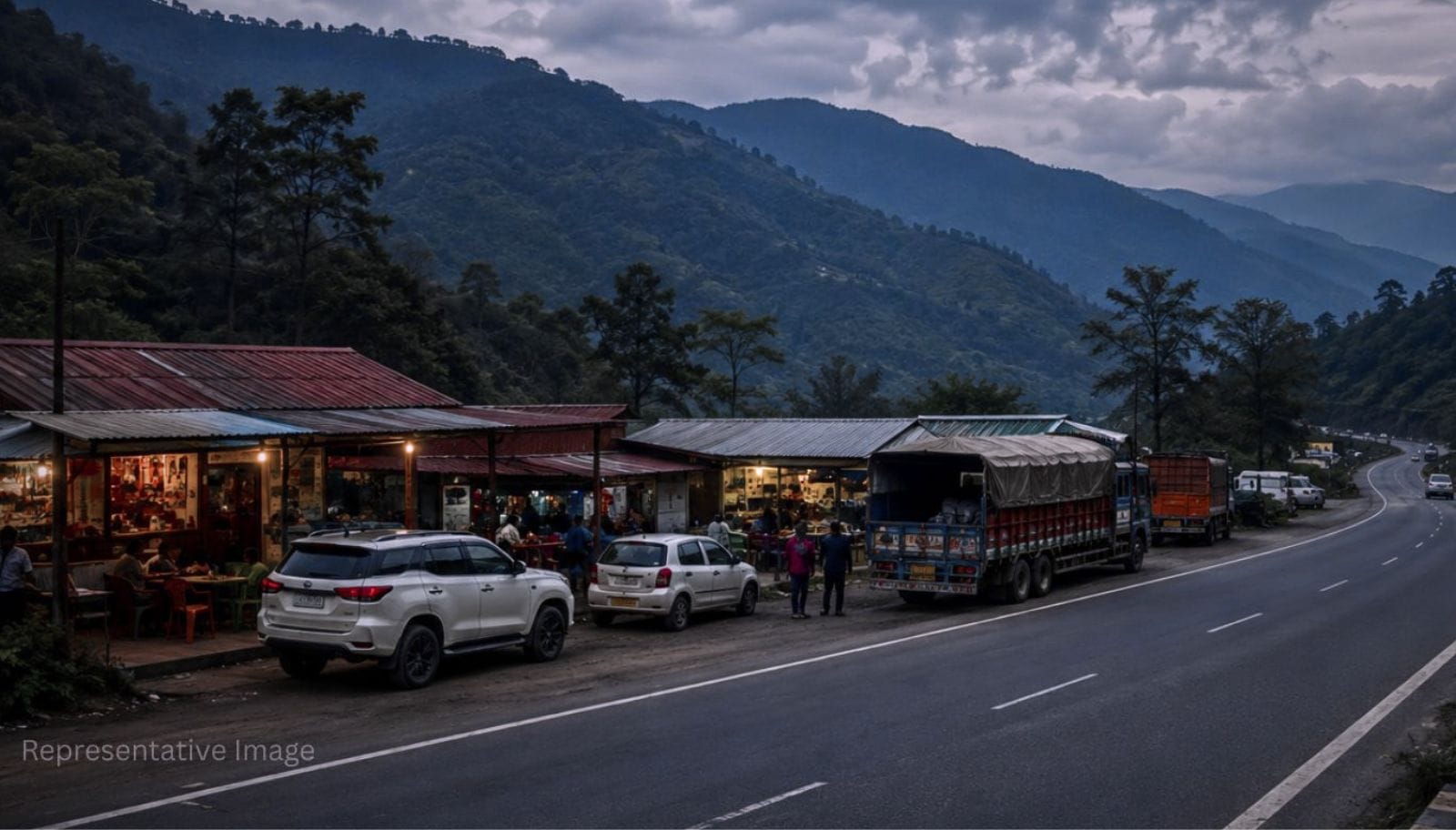
It’s worth being clear about what this order does not do. None of this means every roadside dhaba in Nagaland is suddenly illegal or unsafe. Countless highway eateries across the state have operated for years without dispute, serving truckers, taxi drivers and travellers who depend on them for food and rest along long, often remote stretches where organised rest stops are few and far between.
Many of these families, running a small highway dhaba isn’t a side hustle it’s the primary source of household income, built up over years, sometimes across generations, with savings poured into a modest structure by the roadside. Some of these businesses employ extended family members and serve as the sole earning source for entire households, meaning any abrupt closure carries consequences well beyond the loss of a single shopfront.
That’s exactly what makes enforcement tricky in practice, and why this story is about more than just highway rules. Clearing genuine encroachments may improve highway safety and keep room open for future road-widening or drainage and repair work, both legitimate public interest concerns backed by real accident data. But travellers still need somewhere safe to stop, eat and rest, especially on long-distance routes where the alternative to a roadside dhaba might be nothing at all for dozens of kilometres.
Simply removing structures without a clear plan for what replaces them risks solving one problem – highway safety — while creating another: stranded travellers and families losing their only source of income overnight.
Elsewhere in India, authorities facing similar pressure have tried to ease this tension by developing designated truck lay-bys and officially approved wayside amenities — structured, planned facilities set back from the carriageway that offer the same services (food, rest, fuel, parking) without encroaching on protected highway land.
These planned facilities are typically developed either directly by highway authorities or through public-private partnerships, and in some states, dhaba owners displaced by enforcement drives have been offered priority allotment in these new, legally sanctioned locations as a way of preserving livelihoods while still meeting safety requirements.
Whether Nagaland’s administration follows a similar path, offering displaced business owners a legitimate alternative site, or simply proceeds with removals without addressing what comes next, will likely shape how this policy is remembered by the communities it affects most directly.
As Nagaland begins identifying and acting on violations, the real test won’t just be how many structures come down or how quickly. It will be whether the process stays transparent, whether affected business owners are given fair notice and a genuine chance to relocate, and whether the state manages to balance the Supreme Court’s safety mandate with the everyday economic realities of the people whose livelihoods depend on that stretch of highway.