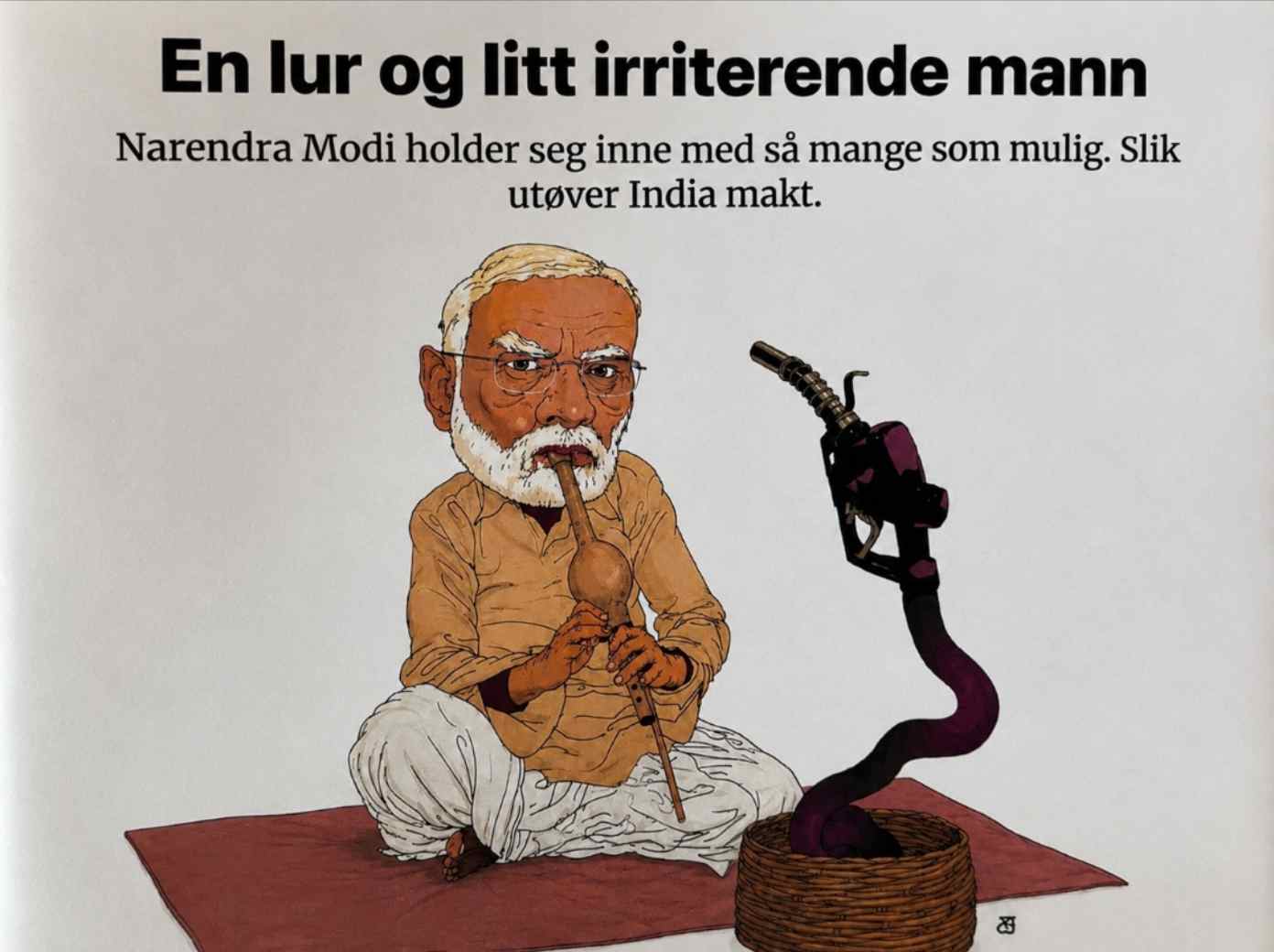
A political cartoon published by Norwegian newspaper Aftenposten during Prime Minister Narendra Modi’s visit to Oslo has triggered widespread debate in India, with many social media users accusing the paper of reviving colonial-era stereotypes about the country.
The cartoon portrayed Modi as a snake charmer and appeared alongside a headline that roughly translated to “a sneaky and slightly annoying man.”
The image quickly spread online after screenshots from the newspaper began circulating across Indian social media platforms. While political cartoons targeting world leaders are common in Europe, many Indians argued that the controversy was not only about criticism of Modi, but about the specific imagery used. The “snake charmer” stereotype has a long history in Western portrayals of India.
During the colonial period, British travel writing, films, postcards, and newspaper illustrations often reduced India to images of snake charmers, fakirs, elephants, crowded streets, and superstition.
Historians and media scholars have frequently argued that such depictions shaped a simplified Western understanding of India for decades.
Even after India’s economic and technological rise, similar debates have surfaced repeatedly.
In 2014, The New York Times faced backlash over a cartoon published after India’s Mars Orbiter Mission showed a traditionally dressed Indian man with a cow entering an elite “space club.”
Many accused the paper of using outdated stereotypes despite India becoming one of the few countries to successfully reach Mars orbit. While online users connected the Norway cartoon to that earlier controversy.
One X user wrote: “India builds satellites, digital payment systems and global tech companies, yet parts of Western media still return to snake charmers and poverty clichés.” Another user argued that criticism of political leaders should not rely on civilisational stereotypes.
The controversy also gained attention because it emerged during a larger debate surrounding press freedom and Modi’s interaction with foreign journalists.
Days earlier, Norwegian journalist Helle Lyng publicly questioned Modi during his Oslo visit by asking: “Why don’t you take some questions from the freest press in the world?” Her remark went viral shortly after India slipped to 157th place in the 2026 World Press Freedom Index released by Reporters Without Borders (RSF), while Norway ranked first.
Lyng later defended her questioning style, stating: “Journalism is sometimes confrontational. We seek answers.”
Related : “Why don’t you take questions?” Norwegian journalist’s remark to PM Modi sparks Press Freedom debate
The sequence of events — the press freedom debate followed by the cartoon controversy — intensified online discussion around how India and its leadership are portrayed internationally.
Those defending the newspaper said the cartoon was political satire and should be viewed in the context of Europe’s strong free speech culture.
European newspapers have a long tradition of publishing aggressive caricatures of presidents, monarchs, and political leaders. Critics of the backlash argued that satire is intentionally provocative and uncomfortable by nature. Others disagreed.
Several social media users argued that there is a difference between mocking political power and using imagery historically associated with racial or colonial stereotypes.
The debate is no longer only about one cartoon or one newspaper. It has expanded into a larger discussion about press freedom, satire, racism, and whether parts of Western media still rely on outdated cultural imagery while covering India.
Must Read : Over 700 citizens move EC against PM Modi’s speech, allege model code violation