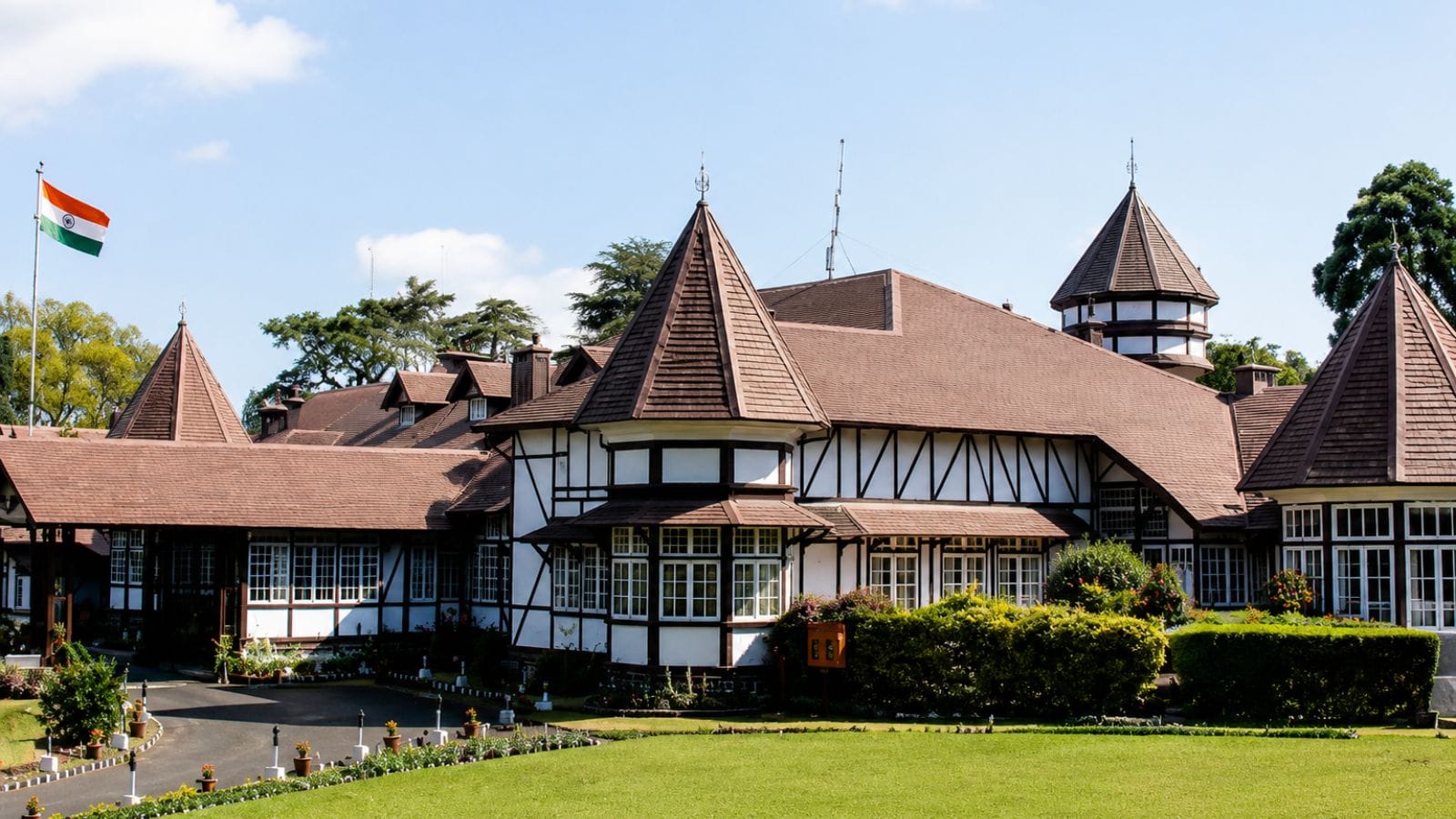
SHILLONG : The Meghalaya government has officially declared Lok Bhavan a protected heritage building, giving legal recognition to one of Shillong’s oldest and most historically important public landmarks.
The notification was issued under the Meghalaya Heritage Act, 2012, with the government stating that the decision was taken to preserve the structure’s historical, architectural and cultural importance.
For decades, Lok Bhavan has remained closely associated with Meghalaya’s administrative and political history. The building, earlier known as Raj Bhavan, has long stood as one of Shillong’s most familiar colonial-era landmarks and continues to hold symbolic importance in the state’s public life.
With the latest declaration now in force, the entire complex will come under the protection of the Meghalaya Heritage Regulations, 2013. This means future repairs, renovations or structural changes to the property will now require conservation safeguards aimed at preserving the building’s original identity.
A building shaped by history
The present structure traces its history back to the devastating Great Assam Earthquake of 1897, which destroyed the original Government House that once stood on the same site.
After the earthquake, reconstruction work was carried out under the supervision of Sir Henry Cotton, who was then serving as the Chief Commissioner of Assam. Unlike conventional government buildings of that period, the new structure was designed with earthquake resistance in mind.
Engineers used a timber-based framework instead of heavy masonry, allowing the building to better withstand seismic activity in the hill region.
Completed in 1903, the structure reflected a classic colonial architectural style with sloping roofs, wooden detailing and broad verandas — features that would later become strongly associated with Shillong’s old hill-station identity.
Read Also : Meghalaya govt plans Rs 9 Crore Housing project for IAS and MCS officers
More than 120 years later, Lok Bhavan continues to stand as one of the city’s surviving colonial-era structures.
From Raj Bhavan to Lok Bhavan
The landmark also underwent a symbolic transition in recent years after the government renamed Raj Bhavan as Lok Bhavan, a move aimed at giving the institution a more public and people-centric identity.
Earlier this year, parts of the historic complex were also opened to the public during Republic Day celebrations for the first time, drawing large public interest.