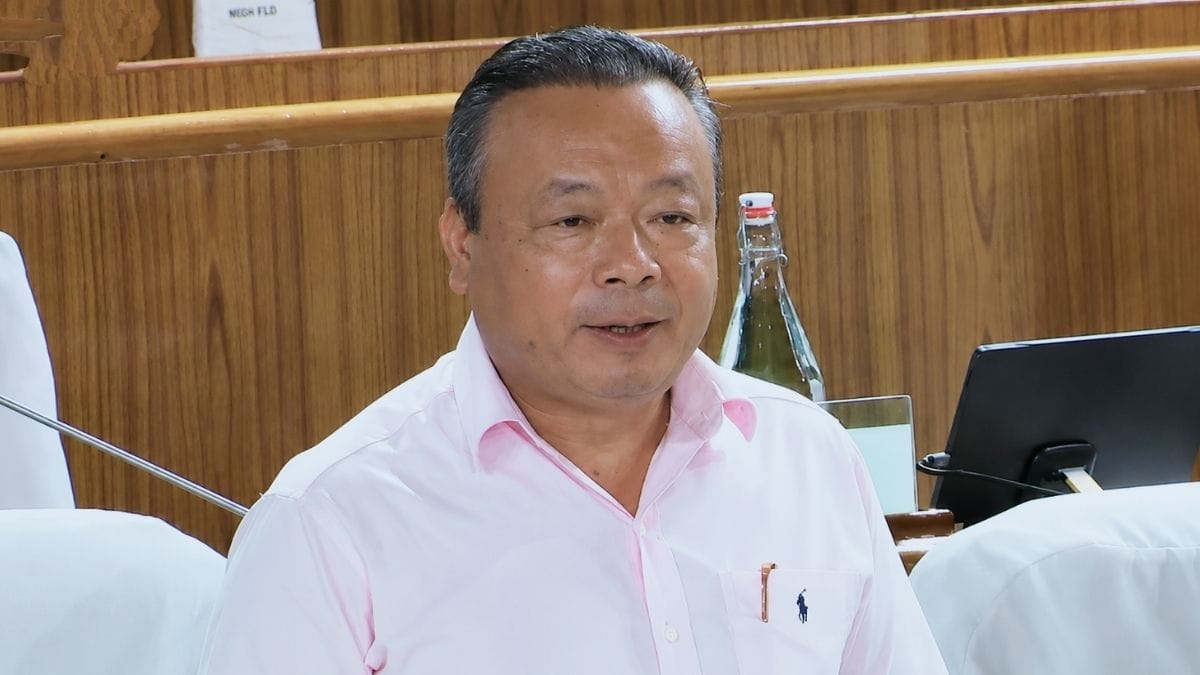
SHILLONG : West Shillong MLA and UDP leader Paul Lyngdoh has called for an immediate Education Reforms Commission for Meghalaya, saying the state’s education system has expanded faster than its quality has improved.
Speaking during a Short Duration Discussion on the current state of education in the Meghalaya Assembly on Thursday, Lyngdoh said Shillong once had a reputation as the education hub of the Northeast, producing prominent administrators, politicians, diplomats and academics. He said that legacy should not simply be remembered but used as a reason to rebuild the education system.
“Shillong is the cradle of education in the Northeast,” Lyngdoh said, adding that the purpose of the discussion was to “reignite that passion, reignite that spark” which had helped Shillong establish its educational reputation.
He pointed to the city’s institutions and their alumni, including former Chief Election Commissioners Harishankar Brahma and J.M. Lyngdoh from St Edmund’s College, and several former chief ministers who studied at St Anthony’s College.
Lyngdoh also recalled the international reach of Shillong’s schools and colleges, saying students from Bangladesh had travelled to the city for education. He said this history demonstrated what Meghalaya’s education system had once been capable of achieving.
PGI score improves, but Meghalaya still trails Northeast
Lyngdoh acknowledged the state’s improvement in the latest Performance Grading Index, but questioned whether the pace of improvement was sufficient.
Meghalaya’s PGI 2.0 score increased from 448 in 2024–25 to 525.71 in 2025–26, moving the state from Akanshi-3 to Akanshi-1. The state government has described the two-grade jump as a major improvement and said it was the first time Meghalaya had moved out of the lowest category since the PGI framework was introduced.
Lyngdoh welcomed the improvement but said the broader picture remained concerning.
“Therefore, the issue before the House is not whether Meghalaya and its education scenario has improved, but whether it is improving fast enough,” he said. He argued that Meghalaya’s position among the Northeastern states should remain a concern even after the rise in its overall score. The latest PGI improvement is substantial, with the state’s score rising by nearly 31 per cent over three years, but Lyngdoh said policymakers needed to examine why Meghalaya continued to lag its better-performing neighbours.
Lyngdoh questions MBOSE credibility
Lyngdoh also launched a pointed criticism of the Meghalaya Board of School Education, saying public confidence in the board had weakened.
“I’m a product of MBOSE, and at one point of time everybody would clamor to get their children sent to the board,” he said.“ Today, I doubt whether even officials of MBOSE would wish to send their children to MBOSE, or would they rather choose ICSE institutions?”
He questioned the timing of the SSLC examination, particularly the decision to hold it during the colder months. “What is the justification to have the SSLC examination in the freezing months of December and January?” he asked.
Lyngdoh compared Meghalaya with Assam, saying students there sit for examinations in February despite Assam having a warmer climate. The timing, he argued, leaves Meghalaya students with less preparation time and could disadvantage those competing against students from other boards. The issue has already been under discussion within the state government.
Education Minister Lahkmen Rymbui said in February that the SSLC examination for 2026 would be held in December, after the 2025 examination was shifted from the planned December schedule to January following a request from MBOSE.
Lyngdoh also questioned MBOSE’s prescribed textbook policy, arguing that schools should have greater flexibility to select books suited to their students, particularly at lower and middle levels.
Reforms without capacity building
The West Shillong MLA said MBOSE had introduced several structural changes, including biannual examinations, removal of the best-of-five system and adoption of NCERT courses. But he questioned whether the board had developed the institutional capacity needed to implement those reforms effectively.
“The board has introduced major structural reforms biannual exams, removal of the best-of-five, adoption of NCERT courses but this has been done without something very elementary: strengthening the inter-institutional capacity first,” he said.
He pointed to limited teacher retraining, weak counselling and academic support systems, and the absence of a proper capacity audit.Lyngdoh also questioned whether holding two examinations every year had achieved the intended result.
“The introduction of two examinations in a calendar year has put more stress on students,” he said, arguing that some students were becoming less serious about examinations because of the additional opportunity. He suggested conditional flexibility, compensatory passing and grace marks linked to aggregate performance, while warning against treating academic weakness and learning disadvantage as the same problem.
‘Digital intox’ replacing digital detox
Lyngdoh also raised concerns about the growing use of mobile phones among students. He described the situation in Meghalaya as “digital intox” rather than digital detox.“
In our case, it’s not digital detox we are practicing digital ‘intox’,” he said. He linked excessive and unregulated phone use to poor concentration, disturbed sleep, anxiety, depression, stress and headaches. Lyngdoh referred to a 2025 study by D. Paswet on social media use among higher secondary students in Jowai town, saying the research found that while digital platforms could support learning, excessive use affected concentration and interpersonal relationships. He asked whether the government had conducted or planned a statewide study covering students in both urban and rural areas to examine the relationship between digital-device use and mental health.
Learning outcomes and teacher training remain weak
Breaking down the education indicators, Lyngdoh said Meghalaya continued to face serious weaknesses in several areas. He said the state was at the bottom nationally on learning outcomes, close to the bottom in access and near the lower end in infrastructure. He also pointed to equity, where Meghalaya was at the bottom nationally alongside Jharkhand, while teacher education and training remained only marginally above the national lowest level. Governance was the exception he highlighted, with the state recording a comparatively strong score of 85.6 per cent.
The contrast, he argued, showed that administrative performance alone could not compensate for weaknesses in classroom learning, teacher development and student support.
206 schools have zero enrolment
Lyngdoh also raised questions over the size and distribution of Meghalaya’s school network. He cited figures showing that the state had more than 14,500 schools, including 206 schools with zero enrolment and another 2,269 schools with fewer than 10 students. Similar figures have been cited publicly in discussions around Meghalaya’s school network, with reports putting the total number of schools at around 14,500 and highlighting the large number of zero- and low-enrolment institutions.
“This system expanded faster than its quality improved too many schools, too little strategic planning,” Lyngdoh said. He called for consolidation where appropriate instead of continuing to expand the number of schools without examining whether existing institutions were viable.
“Instead of endlessly adding schools, we should consolidate where appropriate and strengthen the schools that actually serve students,” he said.
Warning over Meghalaya’s next generation
Lyngdoh connected the present condition of education with Shillong’s earlier achievements. He recalled how institutions in the city had produced people who went on to occupy some of the country’s highest offices. He then asked what Meghalaya would produce three decades from now if the current weaknesses continued.
“Imagine a school in remote Northeast producing two occupants of the position of Chief Election Commissioner of this country,” he said. “Let’s imagine if these things continue to plague us, what will be produced 30 years down the line?”
He blamed the rote-learning system for contributing to the decline and said Meghalaya needed a fundamental rethink rather than isolated changes to examinations or curriculum.
Calls for Education Reforms Commission
Lyngdoh’s main demand was the immediate creation of an Education Reforms Commission. He said the commission should examine the education system as a whole, including learning outcomes, teacher preparation, institutional capacity, school consolidation, examination reforms, student support and the changing impact of technology.
He ended his intervention by quoting Irish poet W.B. Yeats.“Education is not the filling of a pail, but the lighting of a spark,” he said.
“Let that spark be lit again.” He then gave a direct call for action:
“Action speaks louder than words. Let’s act now.”