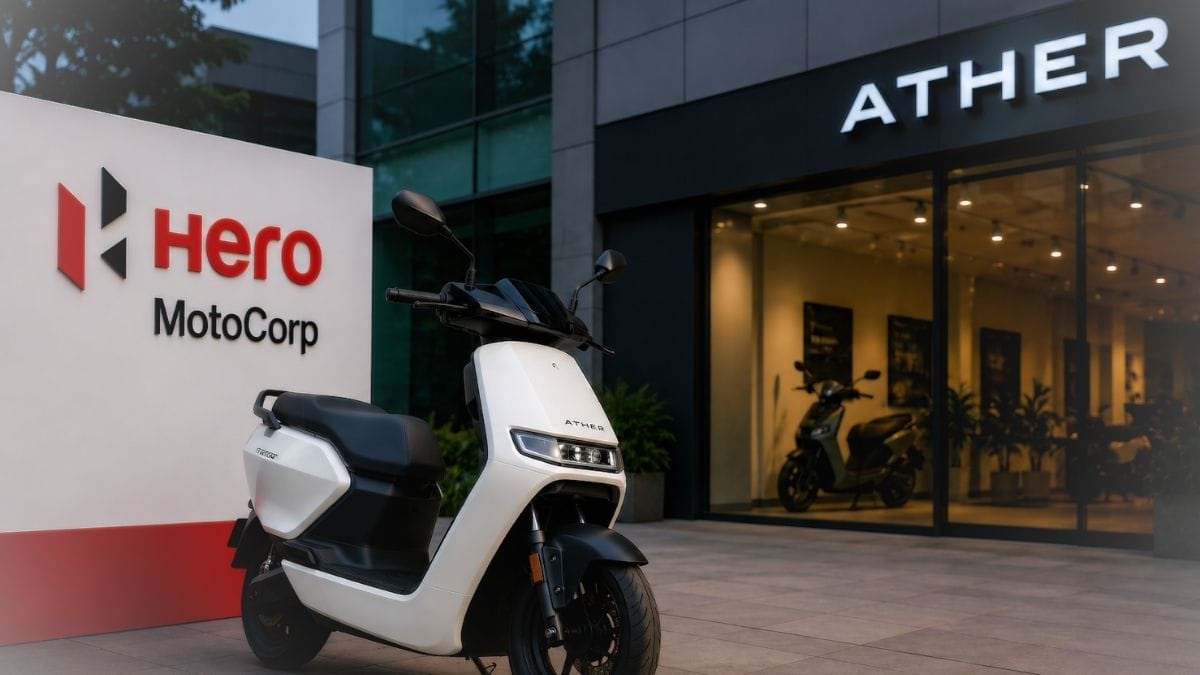
NEW DELHI : Hero MotoCorp bought another chunk of Ather Energy on August 28, picking up roughly 1.18 crore shares at ₹1,480 apiece in a ₹1,758 crore block deal that pushes its stake in the electric two-wheeler maker from 29.88 percent to around 32.8 percent, its second capital commitment to the company inside a single month.
Exchange data shows the Government of Singapore as the seller in this latest transaction. Since it’s a secondary purchase, the ₹1,758 crore flows to that outgoing shareholder rather than into Ather’s own balance sheet, a different structure entirely from the ₹960 crore Hero committed earlier this month through convertible warrants Ather issued directly. That earlier preferential issue raised ₹1,200 crore in total, with Hero contributing ₹960 crore, the India-Japan Fund putting in ₹200 crore, and co-founders Tarun Mehta and Swapnil Jain each chipping in ₹20 crore. Between the two moves, Hero has now backed Ather through both a direct capital injection and an open-market share purchase within the same few weeks.
The timing lines up with a genuine turnaround in Ather’s own numbers. Revenue from operations hit ₹1,216.92 crore in the June 2026 quarter, up 88.8 percent from ₹644.58 crore a year earlier, while the consolidated net loss shrank to ₹51.09 crore from ₹178.23 crore over the same stretch. The company also posted its first-ever positive quarterly EBITDA in June, roughly ₹9.45 crore, a sharp swing from an EBITDA loss of ₹105.97 crore twelve months prior. That momentum builds on an already strong FY26. Ather sold 2,62,942 electric two-wheelers across the year, a 69 percent jump from FY25, pushing its market share to 18.6 percent.
Fourth-quarter volumes alone hit a record 83,418 units, up 76 percent year-on-year. Full-year revenue from operations climbed to ₹3,671.76 crore, against ₹2,255 crore in FY25, with total income reaching ₹3,823 crore. The company hasn’t turned profitable yet, but the losses have narrowed considerably as both volume and revenue have scaled up.
A big part of that growth traces back to the Rizta, Ather’s family scooter, which has opened the brand up to customers well beyond its earlier premium-only positioning, alongside a steadily expanding retail and charging network.
Reuters reported in August that strong Rizta demand was a key driver behind the company’s sharply reduced first-quarter loss. This deepens a strategy it’s already pursuing on two fronts for the Company. The company also runs its own electric-scooter line under the VIDA brand, but its position in Ather now gives it real financial weight in a completely separate EV operation, one with its own products, software stack and charging infrastructure and retail footprint already built out.
Ather shares climbed during trading on August 28, touching ₹1,579.90, close to the stock’s previous 52-week high of ₹1,580, before ending the day at ₹1,616.30, well above the ₹1,480 price Hero actually paid in its block deal.
Ather’s June quarter loss of ₹51.09 crore was smaller than the ₹178.23 crore loss a year earlier, even as the company continued spending heavily on production capacity, new products, distribution and technology.
Hero’s own stake in Ather now stands at roughly 32.8 percent following the two transactions, up from 29.88 percent at the start of the month.