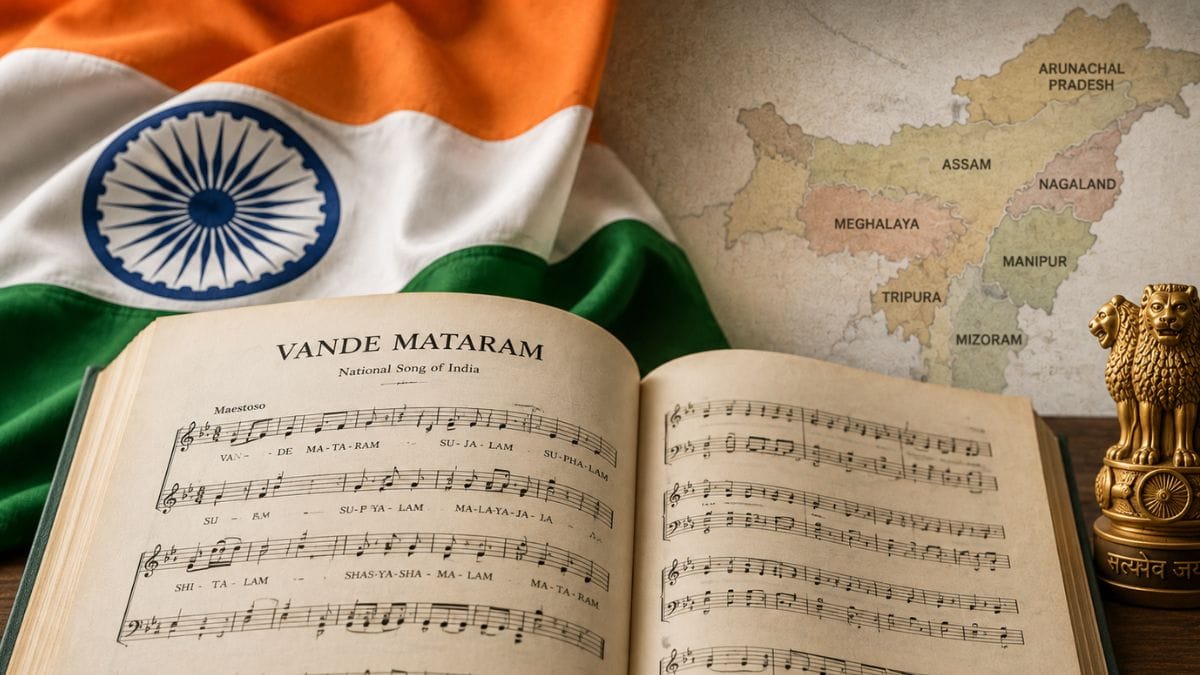
The Centre’s new protocol for Vande Mataram has triggered different responses across the Northeast, with objections focusing on the full six-stanza version, compulsory participation and religious references contained in the later verses.
The Ministry of Home Affairs issued fresh instructions on January 28, 2026, prescribing an official version of the National Song and setting out the occasions for its playing and singing.
A consolidated order issued on July 9 brought together instructions covering both Vande Mataram and the National Anthem, with wording that shifts between “shall” and “may” depending on the setting. This wording split has become central to the entire controversy, because the Union government’s own order is considerably more specific than the broad public claim that Vande Mataram has simply been made compulsory everywhere.
The January 28 order prescribes an official six-stanza version running around 3 minutes and 10 seconds, and lists formal occasions when the National Song shall be played, civil investitures, specified functions involving the President or Governor, flag ceremonies, and other occasions covered by special government instructions. When Vande Mataram and Jana Gana Mana are performed together, the order specifies the National Song comes first, followed by the National Anthem.
The wording changes outside these formal settings: the order says the National Song may be sung at other significant occasions, describing mass singing there as desirable rather than mandatory. Schools fall into this softer category too, the order states the day’s work in all schools may begin with community singing of the National Song, while separately instructing school authorities to make adequate provision for popularising the National Song, National Anthem, and respect for the National Flag among students.
The relevant provisions break down as:
- Specified formal occasions: National Song shall be played
- Certain ceremonial occasions: Mass singing shall accompany the rendition
- Other significant occasions: National Song may be sung
- Schools: Day’s work may begin with community singing
This gap in wording matters directly when claims are made that every school or public function has been ordered to conduct compulsory singing, the order simply doesn’t say that uniformly.
The version itself has also changed substantially. The two stanzas most commonly heard in public broadcasts for decades run around 65 seconds; Akashvani began using the full six-stanza version from March 26, with the complete rendition running close to three times that length. The later stanzas include religious imagery, references to Durga, Kamala and Vani, along with temples and other devotional content, and it’s specifically these portions that have become the focus of objections raised by political representatives, student organisations, and religious bodies across parts of the Northeast.
In Meghalaya, North Shillong MLA Adelbert Nongrum of the Voice of the People Party met the state Chief Secretary in March and submitted a formal letter of protest.
“I am not against the national song Vande Mataram. But I am totally against the full-length version of the national song and I fully subscribe to the first two stanzas,” he said. Nongrum went further, framing his objection in explicitly constitutional and religious terms:
“If such things happen, it is like we allow infringing the Article 25 of the Constitution which guarantees us as a citizen, the Freedom of Faith and Religion. I would also like to remind as a Christian, as a believer, I will quote from the 10 Commandment that I am the Lord, Your God, you shall not have any strange God before me.”
The Khasi Students’ Union followed with a wider response, general secretary Donald V Thabah announced on March 20 that the organisation would identify locations where the full version was being performed and organise protests, including at schools and government functions, arguing the later stanzas reference Hindu deities in ways that could conflict with the religious and cultural beliefs of indigenous tribal communities.
The Meghalaya government itself has not issued any blanket rejection of Vande Mataram, and its position shouldn’t be inferred from an individual MLA’s or student body’s statements.
Mizoram has taken a firmer, government-level stance. Chief Minister Lalduhoma told reporters in March that “Mizoram would accept only the first two stanzas, while anything beyond that would not be acceptable to the state government or its people,” clarifying that the subsequent stanzas contain religious references rather than purely patriotic themes.
The Mizo Zirlai Pawl, the state’s apex student organisation, has separately opposed compulsory singing of all six stanzas in educational institutions, with its executive committee resolving to continue taking steps to ensure students aren’t compelled to sing or listen to the full version, arguing the additional stanzas portray the motherland through Hindu deity imagery that could conflict with Christian beliefs among students.
Mizoram’s constitutional backdrop includes Article 371G, which provides special protection concerning the religious and social practices of the Mizos and limits how certain Acts of Parliament apply to the state unless its own Legislative Assembly decides otherwise, though that provision doesn’t automatically exempt every Union instruction touching a national symbol.
Nagaland has seen the broadest range of objecting voices. The Nagaland Baptist Church Council, the state’s largest church body, issued a formal statement on August 13 through general secretary Rev Dr Mar Pongener and secretary for social concern Dr Villo Naleo, declaring it would oppose “any directive or practice that seeks to make the singing of ‘Vande Mataram’ compulsory, particularly for those belonging to the Christian community,” while insisting that “patriotism must never be reduced to compulsory conformity.”
The council was careful to frame this as principle rather than defiance, stating it “fully respects India’s national symbols, patriotic sentiments and constitutional values,” while cautioning that coercion “may result in outward compliance but cannot create genuine loyalty, conviction or a sense of belonging.”
It called on the government, educational institutions, student organisations, churches and civil society to approach the matter with “wisdom, restraint and constitutional sensitivity,” while urging all stakeholders to remain peaceful.
Also, the Naga Students’ Federation has separately opposed participation in programmes involving the full version and has asked educational institutions not to send students to Independence Day programmes featuring it, a position the NBCC explicitly acknowledged and appreciated in its own statement.
Assam presents a different picture again. AIUDF leader Rafiqul Islam said on August 16 that people should be free to sing Vande Mataram voluntarily rather than being forced to, a political statement rather than evidence of any rejection by the Assam government itself.
Weighed together, the regional picture shows genuinely different responses rather than one shared Northeast position, objections from an MLA and student union in Meghalaya, a clear government-level stance in Mizoram, opposition from political, student and church bodies in Nagaland, and no comparable government rejection established in Assam.
The underlying legal questions run through Articles 19 and 25 of the Constitution. Article 19(1)(a) protects freedom of speech and expression, subject to constitutionally permitted restrictions, while Article 25 protects freedom of conscience and the right to freely profess, practise and propagate religion, subject to its own constitutional limitations.
Article 51A(a) separately places a fundamental duty on citizens to respect the Constitution, the National Flag and National Anthem. Worth noting here: the Constitution never designated Vande Mataram as the National Anthem, that status belongs to Jana Gana Mana, while Vande Mataram holds the distinct status of National Song.
The Supreme Court’s 1986 ruling in Bijoe Emmanuel vs State of Kerala offers relevant precedent on compelled patriotic expression, though the case itself concerned the National Anthem, not Vande Mataram.
Three Jehovah’s Witness schoolchildren had refused to sing the National Anthem on religious grounds, standing respectfully while it played, and were subsequently expelled.
The Court found their rights had been violated, drawing a line between actual disrespect toward the Anthem and a respectful, conscience-based decision not to sing it. But that ruling didn’t establish a blanket right to opt out of every form of patriotic expression, and since it never addressed Vande Mataram specifically, it functions as a relevant constitutional analogy on freedom of conscience rather than a directly applicable precedent.
A separate legislative thread adds another layer: Parliament has taken up the Prevention of Insults to National Honour (Amendment) Bill, 2026, aimed at extending statutory protection to the National Song under the existing law covering offences against national symbols.
That raises a distinct legal questions from compelled singing, making disrespect toward a national symbol a punishable offence doesn’t automatically mean every citizen must vocally participate in its rendition, and the actual scope of that obligation would depend entirely on the enacted legislation specific provisions once finalised.
What all of this leaves is a genuinely open legal question rather than a settled one: whether the state can require vocal participation in a national song when someone objects to specific parts of its prescribed text on sincere religious or conscientious grounds.
How this resolves will hinge on the precise scope the MHA instructions actually carry? how the relevant constitutional protections in Articles 371A and 371G ultimately apply, and should the matter reach a courtroom, how judges choose to balance the standing of national symbols against the public duties and individual freedom of conscience wrapped up in this dispute.