
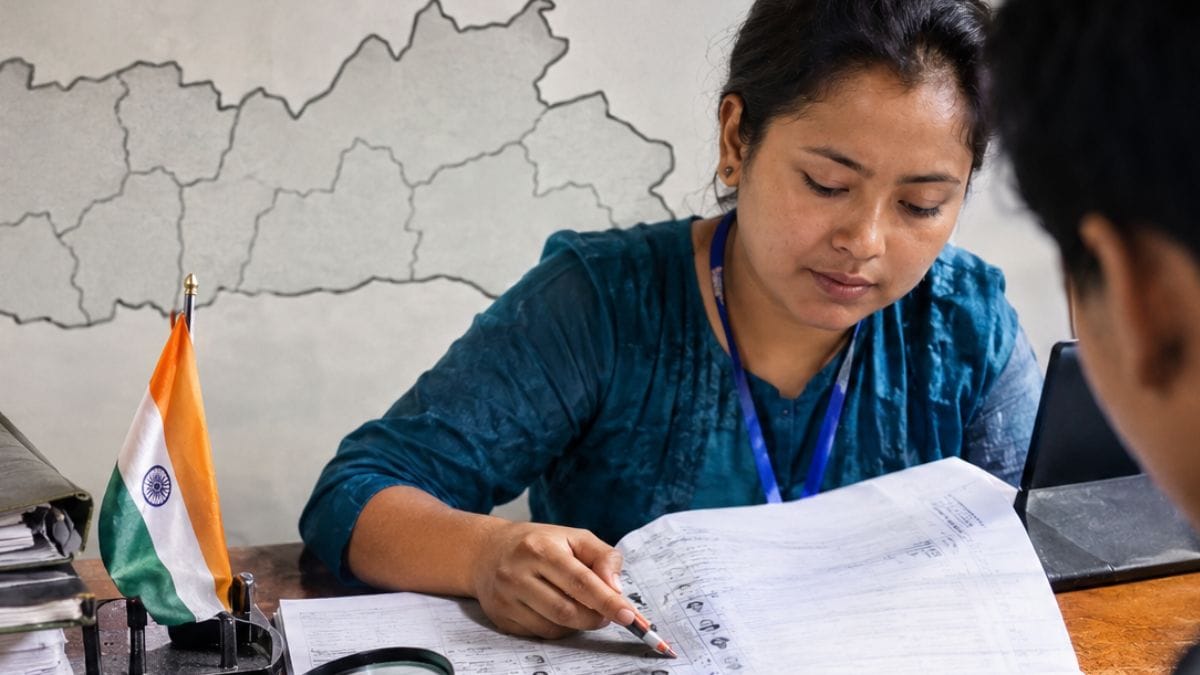
The Special Intensive Revision (SIR) 2026 of Meghalaya’s electoral rolls stands as one of the most comprehensive administrative revisions of voter records the state has seen in over two decades. Led by the Election Commission of India through the Office of the Chief Electoral Officer, Meghalaya, the exercise set out to purge invalid records, eliminate duplicate entries, and establish a clear lineage trail for every voter, using the 2005 Special Intensive Revision database as its foundational baseline.
When the Draft Electoral Roll was published on August 5, 2026, it showed a net contraction in the overall electorate alongside a substantial volume of entries flagged for further inquiry. Out of a total draft electorate exceeding 21.69 lakh voters, over 6.51 lakh entries, nearly 30 percent of the active roll, were earmarked for rigorous scrutiny during the claims and objections phase.
That sheer volume has sparked genuine public discussion across districts, making it worth understanding the technical mechanics behind the revision, the real distinction between deleted voters and flagged voters, and the statutory rights guaranteed to citizens caught up in either category.
Before the SIR 2026 house-to-house enumeration drive began, Meghalaya’s registered voter base stood at 23,49,645. Following complete door-to-door verification by Booth Level Officers, the active draft roll electorate was revised down to 21,69,243, a total exclusion of 1,80,402 entries during the initial enumeration phase.
Of the electors retained, female voters continue to outnumber male voters statewide, 11.16 lakh against 10.53 lakh, alongside five electors recorded under third gender. On the administrative side, the Election Commission approved 86 new polling stations during this cycle, taking the statewide total from 3,551 to 3,637 locations across all 60 legislative assembly constituencies.
A significant source of public confusion has been conflating voters removed from the draft roll entirely with voters whose records are simply flagged for inquiry, two very different situations with very different consequences.
The first category, ASDD exclusions, covers 1,80,402 names removed prior to the draft roll’s publication under the Absent, Shifted, Dead, and Duplicate protocol:
- Deceased electors (81,490): the single largest category, comprising voters whose deaths were confirmed through family members, local authorities, or civil register records
- Untraceable or unreturned enumeration forms (45,013): individuals who couldn’t be located at their registered address despite multiple visits by Booth Level Officers
- Permanently shifted (42,532): voters who relocated outside their designated polling station’s jurisdiction or left the state entirely
- Duplicate entries (6,701): double registrations detected across multiple booths or constituencies
Refused or others (4,668): cases where residents declined to fill out enumeration forms or submitted invalid responses
East Khasi Hills district recorded the state’s highest concentration of these exclusions, accounting for 69,986 removed names, driven largely by urban mobility and previously unpurged records in the district.
The second category is where most of the current anxiety sits, and it’s important to be clear that these voters have not been deleted. Their names remain on the draft roll published August 5; what’s flagged is a data gap or logical contradiction when their record is cross-referenced against the 2005 baseline. This category splits into two distinct groups:
- No Mapping (2,22,878 electors, roughly 10.27% of the draft roll): neither the voter nor their parents or grandparents could be linked to the 2005 SIR roll at all. These electors must respond to an official notice and present supporting lineage or residence documents.
- Mapping Discrepancies (4,28,858 electors, roughly 19.77% of the draft roll): the voter is linked to a 2005 record, but automated ECI Net algorithms flagged a logical inconsistency in the data. These electors need to clarify the specific error, spelling, age gap, or similar, before an ERO or AERO hearing officer.
When field data was uploaded to the central ECI Net platform, automated validation routines checked every entry against the 2005 historical baseline using a defined set of logical rules. Six specific triggers account for the flags generated:
- Textual name mismatches: differences between how an elector’s name, or their parents’ names, was spelled on the 2026 enumeration form versus the 2005 baseline record
- Biological parent-child age anomalies: flagged automatically when the recorded age gap between an elector and their parent falls below 15 years or exceeds 50 years
- Grandparent age discrepancies: cases where the calculated age gap between an elector and their recorded grandparent averages less than 40 years
- Sibling birth interval contradictions: instances where siblings linked to the same parents show a recorded age gap of less than 9 months
- Excessive progeny linking: situations where more than 6 children are linked to a single parent record in the database
- Parental record inconsistencies: cases where a parent’s listed identity on a child’s form doesn’t structurally match that parent’s own registered 2005 voter file
None of this scrutiny happens without legal guardrails. Under the Representation of the People Act, 1950, and the Registration of Electors Rules, 1960, election officials cannot arbitrarily remove a voter’s name from the roll, strict due process applies before any ERO or AERO can modify or delete a record during this revision. That process requires, in sequence:
- Formal service of notice: a written notice specifying the exact discrepancy must be generated, printed, and physically served to the voter, with a signed acknowledgment retained by the field officer
- Right to be heard: the voter must get a genuine opportunity to appear before the designated officer with supporting documents, birth certificates, school records, legacy certificates, or village council verification among them
- Reasoned speaking order: if an ERO ultimately rejects a claim or deletes a name, they’re legally required to issue a written order explaining exactly why
Put together, the scale of Meghalaya’s SIR 2026, over 6.5 lakh flagged records against a backdrop of legally mandated notice and hearing rights.
It means in the coming weeks of the claims and objections window will matter enormously for hundreds of thousands of the state’s voters, and for how cleanly the final roll reflects who is actually eligible to vote.