
• About
  • Get Jnews
  • Contcat Us
Friday, October 2, 2026
The Shillong Daily
No Result
View All Result
  • Login
  • News

    Trending Tags

    • Commentary
    • Featured
    • Event
    • Editorial
  • National
  • News

    Trending Tags

    • Commentary
    • Featured
    • Event
    • Editorial
  • National
No Result
View All Result
Morning News
No Result
View All Result
Home Explained

Bankers’ Books Evidence Act 2026: What the new law means for bank records

The Shillong Daily by The Shillong Daily
September 15, 2026
in Explained
Reading Time: 4 mins read
0
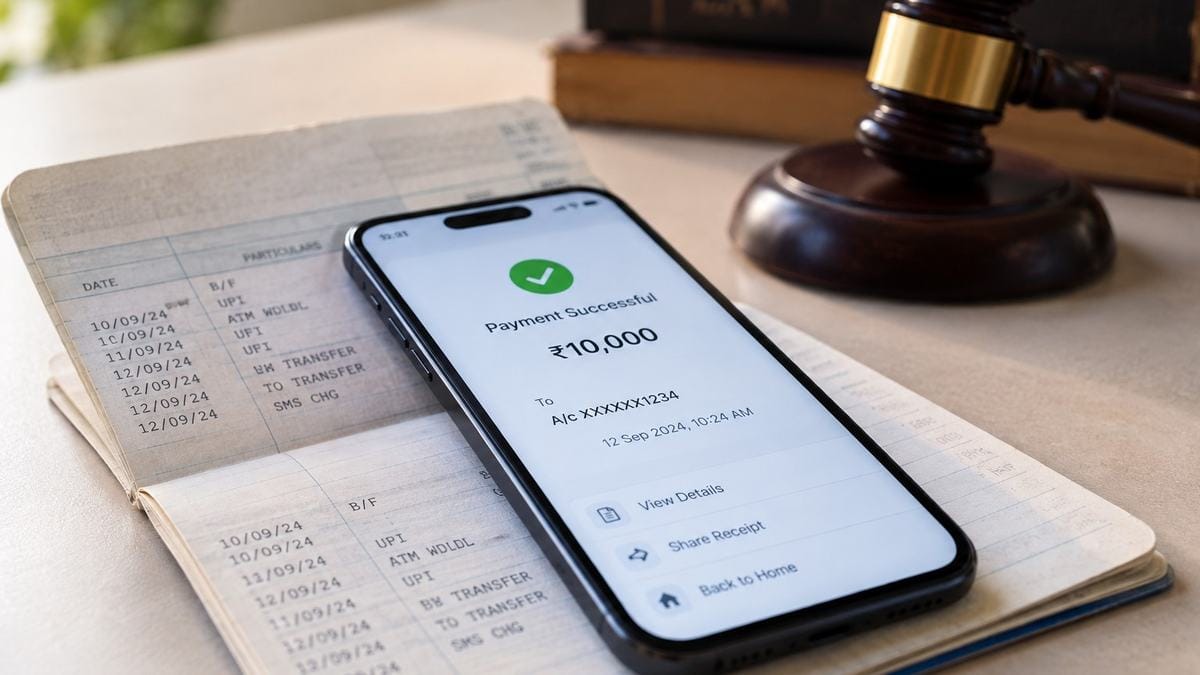
Representative Image

Your bank records can be digital evidence now. India’s banking system stopped running on physical ledgers years ago, but the law governing how those records could be used in court never caught up, until now. The Bankers’ Books Evidence Act, 2026 replaces the outdated 1891 statute and formally brings electronic, digital, virtual and cloud-based banking records into India’s legal framework.

The new Act received the President’s assent on August 13, 2026, and the Central Government has set October 1 as the date every provision takes effect. From that day, the old 1891 law steps aside entirely.

READ ALSO

Disha Salian death case: CBI begins probe into murder, gang rape allegations

UPI charges explained: 0.4% MDR on payments above ₹2,000, ₹300 cap and exemptions

What’s actually changing isn’t that banks are somehow becoming digital, they’ve been running on digital infrastructure for well over a decade. What’s changing is that India’s evidence law is finally catching up to that reality, explicitly recognising where modern banking records actually sit, across electronic systems, digital storage, virtual environments, cloud servers, and backup or disaster-recovery sites, rather than assuming everything still lives in a physical ledger at a branch.

Under the new law, a “bankers’ book” now covers ledgers, day-books, cash-books, account books and similar records used in ordinary banking, whatever form they’re kept in, physical, electronic, digital, or stored off-site in a virtual or cloud environment, including backup and disaster-recovery locations. This matters because a single bank transaction today rarely lives in one place, it typically passes through core banking systems, associated storage infrastructure, and multiple backend layers before it ever shows up as a line item in a customer’s app.

Here’s where customers need to pay attention: this law does not turn every screenshot of a banking app into legally certified evidence. The Act treats certified copies differently depending on how a bank actually maintains its records, and any digital or electronic record still needs to carry the specific certification the law requires. For digital records specifically, that certification framework covers copies of entries stored electronically or digitally, and allows the required certification to be authenticated manually, digitally, or electronically. The government describes this explicitly as an effort to simplify and standardise how banking records get certified.

The important difference is between having a record and proving that record in court, is the part most customers will miss if they’re not paying attention. A transaction showing up in a banking app, an emailed statement, or a downloaded PDF is not automatically the same thing as the certified bank record the Act treats as admissible evidence. The screenshot on your phone and the certified record a court will actually rely on are two different documents, even when they show the exact same transaction.

The law also reshapes how courts deal with bank officials directly. Where a bank isn’t itself a party to a case, a bank officer can no longer be routinely summoned just to produce records or explain what’s in them, courts now have to record a specific, written justification before ordering that kind of attendance. This doesn’t mean banks can simply decline court requests, the Act still allows courts to order inspection and production of bankers’ books along with certified copies of relevant entries. What’s changed is the underlying logic: the process is now built to lean on properly certified records first, rather than defaulting to pulling a bank employee physically into a courtroom with original ledgers in hand.

The Act also addresses what happens when a record’s accuracy or authenticity is disputed, laying out conditions around the integrity of electronic records and when further evidence or examination becomes necessary.

Digital storage, in other words, doesn’t put a record beyond question, courts retain full ability to interrogate whether something is genuine or has been tampered with.

“Legal proceeding” under this Act stretches well past a standard courtroom trial too, covering arbitration, and certain investigations or inquiries conducted specifically to gather evidence under criminal procedure law or other applicable statutes.

The Act also allows the Central Government to extend its coverage to other specified financial-sector entities through notification, giving the framework room to grow beyond traditional banking as financial records increasingly originate from a wider range of regulated institutions, not just banks in the conventional sense.

For an ordinary customer, the practical takeaway is straightforward. Keep your bank statements and transaction records, that habit hasn’t changed. But don’t assume a screenshot automatically carries the same weight as a certified bank record the moment a transaction becomes legally contested. In disputes over loans, payments, account balances, or transfers, it’s the bank’s own certified record, not the image sitting in your phone gallery, that will actually carry evidentiary weight.

The government frames this Act as modernising banking law, cutting procedural friction, and improving ease of doing business. But the more significant shift here is quieter than that: Indian law is finally describing banking records in the form banks have actually kept them for years.

The paper ledger didn’t disappear yesterday, it disappeared a long time ago, replaced by databases, networks and cloud infrastructure. From October 1, the law simply catches up to what banking already became.


Tags: bank statementsBankers' Books Evidence Act 2026banking law Indiadigital bank recordselectronic evidenceRBI banking rules
Previous Post

RBI repo rate and home loan EMI: How interest rate cuts affect borrowers

Next Post

Conrad announces proposed Dalu-Baghmara-Ranikor-Shella road corridor to Northeast

Related Posts

Disha Salian death case: CBI begins probe into murder, gang rape allegations
Explained

Disha Salian death case: CBI begins probe into murder, gang rape allegations

September 19, 2026
UPI charges explained: 0.4% MDR on payments above ₹2,000, ₹300 cap and exemptions
Explained

UPI charges explained: 0.4% MDR on payments above ₹2,000, ₹300 cap and exemptions

September 15, 2026
RBI repo rate and home loan EMI: How interest rate cuts affect borrowers
Explained

RBI repo rate and home loan EMI: How interest rate cuts affect borrowers

September 14, 2026
Nepal flash flood explained: How ice, rock and a blocked river created a deadly surge
Explained

Why Nepal’s devastating flood came so fast and vanished almost as quickly

August 28, 2026
Vande Mataram controversy explained: MHA order, six stanzas and Northeast objections
Explained

Vande Mataram row in Northeast: Why Meghalaya, Mizoram and Nagaland object to full version

September 15, 2026
SIR the special intensive revision of Meghalaya, explanation
Explained

Meghalaya SIR 2026: How electoral roll scrutiny, mapping discrepancies and voter safeguards work

August 17, 2026
Next Post
Conrad announces proposed Dalu-Baghmara-Ranikor-Shella road corridor to Northeast

Conrad announces proposed Dalu-Baghmara-Ranikor-Shella road corridor to Northeast

India’s consumer confidence rises to 66.92 in September 2026

India's consumer confidence rises to 66.92 in September 2026

Pimpri-Chinchwad church demolished as members question civic action and court proceedings

Pimpri-Chinchwad church demolished as members question civic action and court proceedings

AFTF welcomes end of 80:20 recruitment ratio, seeks reforms in Arunachal

Teachers’ associations reject call to remove Meghalaya Education Secretary Vijay Mantri

Amit Shah sets 2029 deadline for UCC across 21 NDA-ruled states

Amit Shah sets 2029 deadline for UCC across 21 NDA-ruled states

POPULAR NEWS

Meghalaya’s new SPF teacher appointments explained amid ‘availability of funds’ clause

Meghalaya teacher appointments under SPF raise questions over ‘availability of funds’

September 2, 2026
KSU announces five-day agitation across Khasi-Jaintia Hills, Khliehriat meeting on August 11

KSU calls off public bike rally in Shillong, CEC members to sit in at Khyndailad

August 19, 2026
VPP demands Vijay Kumar Mantri’s removal over education policies

VPP demands Vijay Kumar Mantri’s removal over education policies

September 16, 2026
Assam 8.5-Magnitude Earthquake Claim Goes Viral: What Science Says About The Warning

Assam Earthquake alert: Viral 8.5-magnitude claim raises questions over late August warning

August 27, 2026
Meghalaya withdraws STING energy drink ban after inquiry finds no causal link

Meghalaya imposes statewide freeze on Sting energy drink pending lab tests

August 16, 2026

About

The Shillong Daily is an independent news site out of Meghalaya. We cover the stories shaping Meghalaya and the Northeast, alongside business, economy and market news that matters to readers here. We’re not chasing every headline first — we’d rather dig through the numbers, check the details and tell you what actually happened. Journalism for a region that deserves more than a footnote.

Follow us

Recent Posts

  • Lionel Messi named Doctor Honoris Causa by University of Buenos Aires
  • India’s external debt hits record $778.2 billion as near-term debt burden rises
  • Police to examine deepfake video linking Vivek Syiem with Prestone Tynsong
  • BJP’s 10 MLAs may discuss Cabinet reshuffle with Amit Shah, says A.L. Hek

Categories

  • Analysis
  • Business
  • Crime
  • Economy
  • Editorial
  • Education
  • Entertainment
  • Explained
  • Faith
  • Governance
  • Guest Column
  • Health
  • International
  • Letters to the Editor
  • Meghalaya
  • Music
  • National
  • National
  • Northeast
  • Politics
  • Satire
  • Shillong
  • Sports
  • Stock Market
  • Top Stories
  • About Us
  • EDITORIAL POLICY
  • TERMS OF USE
  • DISCLAIMER
  • PRIVACY POLICY
  • CORRECTIONS POLICY
  • CONTACT

2026 The Shillong Daily. All rights reserved.

Welcome Back!

Login to your account below

Forgotten Password?

Retrieve your password

Please enter your username or email address to reset your password.

Log In
error:
No Result
View All Result
  • Home
  • Meghalaya
  • Business
  • Economy
  • Stock Market
  • Explained
  • Northeast
  • Analysis
  • Politics
  • Satire
  • Top Stories

2026 The Shillong Daily. All rights reserved.