
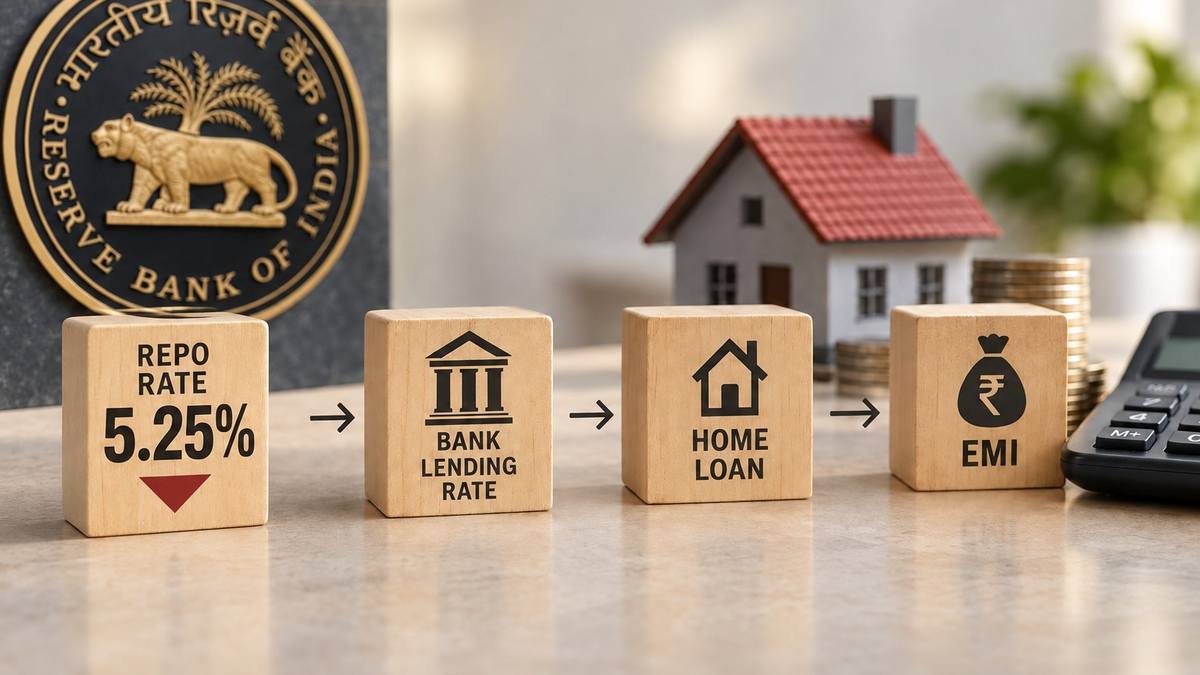
The Reserve Bank’s repo rate sits at 5.25 percent right now, and a striking number of borrowers assume that figure is somehow their loan rate too. It isn’t, and understanding why exposes a gap between how monetary policy gets reported and how it actually reaches someone’s EMI.
The repo rate is simply the rate at which the RBI lends to commercial banks. What a customer pays on a home loan is that rate plus a spread the bank adds on top, along with several other components that shape the final number. When the RBI cuts the repo rate, that cut doesn’t move directly into a borrower’s account, it has to pass through a chain: the benchmark the loan is tied to, the bank’s own spread, the loan’s reset mechanism, and the specific terms written into the loan agreement, before an EMI actually changes.
For most new floating-rate retail loans, home loans included, banks are now required to link the interest rate to an external benchmark, the RBI’s own repo rate, certain Treasury Bill yields, or other approved market benchmarks, with a mandatory reset at least once every three months. This rule exists precisely because older internal benchmarks, the Base Rate and MCLR, were too slow at passing on rate changes, external benchmarking was introduced specifically to make that connection faster and more transparent.
Even so, a repo-linked loan is never simply a 5.25 percent loan. Banks add their own spread on top, and that spread varies by borrower profile, loan category and contract terms. The repo rate is the starting reference point, not the price the customer ultimately pays.
Here’s what that looks like in real numbers. Take a ₹40 lakh home loan over 20 years. At 8.50 percent interest, the EMI runs about ₹34,713 a month. Drop the effective rate by 25 basis points to 8.25 percent, and the EMI falls to roughly ₹34,083, a saving of about ₹630 monthly. Push it down further to 8.00 percent, and the EMI drops to around ₹33,458, a total reduction of about ₹1,255 from where it started. That’s the honest scale of what a rate cut delivers to an ordinary household, meaningful over a year, but nowhere near as dramatic as a headline announcing a policy change might suggest. A quarter-point move is exactly that, a quarter of one percentage point, and its real effect on any individual EMI depends on loan size, remaining tenure, and how the lender chooses to apply it.
There’s a further wrinkle most borrowers don’t expect: a change in the benchmark doesn’t automatically produce an identical change in the EMI itself. Banks have latitude here, they can adjust the EMI amount directly, extend or shorten the number of remaining instalments, or use some combination of both, depending on the loan’s terms and applicable regulations. RBI rules do require lenders to offer borrowers specific options when a rate resets, changing the EMI, changing the tenure, switching to a fixed rate if the bank offers one, or making a partial or full prepayment, but which option actually gets applied, and when, is not automatic.
Timing adds another layer. If a loan hasn’t reached its next scheduled reset date, the borrower won’t see the new rate reflected yet, even though the underlying benchmark has already moved. Exactly when that catches up depends entirely on the specific loan agreement and the lender’s reset cycle, not on the date the RBI made its announcement.
The gap widens further for anyone still sitting on an older loan structure. Current rules require new floating-rate retail loans to use external benchmarks, but loans sanctioned earlier can remain tied to MCLR or other internal benchmarks, depending on when they were taken out and whether the borrower has since switched. That means two people holding what looks like a similar home loan, taken at similar times, can experience monetary policy completely differently, one riding an externally benchmarked loan that adjusts fairly quickly, the other stuck on an older internal benchmark that moves at a noticeably slower pace. The RBI’s own data confirms this isn’t uniform across the system either, foreign banks have shown stronger transmission of the recent easing cycle than public-sector or private-sector banks, meaning a single rate cut simply doesn’t ripple through every lender’s book the same way.
There’s also a side to this that rarely makes headlines: lower interest rates help borrowers, but they work against savers. Someone with a floating home loan wants rates to fall. Someone parking money in a fixed deposit wants the opposite. Banks have to balance both, because deposits fund the very loans they’re lending out. That’s why an easing cycle can produce genuinely mixed outcomes within the same household, a family might see their home loan EMI drop while a new fixed deposit they open earns noticeably less than it would have a year earlier. “RBI cuts rates, everyone saves money” isn’t actually how this works in practice.
Given all of that, the useful question for any borrower isn’t “what’s the current repo rate,” it’s a more specific set of questions entirely: What benchmark is my loan actually linked to? What’s my current spread above that benchmark? When is my next scheduled reset? Has my bank actually passed through the RBI’s most recent change? And when a reduction does apply, has it lowered my EMI, or has it simply shortened how many instalments remain while the EMI itself stays the same? The answers to those questions determine whether easier monetary policy has genuinely reached a borrower, or whether it’s sitting somewhere between the RBI’s announcement and their actual loan statement, waiting on a reset date that hasn’t arrived yet.
The RBI has separately proposed a more standardised framework for how lenders price interest on advances, covering benchmark reset dates and interest-calculation practices more uniformly, specifically aimed at improving transparency for exactly this reason.
The repo rate tells you where the RBI has moved. It does not tell you where your loan has moved. Only your own statement can answer that.