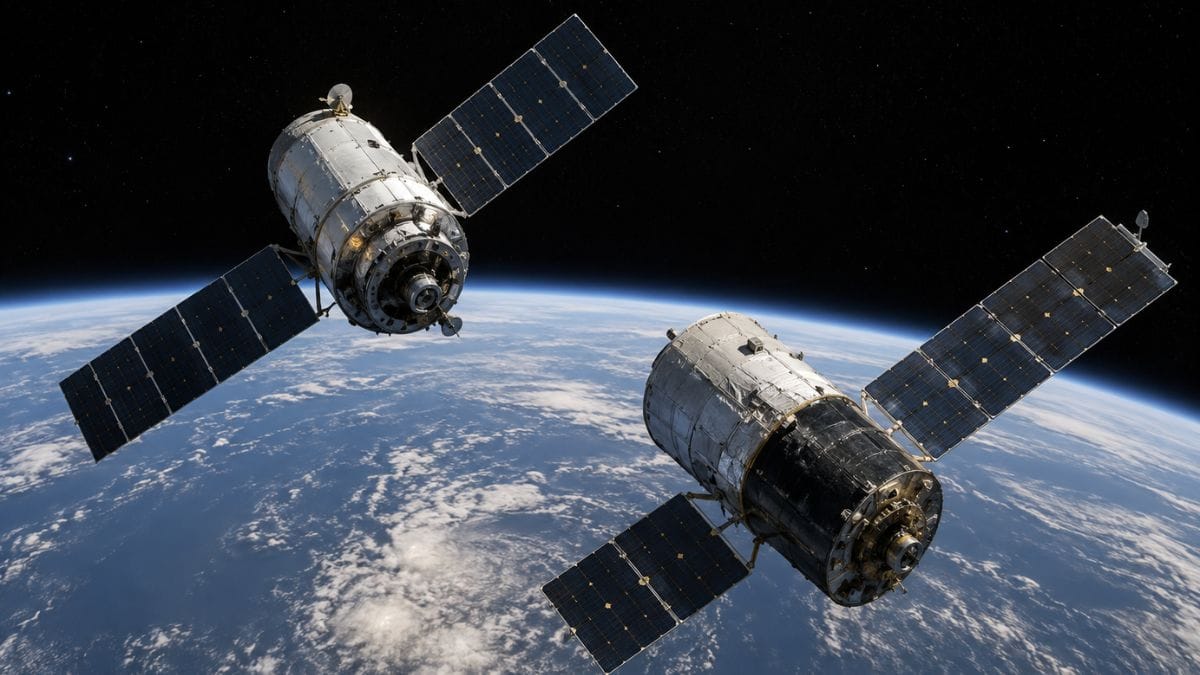
Hundreds of kilometres above Earth, satellites are learning to hunt each other. Once they largely stayed in fixed orbits. Now many can approach, inspect, follow and, if required, capture other spacecraft.
Both the United States and China are building these capabilities, according to space-tracking data, technical documents and interviews with current and former military officials examined by Reuters.
The central question for planners is straightforward: when does a satellite designed to inspect or service another become a weapon?
In June, China’s unmanned Shenlong spaceplane released a small object while operating hundreds of miles above Earth. Commercial tracker LeoLabs watched the object manoeuvre around another Chinese satellite before returning to the spaceplane. The purpose remains unclear.
Close-proximity operations demand precise calculation and control. China has conducted several. US officials have described some as orbital “dogfighting.” Chinese spacecraft have also demonstrated the ability to seize a defunct satellite and alter its orbit.
Chinese researchers linked to military institutions are working on systems that calculate fuel-efficient pursuit paths. Other work examines coordinated multi-satellite operations and concepts involving nets. A further advance on-orbit refuelling could extend how long such spacecraft remain manoeuvrable.
A US Space Force official said China likely attempted a refuelling test last year.
None of this is automatically offensive. The Secure World Foundation notes that Chinese rendezvous and proximity operations can serve civilian purposes: inspection, servicing, logistics and space situational awareness. Public evidence does not yet confirm that China’s known programmes are deployed as co-orbital anti-satellite weapons.
The United States has practised similar techniques for decades. Military and intelligence satellites have made numerous close approaches to foreign spacecraft. The Space Force’s Geosynchronous Space Situational Awareness Program is used to observe and inspect objects in orbit. There is no public evidence these operations have damaged or disabled another satellite.
The competition is becoming more open. Last year a US military satellite moved close to a British spacecraft while China’s Shiyan 12-01 passed roughly 83 kilometres below them, according to Reuters. Three space experts with military backgrounds told Reuters the manoeuvre appeared designed to show Beijing that the US and its allies can coordinate in orbit.
Modern militaries depend on satellites for communications, navigation, intelligence and missile warning. Disrupting them affects operations on the ground. The same close-approach technology that can service a satellite can also disable one.