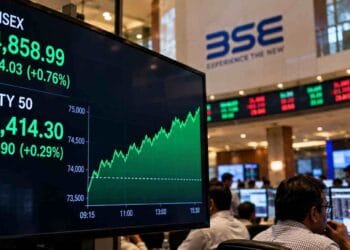
MUMBAI – Tuesday’s sell-off hit large-cap stocks hardest, with banks and energy shares taking much of the damage as crude moved closer to $100 a barrel. The Sensex fell 555 points, or 0.73%, to 75,577.58, while the Nifty lost 144 points, or 0.61%, to 23,635.10, its lowest close since June. Both benchmarks have now fallen about 2.2% in seven sessions.
Oil was the day’s biggest macro problem. Brent rose to around $98.4 a barrel, its highest level since late July, after attacks on Saudi energy facilities increased fears of supply disruption. For India, expensive crude does not stay confined to the energy market. It raises the import bill, puts pressure on the rupee and complicates the inflation and interest-rate equation for equities.
Banks absorbed much of the selling. The Nifty Private Bank index fell about 1%, while ICICI Bank lost around 2% and HDFC Bank fell 1.1%. Reliance Industries also weighed on the benchmark. IT stocks remained under pressure, extending a weak run driven by renewed concerns over US interest rates and spending by American clients.
The market was not uniformly weak. Defence stocks moved sharply higher after the Defence Acquisition Council approved procurement proposals worth about ₹1.10 lakh crore. The defence index gained around 2.5%, while pharma and media stocks also found buyers. Mid-cap and small-cap indices gained about 0.2% each, showing that Tuesday’s damage was concentrated more heavily among large-cap stocks.
The rupee added another pressure point, falling to around ₹94.82 against the dollar, its sharpest one-day decline in more than a month. Reuters reported that state-run banks were again seen intervening on behalf of the RBI as oil prices pushed the currency lower. The intervention can slow the fall, but it cannot make India’s oil bill disappear.
Technically, 23,600 is now the level to watch. The Nifty closed at 23,635 and its daily RSI slipped to 30.88, putting the index into oversold territory without producing a reversal signal. Analysts see 23,600–23,500 as the immediate support zone, while 23,800 has become the first resistance level. A sustained break below 23,500 would expose the index to deeper downside, while reclaiming 23,800 would be the first sign that selling pressure is easing.
The important change from Monday is that oil is becoming the market’s central variable. Foreign selling, weak IT stocks and the rupee were already weighing on equities. With Brent approaching $100, the pressure is spreading through several channels at once. The Nifty is oversold, but an oversold market can stay oversold when the underlying pressure has not gone away.
The 23,600 level may produce a bounce. But a durable recovery needs more than cheaper valuations. Oil needs to stop climbing, the rupee needs to stabilise and large-cap financials need to stop absorbing the bulk of the selling. Until that happens, every recovery attempt has a fairly obvious test waiting above it: 23,800.