
• About
  • Get Jnews
  • Contcat Us
Friday, October 2, 2026
The Shillong Daily
No Result
View All Result
  • Login
  • News

    Trending Tags

    • Commentary
    • Featured
    • Event
    • Editorial
  • National
  • News

    Trending Tags

    • Commentary
    • Featured
    • Event
    • Editorial
  • National
No Result
View All Result
Morning News
No Result
View All Result
Home Analysis

India’s external debt hits record $778.2 billion as near-term debt burden rises

The Shillong Daily by The Shillong Daily
October 2, 2026
in Analysis
Reading Time: 2 mins read
0
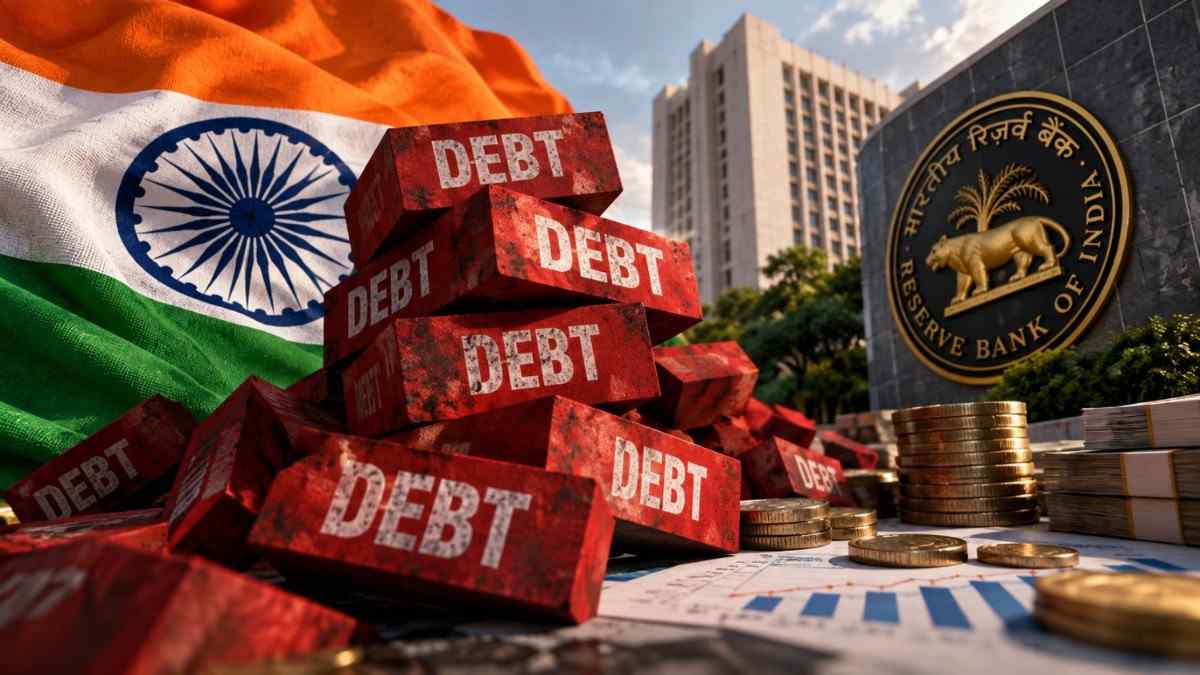
Representational Image

India’s external debt has crossed $778 billion, reaching a record $778.2 billion by the end of June. The headline debt-to-GDP ratio, however, barely changed, slipping from 20.9% to 20.8%. That lower ratio offers some reassurance. But it does not answer the more difficult question: how much of that debt is now moving towards repayment?

RBI data shows total external debt rising by $15.4 billion in the three months to June 2026, from $762.8 billion to $778.2 billion. The external debt-to-GDP ratio slipped from 20.9% to 20.8%. Absolute liabilities climbed. The ratio stayed almost flat. That is the figure the government prefers to emphasise.

READ ALSO

PB Fintech’s 38% crash reveals the hidden concentration risk inside mutual funds

Meghalaya securities market participation at 4.2%, below national average of 9.5%

The largest increase among major borrower groups came from the government itself. General government external debt rose by $6.8 billion to $174.3 billion, from $167.5 billion in March -roughly 4% in a single quarter. As a share of GDP it edged up from 4.6% to 4.7%. The number is not large enough to signal crisis. It is large enough to register when the overall external debt stock is already at a record level.

The government is not the biggest external borrower. Non-financial corporations hold about $281.2 billion. Deposit-taking corporations, mainly banks, account for $203.8 billion. Other financial corporations hold $79.7 billion. Intercompany lending stands at $39.1 billion. A substantial share of India’s external liabilities therefore sits with businesses and banks rather than with the Centre.

Long-term external debt rose by $11.2 billion to $624.7 billion. Short-term debt by original maturity rose by $4.3 billion to $153.5 billion. Loans remain the largest component at 34.3% of the total, followed by currency and deposits at 22.2%, trade credit and advances at 19.1%, and debt securities at 16.5%. The latest increase was not driven by a sudden rush into short-term foreign borrowing.

The more revealing figure appears in the residual maturity data. On that basis, $337.5 billion of external debt falls due within the next 12 months. That is 43.4% of total external debt and equivalent to 50.5% of foreign-exchange reserves, up from 47.3% in March. Residual maturity includes portions of long-term debt that are approaching repayment and is not the same as the $153.5 billion classified as short-term by original maturity. It still shows how large a share of the stock is moving closer to the repayment window.

Corporate exposure is concentrated on the same measure. About $173.8 billion of non-financial corporate external debt and $128.4 billion of bank external debt fall due within one year. The overall size of the debt pile matters less than the volume that must be refinanced or repaid in the near term.India can point to the 20.8% external debt-to-GDP ratio and the 5.6% debt-service ratio as evidence that the stock remains manageable. Those ratios do not settle the sharper questions. Government external debt rose the most in the June quarter. Companies and banks continue to carry large near-term obligations. The share of total debt falling due within a year has increased relative to reserves.

The numbers do not support claims of an imminent external debt crisis. They do show a larger stock, a bigger government contribution in the latest quarter, and a growing portion of liabilities moving toward maturity. The debt-to-GDP ratio can look calm. The maturity schedule is where the pressure sits.


Tags: foreign exchange reservesIndia external debtIndian EconomyRBI
Previous Post

Police to examine deepfake video linking Vivek Syiem with Prestone Tynsong

Related Posts

PB Fintech’s 38% crash reveals the hidden concentration risk inside mutual funds
Analysis

PB Fintech’s 38% crash reveals the hidden concentration risk inside mutual funds

September 26, 2026
Meghalaya securities market participation at 4.2%, below national average of 9.5%
Analysis

Meghalaya securities market participation at 4.2%, below national average of 9.5%

September 18, 2026
Meghalaya has ₹5,490 crore in mutual funds, highest among Northeast states
Analysis

Meghalaya has ₹5,490 crore in mutual funds, highest among Northeast states

September 18, 2026
UPI MDR explained: Who pays the merchant charge and how it affects customers
Analysis

UPI MDR explained: Who pays the merchant charge and how it affects customers

September 17, 2026
9/11 anniversary: Remembering the September 11 attacks and their aftermath
Analysis

9/11 anniversary: Remembering the September 11 attacks and their aftermath

September 11, 2026
Nagaland’s 95.7% literacy rate raises questions as ULLAS continues adult education
Analysis

Nagaland’s 95.7% literacy rate raises questions as ULLAS continues adult education

September 11, 2026

POPULAR NEWS

Meghalaya’s new SPF teacher appointments explained amid ‘availability of funds’ clause

Meghalaya teacher appointments under SPF raise questions over ‘availability of funds’

September 2, 2026
KSU announces five-day agitation across Khasi-Jaintia Hills, Khliehriat meeting on August 11

KSU calls off public bike rally in Shillong, CEC members to sit in at Khyndailad

August 19, 2026
VPP demands Vijay Kumar Mantri’s removal over education policies

VPP demands Vijay Kumar Mantri’s removal over education policies

September 16, 2026
Assam 8.5-Magnitude Earthquake Claim Goes Viral: What Science Says About The Warning

Assam Earthquake alert: Viral 8.5-magnitude claim raises questions over late August warning

August 27, 2026
Meghalaya withdraws STING energy drink ban after inquiry finds no causal link

Meghalaya imposes statewide freeze on Sting energy drink pending lab tests

August 16, 2026

About

The Shillong Daily is an independent news site out of Meghalaya. We cover the stories shaping Meghalaya and the Northeast, alongside business, economy and market news that matters to readers here. We’re not chasing every headline first — we’d rather dig through the numbers, check the details and tell you what actually happened. Journalism for a region that deserves more than a footnote.

Follow us

Recent Posts

  • India’s external debt hits record $778.2 billion as near-term debt burden rises
  • Police to examine deepfake video linking Vivek Syiem with Prestone Tynsong
  • BJP’s 10 MLAs may discuss Cabinet reshuffle with Amit Shah, says A.L. Hek
  • NPP’s five-member Nagaland Assembly bloc disappears as all MLAs merge with NPF

Categories

  • Analysis
  • Business
  • Crime
  • Economy
  • Editorial
  • Education
  • Entertainment
  • Explained
  • Faith
  • Governance
  • Guest Column
  • Health
  • International
  • Letters to the Editor
  • Meghalaya
  • Music
  • National
  • National
  • Northeast
  • Politics
  • Satire
  • Shillong
  • Sports
  • Stock Market
  • Top Stories
  • About Us
  • EDITORIAL POLICY
  • TERMS OF USE
  • DISCLAIMER
  • PRIVACY POLICY
  • CORRECTIONS POLICY
  • CONTACT

2026 The Shillong Daily. All rights reserved.

Welcome Back!

Login to your account below

Forgotten Password?

Retrieve your password

Please enter your username or email address to reset your password.

Log In
error:
No Result
View All Result
  • Home
  • Meghalaya
  • Business
  • Economy
  • Stock Market
  • Explained
  • Northeast
  • Analysis
  • Politics
  • Satire
  • Top Stories

2026 The Shillong Daily. All rights reserved.