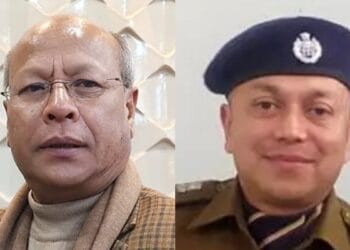
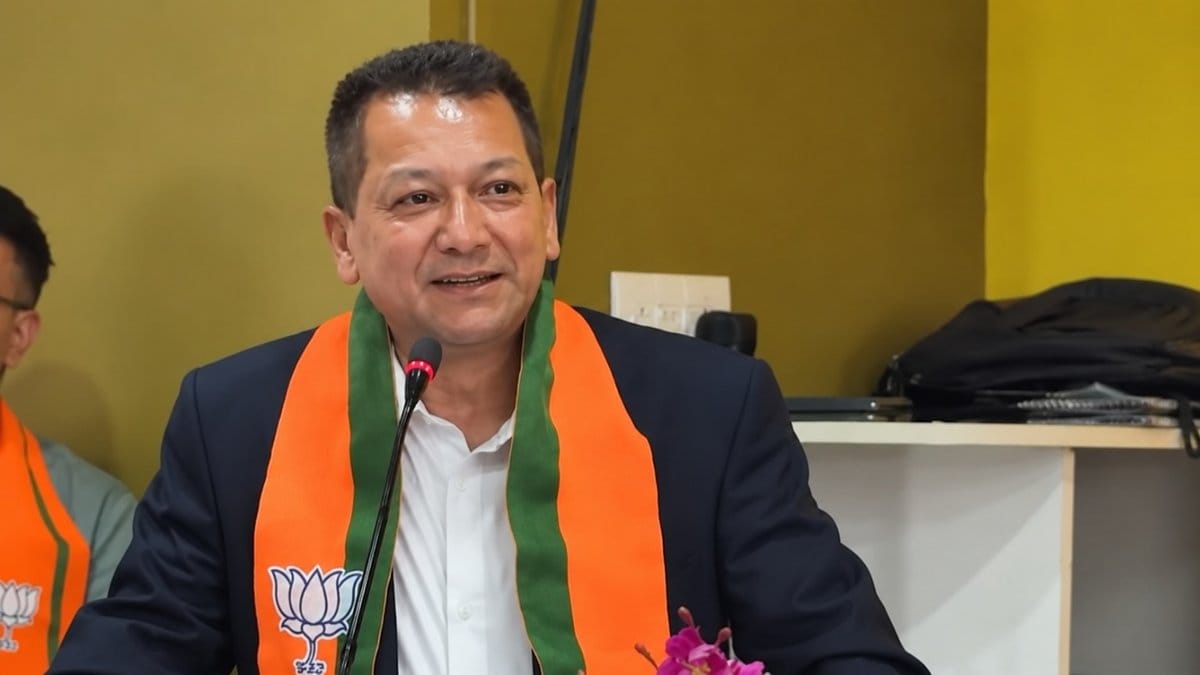
SHILLONG — Dr Jemino Mawthoh moved from the United Democratic Party (UDP) to the Bharatiya Janata Party (BJP) on Saturday closes a long chapter in Meghalaya’s regional politics, but the journey to the BJP began years before his resignation.
The former UDP general secretary and working president had spent years trying to bring Meghalaya’s regional parties onto one political platform. That effort failed, his own party career stalled, and after initially deciding to quit in 2023, Mawthoh finally walked out of the UDP in May 2025.
His BJP induction opened with the Christian gospel hymn “How Great Thou Art” and prayer, adding a striking backdrop to a political switch that had been under discussion for years.
BJP leader and Pynthorumkhrah MLA A.L. Hek made clear that Mawthoh’s entry was not a sudden political decision. Hek said he and former Meghalaya BJP in-charge Rituraj Sinha had visited Mawthoh’s residence several times from 2021, trying to persuade him to join the BJP ahead of the 2023 Assembly election.
Mawthoh confirmed those meetings, recalling that Sinha had visited him and that several central BJP leaders later met him as well. He specifically mentioned Union Minister of State for External Affairs Pabitra Margherita, who visited his residence in 2022.
Mawthoh said he was not ready to join the BJP at that stage because he remained committed to the UDP. Having spent years in the regional party, he said leaving immediately would have gone against the commitment he had made to it.
His political record inside the UDP was substantial. Mawthoh served as the party’s general secretary for nine years and working president for two years, while also attempting to solve what he saw as one of Meghalaya’s biggest political weaknesses: the fragmentation of its regional forces.
“I’ve tried my level best to give my best to the party,” Mawthoh said, recalling his efforts to initiate the formation of one strong regional party in Meghalaya.
He said he held discussions with other regional parties, but despite repeated attempts by different leaders, the idea could not be materialised.
The disappointment eventually became personal. After contesting the 2023 Assembly election and losing, Mawthoh said he decided to resign from the UDP. Party leaders asked him not to leave at that point, and he agreed to withdraw his resignation. He stayed on until April-May 2025, after the Lok Sabha and MDC elections, before finally deciding that his association with the UDP had run its course.
“When I look at the state of affairs in our beloved state Meghalaya, when I look at the political climate and what has been going on in the state, I feel very disgruntled and disillusioned,” Mawthoh said.
His criticism was not limited to the UDP. Mawthoh argued that Meghalaya has people with the ability, intelligence and capacity to move the state forward, but political divisions have repeatedly prevented them from coming together.
That frustration, he said, shaped his decision to choose the BJP. “I feel that the BJP is the right party,” Mawthoh said.
Mawthoh also revealed that the BJP was not the only political option available to him after his resignation. Other parties had approached him, but he spent around 15 months considering his next move and described the period as one of introspection.
He also looked back to the 2019 Lok Sabha election, when he contested from a regional platform and secured around 34% of the vote, or about 2.67 lakh votes. Mawthoh attributed his defeat partly to the political campaign surrounding the Citizenship Amendment Act. He recalled Congress campaigners warning voters that if he won, he would join Prime Minister Narendra Modi and the NDA. According to Mawthoh, the campaign also suggested that his election would threaten religious freedom and the freedom to eat meat in Meghalaya.
The political irony was not lost on Mawthoh himself. The possibility that was used against him in the 2019 campaign has now become his political reality. For those asking why a former regional leader who once advocated a strong regional platform would eventually choose the BJP, Mawthoh offered a simple answer.
“Why not BJP?” he said.
He pointed to the BJP’s national reach, its governments with allies across several states and what he described as changes in infrastructure, reforms, welfare programmes and digital transactions since 2014.
Mawthoh also acknowledged the BJP leaders who had maintained contact with him during the years before his entry. He singled out state BJP spokesperson Mariahom Kharkrang, saying Kharkrang was the first BJP leader to publicly welcome him after his UDP resignation and describe him as an asset to the party.
Mawthoh returned the compliment, calling Kharkrang an important and prospective leader for the BJP in Meghalaya.