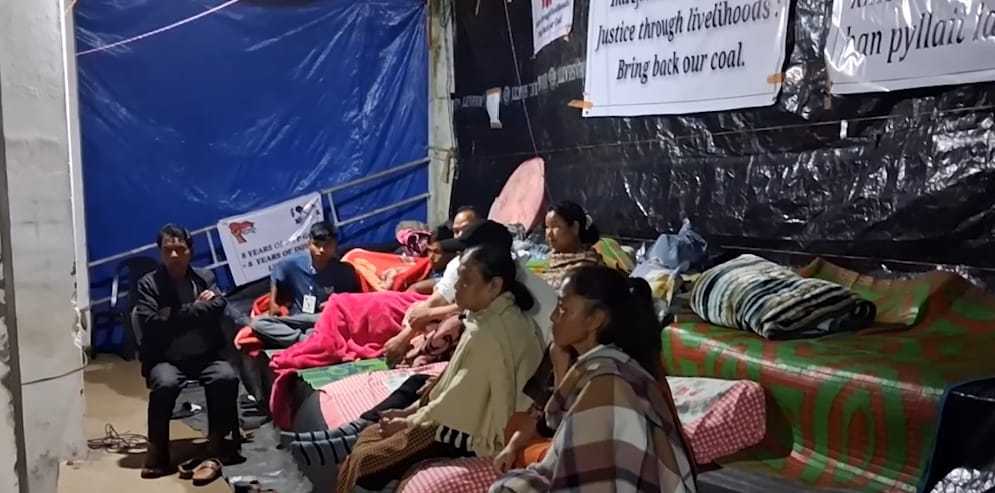
KHLIEHRIAT : An emotional scene unfolded on Friday when the mother of protest leader Marshall S.B. Biam stepped forward to bless her son as the hunger strike entered its fifth day.
The hunger strike, organised by the Jaintia Coal Owners, Miners, Suppliers and Workers Association (JCOMSWA), has become a symbol of the frustration and uncertainty facing many families across Meghalaya’s coal-producing belt.
Leading the protest is JCOMSWA president Marshall S.B. Biam, who says the agitation is aimed at drawing the government’s attention to the worsening livelihood crisis affecting thousands of people dependent on the coal sector.
As supporters gathered near the office of the Deputy Commissioner in East Jaintia Hills, Biam’s mother was seen offering prayers and blessings to her son, a moment that drew attention from those present at the protest site. For those protesters, the struggle is no longer about mining policy. It is about families trying to hold on to their livelihoods after years of uncertainty.
The association said that mine owners, labourers, truck drivers, suppliers and daily wage earners have all been affected by the prolonged deadlock surrounding coal mining operations in the state. According to JCOMSWA, many households in the coal belt continue to depend directly or indirectly on mining-related activities for survival.
Protesters say the lack of a workable solution has left thousands of families facing severe economic hardship.At the centre of the dispute is the state’s scientific mining framework. While the government had clearly stated that mining must operate within legal and environmentally compliant regulations, coal sector groups argue that the existing system remains beyond the reach of most local landowners.
The main concern revolves around the requirement for a minimum contiguous land area of 100 hectares to obtain a scientific mining lease. Association leaders contend that the condition does not reflect the reality of land ownership in the Jaintia Hills region, where many individuals own only a few acres of land. They repeatedly argue that because most small landowners cannot meet the requirement, legal mining remains inaccessible to a large section of traditional miners and workers.
Related : Jaintia Coal workers urge JHADC to intervene over Livelihood crisis
The issue has sparked growing debate in recent months, with several political leaders acknowledging the difficulties faced by small-scale landowners while also stressing the need to comply with environmental and safety regulations. The pressure to establish a legal and sustainable mining framework has increased since the deadly mining tragedy in East Jaintia Hills earlier this year, which renewed concerns about illegal mining activities and worker safety.
For protesters gathered in Khliehriat, the immediate concern is survival.
The association says the hunger strike is not merely a protest against policy but a plea for intervention from a community that feels increasingly left behind.
The agitation began on June 1 after JCOMSWA had earlier notified the district administration of its decision to launch an indefinite hunger strike. Five days later, the protest continues, with no indication yet of when it may end.