SHILLONG – Meghalaya’s oldest police station has finished sixth among India’s best police stations for 2025, putting Sohra Police Station at the top of the State in the Ministry of Home Affairs assessment.
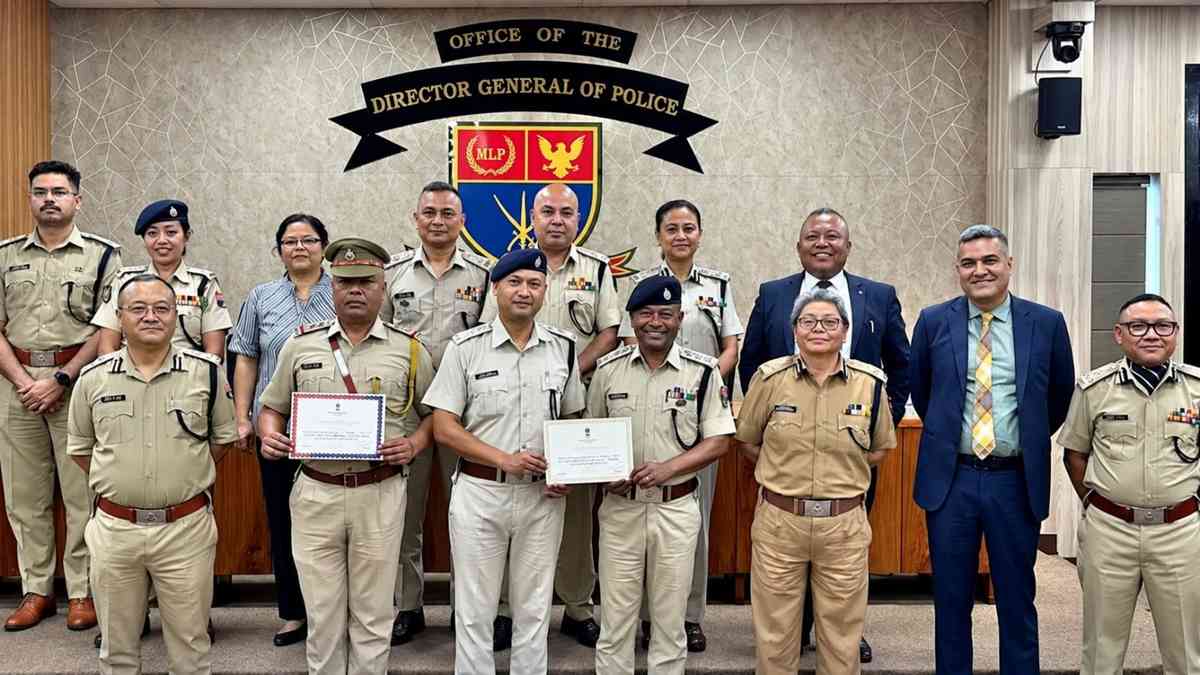
Established in 1885, the Sohra station received formal recognition at Police Headquarters on Tuesday, where DGP Idashisha Nongrang handed over the award to Superintendent of Police (City) Dangsan Khyriem, the SDPO of Sohra and the Officer-in-Charge of Sohra Police Station.
The function was attended by IGP (Law and Order) Davis N.R. Marak, DIG (ER) Sylvester Nongtnger and DIG (Administration) Jubi G. Momin.
East Khasi Hills Superintendent of Police Vivek Syiem said Sohra Police Station underwent a detailed national-level assessment several months ago, with the evaluation covering the station’s overall functioning rather than performance in any individual case.
The assessment examined infrastructure, police performance, public service, response, service delivery, case disposal, cleanliness, digitisation, public feedback and community engagement. Public feedback formed part of the assessment, with responses collected directly from citizens. Police personnel were also evaluated on their relationships with stakeholders and local communities, including their ability to prevent and respond to crime through community engagement.
The assessment also examined the station’s lock-up facilities, record management and level of digitisation, alongside the speed and transparency of investigations, use of digital tools, public-safety measures and interaction with citizens.
The recognition gives Sohra a distinction beyond its historical significance as Meghalaya’s oldest police station. It also provides East Khasi Hills police with a benchmark for its other 14 police stations, with the district currently having 15 stations in total.
Syiem said the district police intend to replicate practices followed at Sohra Police Station across other stations. Measures already being pursued include technology-equipped patrol vehicles, renovation of police station buildings to make them more accessible to the public, and greater emphasis on communication, empathy and professionalism.
The ranking therefore puts a number beside something police stations rarely receive public credit for: how they function when citizens walk through the door, not merely how they perform when a major case lands on the desk.
For a station established in 1885 to finish sixth in the country in a modern assessment covering technology, investigation, public feedback and service delivery is a notable shift in what Meghalaya’s police performance is being measured against. Sohra has the history. Now it has a national ranking to match it.