
The government’s best argument for its rising debt is also the one it least wants examined closely.
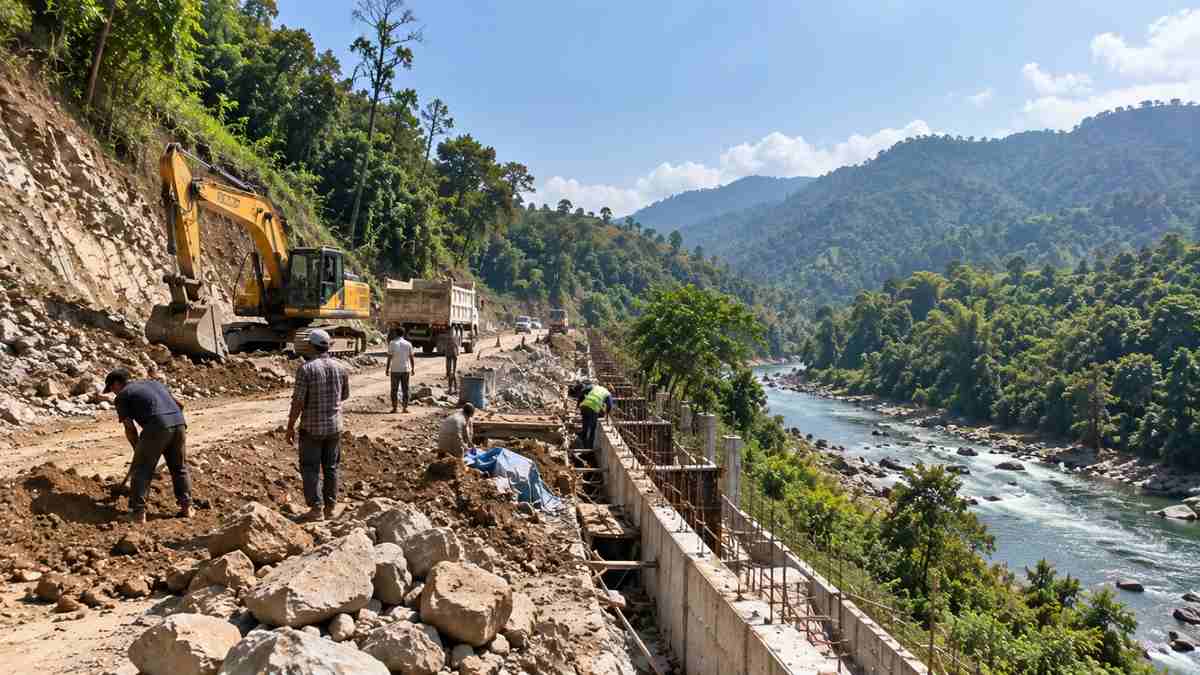
Borrowing to build roads, water systems, tourism infrastructure and power projects isn’t inherently reckless, a state with Meghalaya’s revenue base genuinely can’t fund everything from current income. That’s a fair point. But fair points come with conditions attached, and this one has two: the assets actually have to get built, and once built, they actually have to work. Skip either condition and “productive borrowing” is just a phrase in a budget speech.
This is where the conversation about Meghalaya’s ₹26,601 crore liability stock stops being an accounting exercise and becomes something the government would clearly rather not answer: is this borrowing turning into infrastructure fast enough, competently enough, and productively enough to justify what the state now owes?
The numbers set the stakes plainly. CAG’s audited accounts put Meghalaya’s 2024-25 liabilities at ₹26,601.45 crore, 44.61 percent of GSDP, alongside a fiscal deficit of ₹5,184 crore, 8.69 percent of GSDP. A state carrying that kind of fiscal weight doesn’t get to treat project delays as a footnote. Every stalled tender is borrowed money sitting idle while interest, however cheap, keeps the clock running.
SASCI is where this gets tested directly. These are 50-year, interest-free loans from the Centre, genuinely cheaper to service than ordinary market debt, and the government deserves credit for leaning on that structure rather than costlier borrowing. But cheap money is not the same thing as well-spent money, and Meghalaya’s own project data makes that distinction impossible to ignore.
Take the two flagship tourism projects sanctioned at ₹99.27 crore each under SASCI’s 2024-25 tourism component: the Umiam Lake redevelopment and the MICE infrastructure at Mawkhanu. Central monitoring data shows Mawkhanu sitting at just 12 percent physical progress. Umiam is further along at 49 percent. Both now carry a revised completion date of October 30, 2027, quietly pushed back from whatever timeline was originally promised. And here’s the number that should raise eyebrows in the Finance Department itself: ₹198.54 crore has reportedly been released for Mawkhanu, against an approved project cost of ₹99.27 crore, nearly double the sanctioned amount, for a project that’s barely one-eighth built.
To be fair, that gap alone doesn’t prove wrongdoing, revised costs and staggered release schedules can explain discrepancies like this. But “can explain” is not the same as “has explained,” and right now, nobody outside the monitoring database seems to be asking why a project 12 percent complete has drawn down twice its sanctioned budget. That’s not a hostile question. That’s the most basic question public money demands, and Meghalaya’s government owes citizens an answer without needing an RTI to drag it out.
Umiam carries its own bar to clear. It’s been sold to the public as a major eco-tourism intervention, with projections of over 1.27 lakh visitors annually and close to 4,000 jobs once operational. Those aren’t throwaway numbers, they’re a benchmark the government set for itself. If Umiam eventually hits those figures, the borrowing looks smart. If it opens late, costs balloon further, and visitor numbers land nowhere close to 1.27 lakh, the same borrowing looks like exactly the kind of vanity infrastructure that gets built for ribbon-cuttings, not returns. Completion is test one. Whether anyone actually uses it is test two. Whether it generates real economic activity is test three. Meghalaya hasn’t cleared any of them yet.
The digital library programme deserves the same unsentimental treatment. ₹162 crore, 750 libraries statewide, a genuinely worthy goal on paper, remote students getting access to the National Digital Library and educational resources they’d otherwise never see. But a building isn’t a library. A library isn’t a library either, if the internet doesn’t work, the computers are broken, or nobody’s funding upkeep once the inauguration photos are taken.
How many of these 750 are actually functioning? How many students walk in each week? Who’s paying the electricity bill in year three? The government’s ₹162 crore figure tells us what it intended to spend. It tells us nothing about what students actually received, and until an independent outcome audit answers that, this programme is a press release, not an achievement.
Roads carry the highest stakes of all, given Meghalaya’s terrain makes every kilometre both expensive and economically consequential. The logic behind road investment is sound, shorter travel times, better market access, easier movement for goods and patients alike. But a road’s value isn’t measured in kilometres announced, it’s measured in whether it survives the monsoon, whether maintenance funding actually exists past year one, and whether it connects places that matter economically rather than just looking good on a map.
Meghalaya’s audited accounts already contain the expenditure heads needed to build a genuine public ledger, sanctioned cost against actual spend, physical progress, completion status, project by project. The raw material exists. The government simply hasn’t published it in a form citizens can actually check, and that omission is a choice, not an oversight.
Then there’s the number that undercuts the entire “we’re building the future” narrative: 72.51 percent of Meghalaya’s gross borrowing in 2024-25 went straight to repaying earlier debt. Only 27.49 percent counted as genuine net borrowing for anything new. Repaying debt isn’t scandalous, every government does it. But it means Meghalaya’s headline borrowing figure vastly overstates how much fresh money is actually available for new projects, a state can borrow ₹1,000 crore and have a fraction of that left over once old obligations are settled.
The infrastructure narrative the government sells rests on gross figures. The real fiscal room rests on the net ones, and those numbers tell a considerably less flattering story.
Layer on top of that Meghalaya’s revenue receipts falling 4.58 percent in 2024-25 even as nominal GSDP rose, alongside CAG’s own flagged concerns about the state’s dependence on central transfers, and the equation gets uncomfortable fast. The government is betting that today’s borrowed infrastructure generates tomorrow’s larger economy, which then generates the revenue to service today’s debt. That’s a reasonable bet if the state’s own revenue base actually strengthens alongside GSDP growth. It’s a considerably worse bet if Meghalaya just keeps leaning on Delhi’s transfers and fresh borrowing to paper over the gap, which is precisely the pattern the last two years of data suggest.
None of this means Meghalaya’s borrowing is wrong on its face. SASCI has genuinely given the state access to long-term, interest-free capital it couldn’t otherwise raise, and several of these projects have real developmental logic behind them.
But allocation is not achievement, and the Mawkhanu and Umiam numbers, 12 percent and 49 percent complete respectively, both pushed to 2027, prove exactly why that distinction matters. Until these projects are finished and their promised benefits can actually be measured, in visitors, in jobs, in revenue, the economic return the government keeps citing remains a claim about the future, dressed up as a fact about the present.
Meghalaya doesn’t need to prove that borrowing itself is virtuous. It needs to prove that what it borrowed for is actually working, and right now, the state’s own monitoring data is the strongest evidence against its own talking points. A smaller debt than Maharashtra’s is not an achievement. Converting borrowed money into productive, functioning assets is, and on that test, the receipts are still overdue.