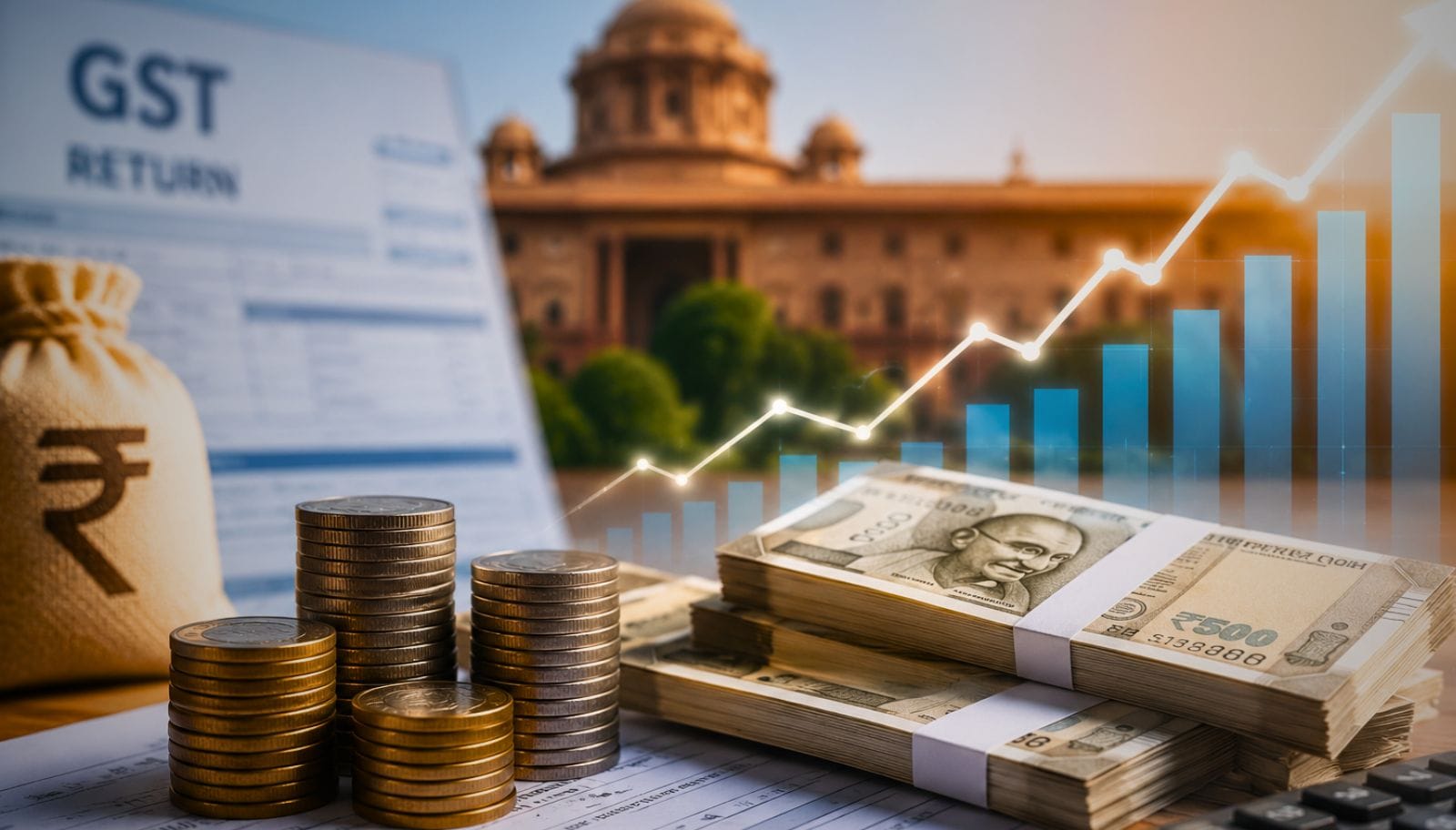
India’s economy delivered a strong signal of resilience this week, with the government reporting that gross Goods and Services Tax collections rose 15.4% year-on-year to touch ₹2.11 lakh crore in July the fastest pace of growth in 14 months. This marks only the second time this financial year that monthly collections have crossed the ₹2 lakh crore mark, a threshold that has become an important benchmark for gauging the health of India’s domestic economy.
The numbers tell a broader story than just tax revenue. Domestic GST collections rose 10.1% to ₹1.45 lakh crore, reflecting steady consumption and business activity across the country. But the real standout was revenue collected from imports, which jumped nearly 29% to ₹66,511 crore. That sharp rise suggests Indian businesses and consumers are importing more everything from machinery to raw materials — even as policymakers continue pushing for greater domestic manufacturing capacity.
After accounting for refunds, which themselves rose over 13% to nearly ₹30,000 crore, net GST revenue for the month stood at ₹1.81 lakh crore, up almost 16% from the same period last year. On a cumulative basis for the financial year so far, gross collections between April and July have grown just over 10% to ₹8.43 lakh crore.
Economists tracking the numbers say the growth isn’t limited to major industrial states either.
Collections from regions such as Andaman & Nicobar, Ladakh, and Jharkhand have picked up meaningfully, pointing to economic formalisation spreading well beyond India’s traditional manufacturing hubs. At the same time, some experts have flagged a note of caution: the heavy reliance on import-linked tax revenue underscores how dependent India still is on foreign goods, reinforcing the case for deeper localisation in manufacturing over the long run. This domestic strength is playing out against a more complicated backdrop internationally. India is currently monitoring a bill moving through the US Congress that proposes tariffs of up to 100% on countries that continue purchasing Russian oil in large volumes.
India has been one of the largest buyers of discounted Russian crude since the Ukraine war began, and government officials have reiterated that the country’s energy purchasing decisions will continue to be guided by national interest and energy security needs, rather than external pressure.
The timing is notable. Just months ago, India and the US finalized a trade agreement that brought down tariffs on a range of Indian exports, a deal officials had described as a major win for labour-intensive sectors like textiles and footwear. Any fresh tariff threat tied to oil purchases could complicate that recently-improved trade relationship, even as both countries continue to expand cooperation in other areas.
Adding another layer to the picture, a separate report this week showed that private equity and venture capital investment in India fell 36% in the first half of 2026, with deal exits also declining nearly 29%. Taken together with the tax data, it paints a picture of an economy where day-to-day consumption and formal business activity remain robust, even as bigger-ticket investment decisions are being made more cautiously amid global uncertainty.
For now, the GST numbers offer reassurance that India’s underlying economic engine continues to run at a healthy pace.