MUMBAI — The Nifty managed a recovery on Friday. The Sensex did not. More importantly, neither index managed to repair what has been a difficult week for Indian equities, with both benchmarks ending their sixth straight week lower.
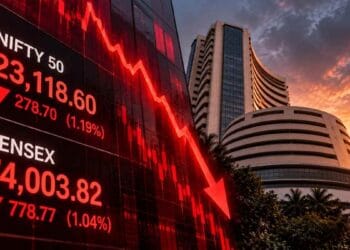
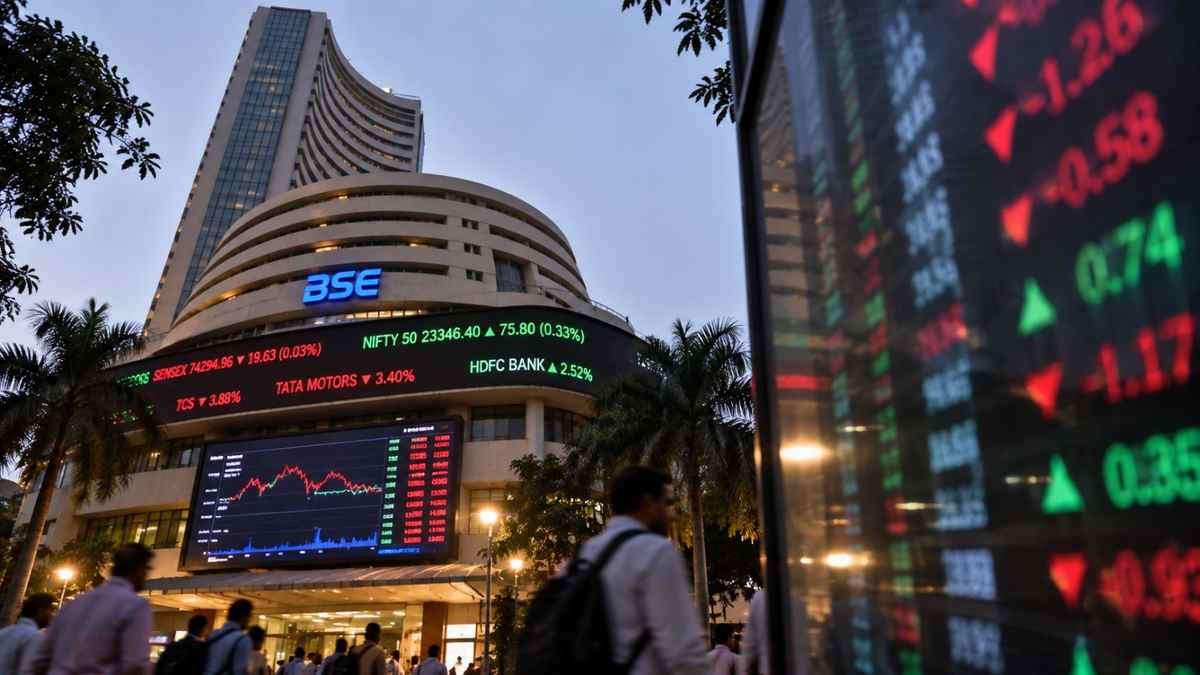
The Nifty 50 gained 75.80 points, or 0.33%, to close at 23,346.40, while the Sensex slipped 19.63 points, or 0.03%, to 74,294.96. The divergence was telling: banks, metals and energy stocks found buyers, but selling in IT and Tata Group companies kept the Sensex almost unchanged.
The weekly numbers remain less forgiving. The Nifty lost 0.22% during the week and the Sensex fell 0.65%, extending India’s longest weekly losing streak since 2020. Ten of the 16 major sectoral indices also finished the week lower. Mid-cap and small-cap stocks were not spared, although their weekly declines were much smaller.
Friday’s biggest corporate drag came from Tata stocks. TCS dropped 3.88%, Tata Motors Passenger Vehicles fell 3.40% and Tata Chemicals plunged 11.04%. Across listed Tata companies, about ₹38,361 crore, or roughly $4 billion, was erased from market value during the session, according to Reuters calculations based on exchange data.
The selling followed renewed uncertainty around Tata Sons, including its leadership and the possibility of listing the holding company. Tata Sons’ board moved to extend N Chandrasekaran’s term and proceed towards compliance with RBI requirements that could require a listing, while Tata Trusts, its 66% shareholder, opposed those moves. The dispute has therefore moved beyond one company and started showing up in the prices of several listed group companies. Banks prevented the broader index from slipping into another weak session. HDFC Bank gained 2.52%, while Adani Ports rose 4.93%, Bharti Airtel 3.12% and Bajaj Finance 2.49%. The Nifty Bank index gained 0.54%, while metal, energy and realty stocks also finished higher.
Oil provided another small piece of relief. Brent crude moved back towards $102-$103 a barrel after crossing $100 earlier in the week, easing some of the immediate pressure on an oil-importing economy such as India. But crude remains expensive enough to keep the rupee, inflation and the trade balance firmly on the market’s radar.
The rupee closed at ₹95.8750 against the US dollar on Friday, down 0.3% over the week. Traders told Reuters that the currency’s approach towards ₹96 has brought visible intervention from the Reserve Bank of India, making that level an important near-term line for the market.
There is another drain on liquidity. The $2.3-billion NSE IPO was fully subscribed by its second day, pulling money into the primary market while shares were struggling in the secondary market. That does not explain the entire market decline, but it adds another competing demand for capital at a time when foreign investors remain sensitive to oil prices and global interest rates.
So Friday’s 0.33% Nifty gain needs to be kept in proportion. Buyers appeared where valuations had already taken a beating, oil gave them some room and banks carried much of the index. But the weekly chart still says something very different: six consecutive weeks of decline.