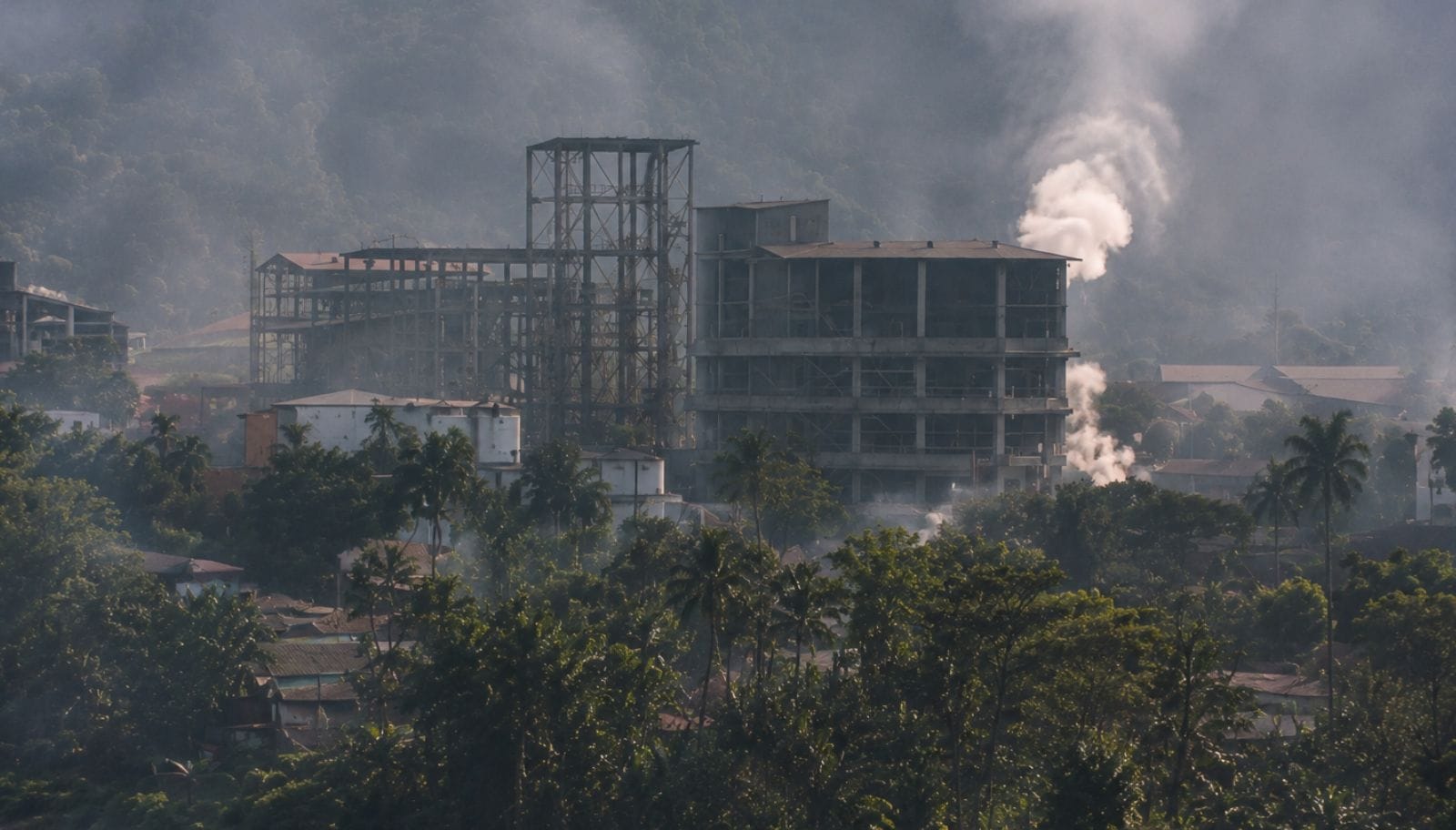
SHILLONG – Byrnihat has recorded the lowest score among all 130 cities assessed under the Centre’s 2026 Swachh Vayu Sarvekshan, putting Meghalaya’s industrial town at the very bottom of the national clean-air performance table, even as the state reports genuine recent improvements in actual pollution levels.
The Ri-Bhoi town scored 108.5 points, the lowest in this year’s assessment, finishing last among the 40 cities in the under-three-lakh population category. Dera Bassi came in second-lowest at 110.5, while Kohima scored 134.1, Dimapur 146.5, and Nagaon 152.3. The Union Ministry of Environment, Forest and Climate Change released the ranking on September 7 under the fifth Swachh Vayu Sarvekshan awards, part of the National Clean Air Programme.
The score measures more than air quality alone. Swachh Vayu Sarvekshan doesn’t simply rank cities by pollution levels detected in the air, it evaluates the systems cities have built to control pollution: road dust management, solid waste handling, vehicle emissions, industrial oversight, construction waste, and public education efforts, combining city self-evaluation with CPCB assessment and independent field verification. That framework is exactly why Byrnihat’s last-place finish stings more than a bad air-quality reading would, it’s a verdict on the machinery meant to fix the problem, not just the problem itself.
Nationally, 108 of the 130 assessed cities showed improved PM10 levels compared to 2017-18, with 72 cutting pollution by more than 20 percent, and 14 cities meeting national air quality standards outright.
Meghalaya can point to real gains of its own. Data placed before the state Assembly showed average PM10 concentration in Byrnihat falling from 106.2 micrograms per cubic metre in January 2026 to 75.7 by July, with PM2.5 dropping from 52.6 to 38.6 over the same stretch. Enforcement, tells a rougher story, the government told the Assembly in August that 28 of 37 industries inspected across the Byrnihat industrial belt over the past two years were found violating pollution-control norms, with industrial activity, road dust, vehicle emissions, residential sources, and the broader Meghalaya-Assam airshed all contributing to the problem.
The Meghalaya High Court has been running its own parallel scrutiny. An August 13 order documented an amicus curiae site inspection covering air pollution, industrial activity, and contamination of the Umtrew River, finding the main access road to the EPIP industrial area badly damaged and unpaved, with heavy trucks kicking up large amounts of dust, alongside garbage accumulation and industrial activity right along the riverbank.
Regulatory action has followed in specific cases, the Meghalaya State Pollution Control Board issued a closure order to Umiam Distillation Private Limited in August after the company ignored a show-cause notice, Shyam Century Ferrous Limited was directed to halt operations and clear an unauthorised clinker depot, and Bodhi Premier LLP had its consent to operate suspended following compliance proceedings, with notices also issued to several other units over effluent and environmental violations.
The court’s findings make clear this isn’t a problem Meghalaya can pin entirely on its own side of the border either. The amicus report flagged industrial activity on the Assam side of Byrnihat, noting smoke from factories there drifting toward residential areas in Meghalaya, prompting the Central Pollution Control Board to commit to directing the Assam Pollution Control Board to address industrial effluents, sewage, and solid waste issues on its side of the boundary.
Meghalaya still carries clear responsibility for its own enforcement gaps. The state has barred new Red Category industries in the notified Byrnihat zone, restricted expansion of existing Red and Orange Category units, and mandated cleaner technology and fuel for new Orange Category industries, alongside road improvements, green buffers, expanded monitoring, mechanised sweeping and water sprinkling under the NCAP and Byrnihat City Action Plan.
None of that closes the gap between what’s been done and where Byrnihat landed nationally. The real issue isn’t whether PM10 improved between January and July, it did. It’s why a town already receiving pollution-control interventions, regular inspections, and direct High Court attention still scored 108.5, well below every other city assessed in the country.
That gap perhaps is the administrative problem Meghalaya now has to answer for: improving individual pollution readings hasn’t yet added up to a clean-air management system anyone would call convincing.