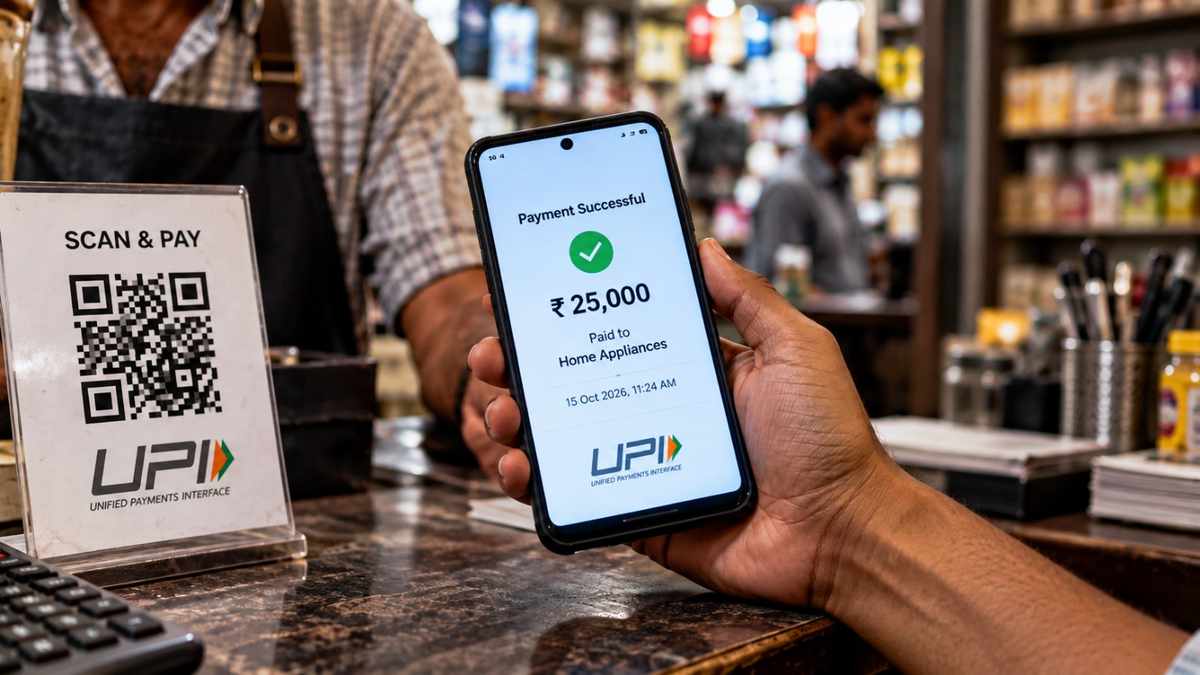
From October 15, UPI will no longer be entirely free for every merchant payment. The National Payments Corporation of India is introducing a Merchant Discount Rate of 0.4% on specified person-to-merchant transactions above ₹2,000.
The change gives the country’s largest real-time payment system a defined revenue stream from part of merchant traffic while keeping most everyday UPI payments outside the charge.
The fee is not a consumer surcharge. Person-to-person transfers will remain free, while banks and payment providers have been instructed that merchants should not pass the MDR directly to customers. The charge sits inside the merchant-payment chain.The numbers are simple.
A ₹3,000 purchase will carry an MDR of ₹12, while a ₹50,000 payment will attract ₹200. Once a transaction reaches ₹75,000, the charge is capped at ₹300.
Most daily payments will never see the MDR. More than 95% of UPI person-to-merchant transactions by volume are worth ₹2,000 or less. Small merchants receiving up to ₹1 lakh a month through UPI QR under the P2PM category will also remain exempt, even when an individual payment crosses ₹2,000.
NPCI has also created different rates for specific sectors. Eligible payments above ₹2,000 involving railways, telecom, insurance, fuel and certain utilities will attract a flat ₹5 charge instead of the standard 0.4%.
Capital-market payments, including mutual funds, securities, stockbrokers and dealers, will carry a much lower MDR of 0.02%, with the charge capped at ₹300.
The legal framework had already shifted two days earlier. On September 14, the Finance Ministry notified that banks and system providers cannot impose direct or indirect charges on UPI transactions up to ₹2,000 or on RuPay debit-card payments.
The notification protected smaller transactions while leaving the larger merchant-payment segment outside that specific zero-charge protection.
The scale of UPI makes the revenue question impossible to ignore. In August, the system processed 24.51 billion transactions worth ₹29.82 lakh crore, with transaction volume rising 22% from a year earlier.
The payments network also carries substantial operating costs. Industry estimates put the annual expense of servers, bandwidth, fraud-prevention systems and bank technical support at around ₹20,000 crore. NPCI says MDR revenue will remain within the UPI ecosystem and support infrastructure, cybersecurity, innovation and customer service.
Analysts at Jefferies estimate that monetising eligible merchant payments could generate ₹5,000 crore to ₹10,000 crore annually for the payments industry. How that money is ultimately divided among banks, payment applications and merchant service providers will determine where the financial benefit lands.
The change follows comments from NITI Aayog Vice Chairman Ashok Lahiri, who argued that digital payments cannot remain free indefinitely when the infrastructure behind them carries operating and set-up costs.
“Many times we want things to be provided free, that’s not sustainable as there are operating costs and set up costs,” Lahiri said.
NPCI has now put a specific mechanism in place. P2P transfers remain free, most low-value merchant payments stay outside MDR, eligible small merchants remain protected and consumers are not supposed to receive a separate charge.
What has changed is the treatment of a narrower but financially significant part of UPI. India is now monetising selected high-value merchant payments on the world’s largest real-time retail payment network, creating a new revenue stream while keeping ordinary UPI use largely free.