
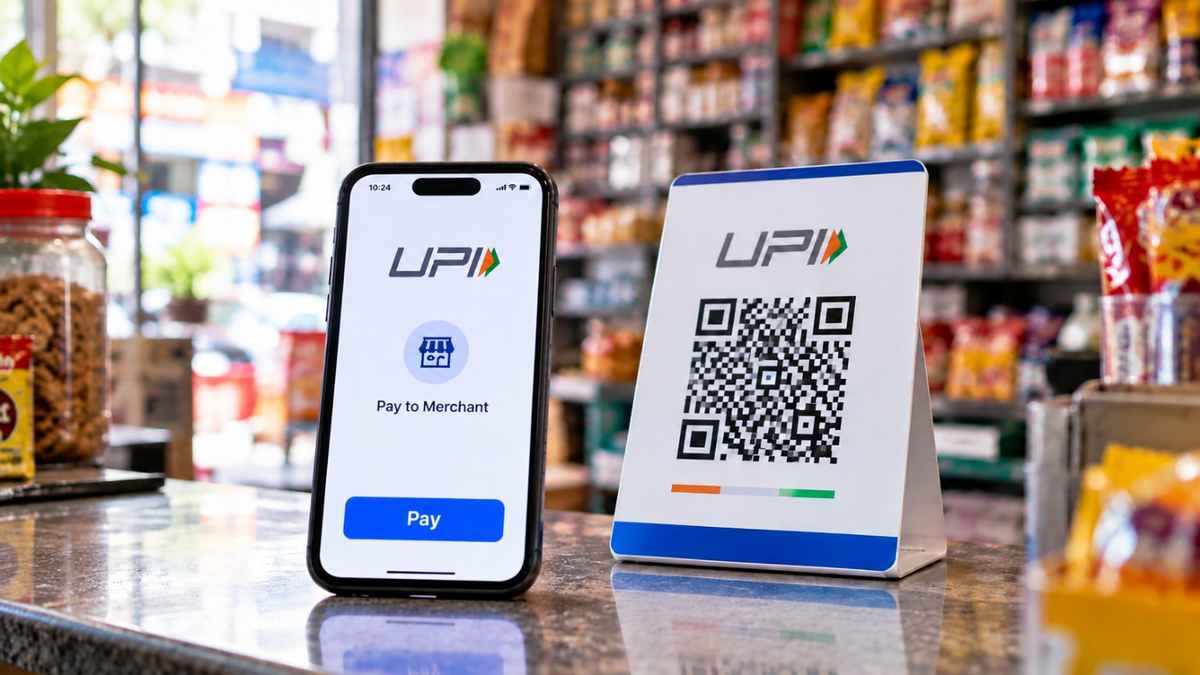
A customer haggles a ₹10,000 item down to ₹9,500. The merchant agrees. The payment goes through UPI, and on the surface, nothing has changed, the screen shows no fee, the receipt shows no charge. But the merchant just lost ₹38 to a new government mandate, and the next customer who tries the same negotiation will find the discount ₹50 smaller. Nobody wrote “UPI fee” anywhere. The cost still moved.
That’s the mechanism worth understanding before the October 15 rollout, because the government’s framing, “UPI stays free,” is technically accurate and economically incomplete at the same time.
From October 15, eligible person-to-merchant UPI payments above ₹2,000 will attract a 0.4 percent Merchant Discount Rate. Transactions up to ₹2,000 stay untouched, person-to-person transfers remain free regardless of amount, and standard merchant transactions of ₹75,000 or more will see the MDR capped at ₹300.
Certain categories get separate treatment entirely: railway, telecom, insurance and fuel payments above ₹2,000 carry a flat ₹5 charge, capital-market transactions get a 0.02 percent rate capped at ₹300.
The Finance Ministry states that roughly 96 percent of person-to-merchant UPI transactions will remain unaffected, and small merchants processing up to ₹1 lakh monthly through UPI QR codes stay under the existing zero-MDR arrangement. This is a narrower policy than the blanket “UPI charges” language circulating in political debate suggests, the burden lands specifically on higher-value merchant transactions.
Here’s where the policy’s real design shows itself: the charge is structured as a merchant-side cost by rule, not by economics. Banks have been explicitly instructed to prevent merchants from passing the MDR directly onto customers as a line-item fee. A merchant selling a ₹10,000 product under the standard 0.4 percent rate pays ₹40 in MDR and receives ₹9,960 instead of the full amount. From there, the merchant has exactly three levers to pull: absorb the ₹40 and accept a thinner margin, shrink the discount offered on the next negotiation, or raise the base price across the board. Most merchants will use some blend of all three, and critically, none of these responses requires writing “UPI charge” anywhere a customer can see it.
This isn’t hypothetical friction, it’s structurally inevitable in India’s negotiated retail economy. Furniture, jewellery, clothing, electronics, higher-value goods where the final price is bargained rather than fixed, all run on exactly this kind of flexible pricing. A merchant who knows accepting UPI now costs money doesn’t need to announce a surcharge. The negotiation simply concludes ₹50 short of where it used to. The customer still walks away feeling like they got a discount. The merchant still absorbed the MDR. And the invoice shows nothing resembling a payment fee, because there’s nothing on the invoice to regulate.
Fixed-price retailers face the same pressure through a different channel. A large, high-volume retailer competing aggressively on price may find absorbing 0.4 percent cheaper than risking customer defection, essentially treating it as a cost of doing business. A thin-margin operator has considerably less room to eat that same 0.4 percent and may have no realistic option but to nudge prices upward. A merchant with strong pricing power, a recognisable brand, a captive customer base, gets to choose. One without it doesn’t. The actual economic burden, in other words, isn’t determined by the MDR rate itself, it’s determined by each merchant’s margin structure and competitive position, which means the “0.4 percent” figure understates how unevenly this policy will actually bite across India’s retail landscape.
There is a legitimate economic case for the MDR too, one that shouldn’t be dismissed just because the pass-through mechanics are murky.
UPI now processes billions of transactions monthly as genuinely critical national payment infrastructure, and a payment rail that generates zero direct revenue for the banks and payment service providers maintaining it cannot indefinitely fund the infrastructure, cybersecurity, and continued investment that keeps it running.
Free-to-the-customer doesn’t mean free-to-operate, someone has always been paying for UPI’s plumbing; this policy simply names who.
But naming the payer on paper and determining who actually bears the cost in practice are two entirely different exercises, and that gap is precisely where enforcement will struggle. A merchant who tacks on a labelled “UPI surcharge” is trivially easy to catch and penalise. A merchant who quietly offers ₹50 less discount than they did last month is functionally invisible to any regulator. A merchant who repriced a product from ₹10,000 to ₹10,050 owes no customer an explanation for that specific ₹50. And a merchant who simply offers better discounts to cash customers than UPI customers has built an entirely legal, entirely undetectable price discrimination system, without ever writing the letters “MDR” anywhere near a receipt.
That’s the real fault line running through this policy: preventing a visible surcharge is enforceable. Preventing an invisible price adjustment is not, because prices are set by markets, not by RBI circulars, and no regulation has ever successfully frozen how a shopkeeper responds to a new cost.
So the honest answer to “does UPI stay free” is: on the payment screen, yes, unconditionally. In the price of the product, the answer depends entirely on which merchant you’re standing in front of, how thin their margins run, how much competition they face, and how badly they need your business that day.
A customer will likely never see the ₹40 MDR on a ₹10,000 purchase. The merchant absorbing it will feel every rupee. And if that ₹40 eventually resurfaces somewhere in the sticker price, months from now, the transaction will still read “free” on the app, even as the actual economics of that free payment have quietly shifted onto the customer’s side of the counter after all.