• About
  • Get Jnews
  • Contcat Us
Thursday, October 1, 2026
The Shillong Daily
No Result
View All Result
  • Login
  • News

    Trending Tags

    • Commentary
    • Featured
    • Event
    • Editorial
  • National
  • News

    Trending Tags

    • Commentary
    • Featured
    • Event
    • Editorial
  • National
No Result
View All Result
Morning News
No Result
View All Result
Home Analysis

Nagaland’s 95.7% literacy rate raises questions as ULLAS continues adult education

The Shillong Daily by The Shillong Daily
September 11, 2026
in Analysis
Reading Time: 3 mins read
0
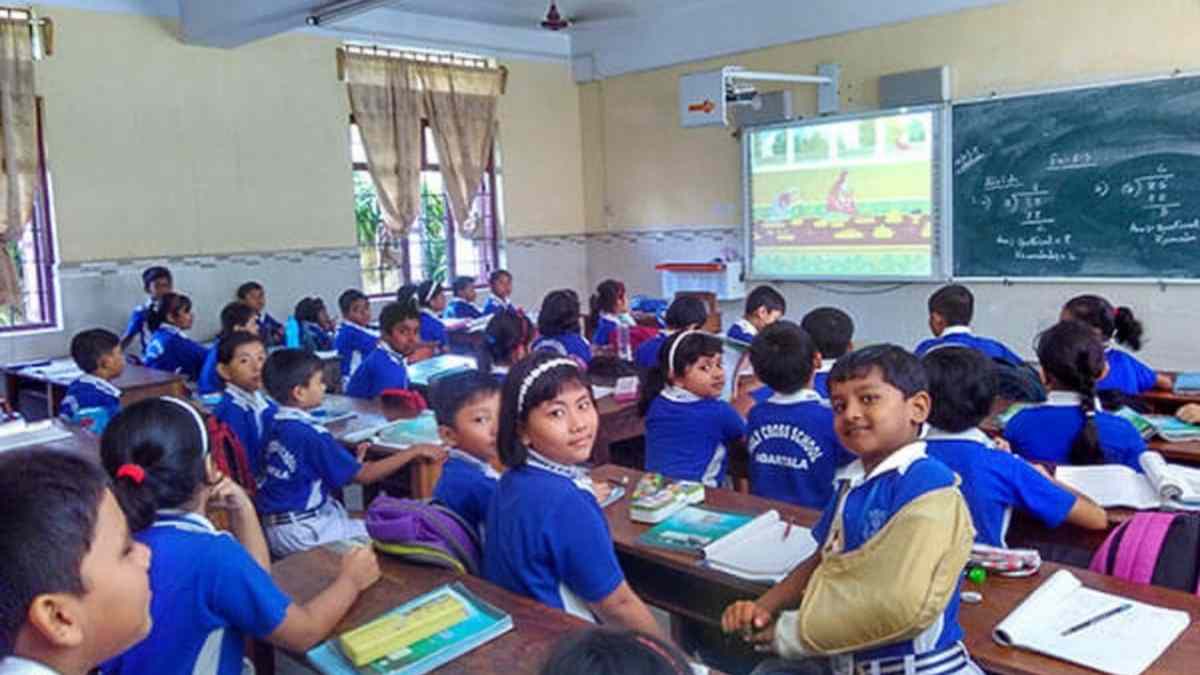
Students attend a class at a school in Nagaland | Representative image.

Nagaland’s 95.7% literacy rate is an extraordinary statistical achievement. It is also a number that deserves closer examination because the state is still running a substantial adult-literacy programme for people who remain outside basic education.

The figure comes from the Periodic Labour Force Survey 2023-24, which measures literacy among people aged seven years and above. Nagaland’s long-term rise has been substantial. Literacy stood at 21.95% in 1963, rose to 42.57% in 1981, 60.59% in 1991, 66.60% in 2001 and 79.55% in the 2011 Census before reaching the latest PLFS estimate. The progression reflects decades of expansion in education, but the Census and PLFS figures come from different statistical exercises and should not be treated as one continuous measurement.

READ ALSO

PB Fintech’s 38% crash reveals the hidden concentration risk inside mutual funds

Meghalaya securities market participation at 4.2%, below national average of 9.5%

The more revealing part of the story sits outside that single statewide percentage. Nagaland continues to implement ULLAS, the Centre’s adult-literacy programme for people aged 15 years and above who missed formal education or remain non-literate.

The state is identifying learners, training volunteer teachers and conducting foundational literacy and numeracy assessments across districts. PLFS estimates literacy across a broad population, while ULLAS is designed to find and educate adults who remain outside basic literacy.

The Centre uses 95% literacy as the benchmark for full literacy under ULLAS, yet Nagaland has not been among the states and Union Territories formally declared fully literate under the programme. Therefore, the question is not whether the PLFS estimate is genuine. It is how much of the remaining literacy problem is being hidden inside a statewide average.

Nagaland’s own ULLAS records show why that question matters. The first seven implementing districts were Mon, Kiphire, Tuensang, Zunheboto, Peren, Phek and Dimapur. Their Census 2011 literacy rates ranged from 54.63% in Mon to 84.76% in Dimapur, and the state identified 210,711 target learners across those districts using Census-era data. These figures are not current district literacy rates, but they show how sharply literacy conditions have differed across Nagaland.

The latest ULLAS assessment gives a more recent picture of the adults still being brought into the literacy system. On March 21, 2026, 5,069 adult learners appeared for the Foundational Literacy and Numeracy Assessment Test across seven districts, with 4,522 passing. Women accounted for 3,208 successful candidates and men 1,314, producing an overall pass rate of approximately 89.2% among those assessed.

The programme is expanding as well. For 2026-27, Nagaland has targeted another 63,882 adult learners across Kohima, Mokokchung, Longleng and Wokha, supported by 952 volunteer teachers covering 452 villages. Those figures are difficult to square with the idea that a high statewide literacy percentage tells the whole story. They point instead to a smaller but still significant population requiring direct intervention.

Meghalaya provides a useful benchmark for readers closer to home. Its literacy rate is 94.2%, just 1.5 percentage points below Nagaland, while it too is using ULLAS to reach adults outside basic literacy.

Meghalaya officials said in April that nearly two lakh people remain illiterate as the state works toward crossing the 95% benchmark. The comparison is not a competition between the two states. It illustrates how closely neighbouring Northeast states can sit in statewide literacy rankings while still dealing with sizeable groups requiring adult education.

Nagaland’s officials have also acknowledged the gap between a high statewide literacy figure and the people still outside formal education. In May 2026, a Kohima official said a sizeable population remained illiterate and had not been covered by formal education, with ULLAS surveys being used to identify those adults.

The May statement puts the focus on the adults who remain outside formal education, despite Nagaland’s high overall literacy rate. The state’s progress is substantial, but the remaining gap still requires targeted work through ULLAS.

The state has made enormous progress over six decades, but the continuing ULLAS work shows that the final stretch is being measured not merely in percentages but in adults being identified, taught and assessed.

Nagaland’s latest literacy estimate stands at 95.7%, while 63,882 adult learners are targeted under the 2026-27 ULLAS phase and 5,069 appeared in the latest assessment.


Tags: adult literacyEducationliteracy rateliteracy rate in Northeast IndiaNagalandPLFS 2023-24ULLAS
Previous Post

Meghalaya showcases 60 MSMEs at first state-level industrial exhibition in Tura

Next Post

Conrad lays foundation for Didak River bridge on Tikrikilla-Jangrapara road

Related Posts

PB Fintech’s 38% crash reveals the hidden concentration risk inside mutual funds
Analysis

PB Fintech’s 38% crash reveals the hidden concentration risk inside mutual funds

September 26, 2026
Meghalaya securities market participation at 4.2%, below national average of 9.5%
Analysis

Meghalaya securities market participation at 4.2%, below national average of 9.5%

September 18, 2026
Meghalaya has ₹5,490 crore in mutual funds, highest among Northeast states
Analysis

Meghalaya has ₹5,490 crore in mutual funds, highest among Northeast states

September 18, 2026
UPI MDR explained: Who pays the merchant charge and how it affects customers
Analysis

UPI MDR explained: Who pays the merchant charge and how it affects customers

September 17, 2026
9/11 anniversary: Remembering the September 11 attacks and their aftermath
Analysis

9/11 anniversary: Remembering the September 11 attacks and their aftermath

September 11, 2026
Himachal’s 99.55% literacy claim hides a striking gap in the numbers
Analysis

Himachal’s 99.55% literacy claim hides a striking gap in the numbers

September 9, 2026
Next Post
Conrad lays foundation for Didak River bridge on Tikrikilla-Jangrapara road

Conrad lays foundation for Didak River bridge on Tikrikilla-Jangrapara road

Titosstarwell Chyne denies UDP exit as Olan Suin says BJP move possible

Titosstarwell Chyne denies UDP exit as Olan Suin says BJP move possible

9/11 anniversary: Remembering the September 11 attacks and their aftermath

9/11 anniversary: Remembering the September 11 attacks and their aftermath

Anthropic researcher quits, warns AI race could threaten humanity

Anthropic researcher quits, warns AI race could threaten humanity

Lahkmen Rymbui defends Vijay Kumar Mantri amid VPP demand for removal

Lahkmen Rymbui defends Vijay Kumar Mantri amid VPP demand for removal

POPULAR NEWS

Meghalaya’s new SPF teacher appointments explained amid ‘availability of funds’ clause

Meghalaya teacher appointments under SPF raise questions over ‘availability of funds’

September 2, 2026
KSU announces five-day agitation across Khasi-Jaintia Hills, Khliehriat meeting on August 11

KSU calls off public bike rally in Shillong, CEC members to sit in at Khyndailad

August 19, 2026
VPP demands Vijay Kumar Mantri’s removal over education policies

VPP demands Vijay Kumar Mantri’s removal over education policies

September 16, 2026
Assam 8.5-Magnitude Earthquake Claim Goes Viral: What Science Says About The Warning

Assam Earthquake alert: Viral 8.5-magnitude claim raises questions over late August warning

August 27, 2026
Meghalaya withdraws STING energy drink ban after inquiry finds no causal link

Meghalaya imposes statewide freeze on Sting energy drink pending lab tests

August 16, 2026

About

The Shillong Daily is an independent news site out of Meghalaya. We cover the stories shaping Meghalaya and the Northeast, alongside business, economy and market news that matters to readers here. We’re not chasing every headline first — we’d rather dig through the numbers, check the details and tell you what actually happened. Journalism for a region that deserves more than a footnote.

Follow us

Recent Posts

  • KSU alleges Meghalaya Police collecting ₹200–₹500 from trucks at Mawkhanu, Thangshalai
  • Scientists reconstruct face of 315,000-year-old Homo sapiens from Moroccan fossil
  • Meghalaya notifies new GHADC rules for ST voters and candidates
  • Selsella NGOs offer free NEET coaching to 50 students from two Garo Hills districts

Categories

  • Analysis
  • Business
  • Crime
  • Economy
  • Editorial
  • Education
  • Entertainment
  • Explained
  • Faith
  • Governance
  • Guest Column
  • Health
  • International
  • Letters to the Editor
  • Meghalaya
  • Music
  • National
  • National
  • Northeast
  • Politics
  • Satire
  • Shillong
  • Sports
  • Stock Market
  • Top Stories
  • About Us
  • EDITORIAL POLICY
  • TERMS OF USE
  • DISCLAIMER
  • PRIVACY POLICY
  • CORRECTIONS POLICY
  • CONTACT

2026 The Shillong Daily. All rights reserved.

Welcome Back!

Login to your account below

Forgotten Password?

Retrieve your password

Please enter your username or email address to reset your password.

Log In
error:
No Result
View All Result
  • Home
  • Meghalaya
  • Business
  • Economy
  • Stock Market
  • Explained
  • Northeast
  • Analysis
  • Politics
  • Satire
  • Top Stories

2026 The Shillong Daily. All rights reserved.