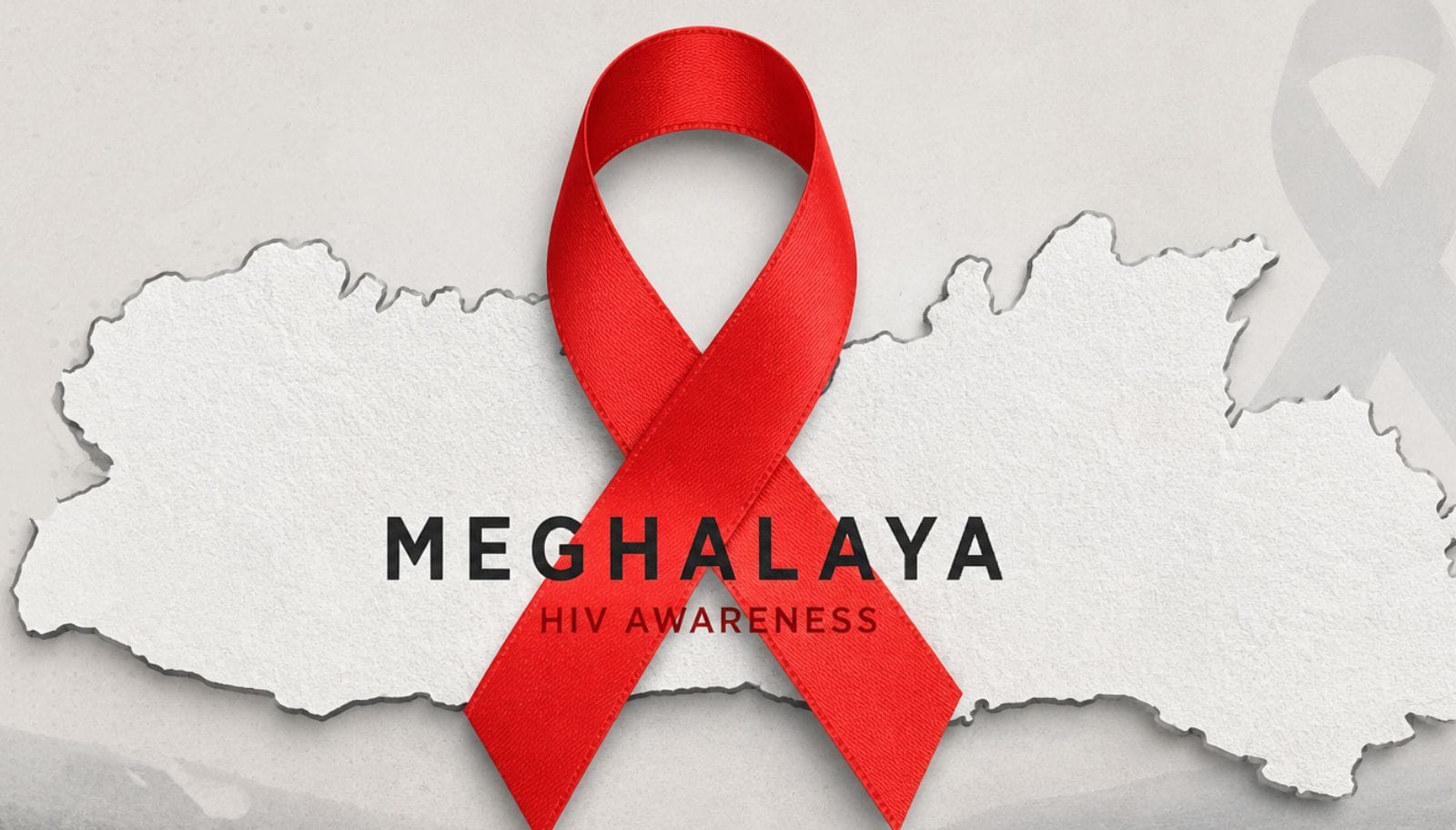
SHILLONG : Meghalaya now has an estimated 9,244 people living with HIV, according to the state’s 2025 HIV Estimation Report, with new detections continuing to climb even as the state pushes deeper into a fresh awareness drive.
Between April and June this year, the Meghalaya AIDS Control Society recorded 558 HIV-positive detections in the general population, along with 60 pregnant women testing positive during the same window. These figures were released as part of the Intensified IEC Campaign 3.0, launched at Lady Keane College on August 12. It’s worth being precise about what these numbers actually mean: MACS describes the 558 as cases detected through testing, not necessarily newly acquired infections, a distinction that matters for accurate reporting.
The state’s estimated adult HIV prevalence among people aged 15-49 stands at 0.40 percent. The mother-to-child transmission concern is a real one. The state’s final vertical transmission rate stands at 9.97 percent, and roughly 284 pregnant women need services annually to eliminate transmission from mother to child entirely.
Zoom out to the longer trend and the picture gets more complicated. Meghalaya records an estimated 681 new HIV infections every year, with an incidence rate of 0.20 per 1,000 uninfected people. Annual new infections are up nearly 59 percent since 2010. That rise has hit certain groups harder than others:
- Infections among women have climbed more than 82 percent since 2010
- Infections among young people aged 15-24 have risen by nearly 64 percent over the same period
- Overall annual new infections are up close to 59 percent since 2010
Meanwhile , the state has made real progress on the treatment side. Annual AIDS-related deaths are estimated at around 33 now, with a mortality rate of 1.01 per 100,000 population, down more than 61 percent since 2010, a decline health officials credit to wider antiretroviral access, expanded testing, and better linkage to care. So this isn’t simply a story of things getting worse, more cases are being caught through testing, more people are surviving, but new infections, especially among women and youth, keep climbing.
Separate data placed before the Meghalaya Assembly in February showed 749 deaths associated with HIV/AIDS over the past decade. Health Minister Wailadmiki Shylla clarified these deaths stemmed from opportunistic infections rather than HIV being recorded as the direct cause. The district-wise breakdown showed a heavy concentration in Khasi and Jaintia Hills:
- East Khasi Hills: 435
- West Jaintia Hills: 123
- East Jaintia Hills: 90
- Ri-Bhoi: 51
- Eastern West Khasi Hills: 16
- West Garo Hills: 9
- West Khasi Hills: 8
- South West Khasi Hills: 7
- East Garo Hills: 4
- South Garo Hills: 3
- South West Garo Hills: 2
- North Garo Hills: 1
- Total: 749
East Khasi Hills alone accounted for more than half of all reported deaths over the decade, which explains why the state has leaned toward district-level interventions rather than treating HIV as a uniform statewide issue.
Earlier district data out of East Khasi Hills showed 3,432 people had tested positive there, but only 1,581 were actually receiving treatment, with 681 reported lost to follow-up entirely.
Health officials have flagged this gap as a real problem, people testing positive but not staying connected to care, while also cautioning against publicly naming specific localities in ways that could fuel stigma.
On the response side, MACS is running a large outreach push under the current campaign:
- 1,026 village-level meetings
- 3,000 school awareness sessions
- 85 college sessions
- 30 folk performances
- 30 flash mobs
- Door-to-door outreach targeting 15,000 households
- 12 special camps at government hospitals10 pop-up awareness booths
With more than half of Meghalaya’s population under 20, schools, colleges and youth groups have become a central part of that prevention effort. The state currently lists 438 HIV testing facilities spread across all 11 districts.
Treatment access has also expanded.
The Assembly was told in February that 10,293 people living with HIV were on antiretroviral therapy as of January 2026, supported by five ART centres, two of them in East Khasi Hills, alongside 392 standalone ICTCs and four mobile ICTCs, though facility distribution still varies significantly between districts.
The government has approved a ₹25-crore, five-year mission-mode programme to strengthen testing and treatment infrastructure, while NACO has separately sanctioned ₹17.8 crore to MACS for 2025-26.
What the numbers point to is a two-front challenge. Treatment is genuinely working, deaths have fallen sharply. But new infections, particularly among women and young people, are still rising, and getting people who test positive to actually start and stay on treatment remains the harder part of the fight.
Health officials continue to stress that stigma remains one of the biggest barriers, whether people feel safe enough to come forward and get tested may end up mattering just as much as the medicine itself.