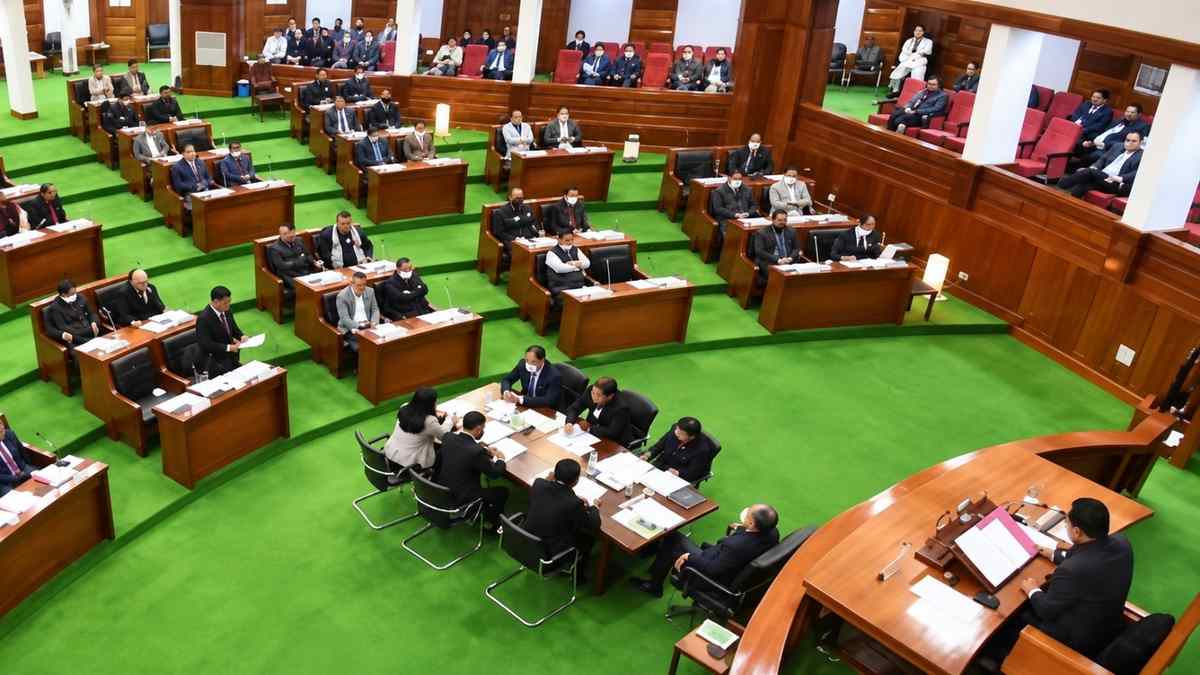
KOHIMA – The Nagaland Legislative Assembly unanimously passed a revised Frontier Nagaland Territorial Authority (FNTA) Bill, 2026 on September 3, creating a new regional authority for six eastern districts, while the same two-day session also saw the House push the Centre to review and relax the Protected Area Permit regime governing foreign visitors to the state.
The FNTA will cover Tuensang, Mon, Longleng, Kiphire, Noklak and Shamator, with the new authority carrying 62 members and powers over 46 subjects spanning legislative, executive, administrative and financial matters. Rather than launching a fresh scheme, it hands the region genuine planning authority, control meant to move development decisions closer to the districts themselves instead of routing everything through state-level administration in Kohima.
The Bill traces back to a February 5 tripartite agreement between the Centre, the Nagaland government and the Eastern Nagaland Peoples’ Organisation (ENPO), which had long pushed for a special administrative arrangement for the six districts.
Getting here wasn’t smooth. An earlier version of the FNTA Bill, introduced in March, was withdrawn after the Centre sought further consideration of provisions tied to legislative powers, with eastern Nagaland legislators separately raising their own concerns at the time.
The government went back to the table, consulted with the Ministry of Home Affairs and ENPO, and returned with a revised draft that Deputy Chief Minister Yanthungo Patton introduced on September 1, passed unanimously just two days later.
Chief Minister Neiphiu Rio was cautious in presenting the new authority within existing constitutional guardrails, telling the House that Article 371A would remain fully protected, untouched and undiluted, and describing the FNTA as a way to close the development gap in Eastern Nagaland without threatening the state’s underlying unity.
Money featured prominently in the discussion too. The state government wants the proposed special development grant for Eastern Nagaland raised from ₹5,000 crore to at least ₹10,000 crore, with state funding allocated based on population and geographical area, while expecting the Centre to chip in additional support for infrastructure and broader development work. The push reflects years of frustration in the six districts over poor connectivity, infrastructure shortfalls and limited access to development opportunities that residents say never quite reached them under the existing setup.
The same sitting produced a second, entirely separate demand aimed squarely at Delhi. The House unanimously adopted a resolution calling on the Centre to urgently review and withdraw the Protected Area Permit regime, restoring the relaxation that had been in place before its reimposition in December 2024. Tourism Minister Temjen Imna Along argued the PAP rules were actively hurting tourism, investment, business engagement and international visitor traffic, and pushed back on treating Nagaland the same as neighbouring states facing very different security or refugee-related concerns.
Rio backed the demand too, while acknowledging the Centre’s legitimate authority over national security and foreign-national regulation, pointing to a sharp drop in armed-group incidents in recent years as evidence that security controls ought to reflect Nagaland’s present reality rather than conditions from years past. The resolution stops well short of asking for zero oversight though, the state has instead proposed technology-based registration and monitoring of foreign visitors, run in coordination with central agencies, if the PAP restrictions are eased.
The two-day session wrapped up on September 3 after the Assembly passed six government Bills in total and adopted the PAP resolution alongside them.