
The argument over India’s debt has become noisier than it is precise. One large rupee figure is treated as proof of crisis. Another set of ratios is treated as proof of safety. Both miss the harder question.
The Centre’s liabilities stand at roughly ₹201–215 lakh crore depending on the measure. Add the states and general government debt sits above 80% of GDP. The Centre’s own debt-to-GDP ratio is projected to ease from 56.1% to 55.6%. The fiscal deficit target is 4.3%. The government says it wants the central ratio near 50% by 2030-31.
Debt is rising in absolute terms. Relative to the size of the economy it is being edged down. That is possible only because nominal GDP is still growing faster than the debt stock. Real growth was estimated at 7.4% for 2025-26. The latest quarter came in at 7.8%. Nominal GDP grew 10.3%.
Growth is doing part of the fiscal work. It expands the tax base and makes the ratio look manageable. It does not pay the interest bill.
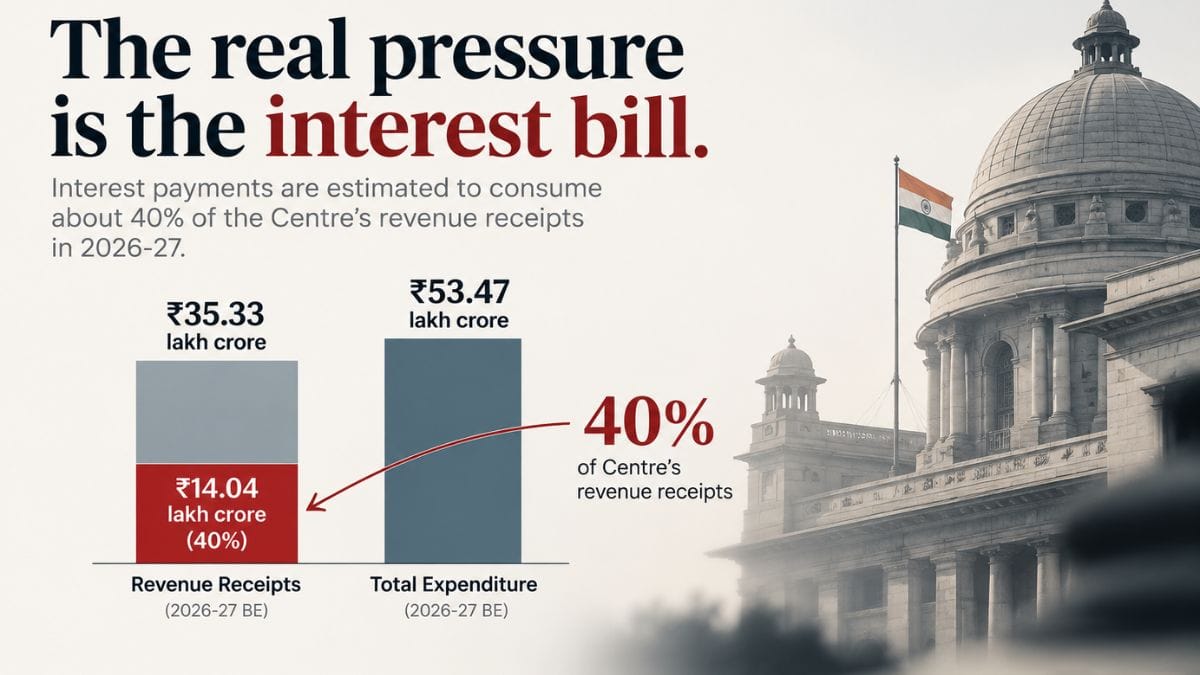
Interest does. The Budget puts interest payments at about ₹14 lakh crore – roughly 40% of the Centre’s revenue receipts. Total expenditure is set at ₹53.47 lakh crore. Receipts excluding borrowing are estimated at ₹36.52 lakh crore. Before the government decides what to spend on roads, defence, education or welfare, a large share of its recurring income is already committed to servicing past borrowing.
This is the central pressure point. India is not facing an imminent loss of market access. The debt is largely domestic. The ratio is not exploding. The real constraint is different: interest has become a heavy fixed claim on future budgets. When revenue rises, there is room. When revenue slows, interest does not adjust with it.
The government’s reply is capital expenditure -₹12.22 lakh crore in the current Budget, or ₹17.15 lakh crore when grants to states are included. The economic logic is sound only if the projects actually raise productivity. A railway line that cuts logistics costs can justify the borrowing. An underused scheme completed because the allocation had to be spent cannot. Capital expenditure is not productive simply because it is labelled capital expenditure.
The monthly accounts make the scale plain. By July the Centre had collected ₹13.07 lakh crore and spent ₹17.62 lakh crore. Capital expenditure stood at ₹4.51 lakh crore. Interest payments alone had already reached ₹4.27 lakh crore.
The vulnerability is growth. As long as the economy expands at a healthy pace, the current strategy can hold. If growth weakens while interest costs remain high, tax collections lose momentum but the interest bill does not. The government then faces harder choices: borrow more, raise taxes, cut spending, or delay investment. Capital expenditure is usually the easiest item to cut – and the one that most directly weakens the growth needed to stabilise the debt ratio.
The present arrangement is a bargain with growth. It requires nominal income to keep expanding, tax revenue to improve, the deficit to narrow, and borrowed money to generate enough productive capacity to support future obligations.
So far the numbers still add up. That is not the same as saying the risk has disappeared. The danger is not that India is already in a debt trap. The danger is treating today’s growth as a permanent solution to yesterday’s borrowing.