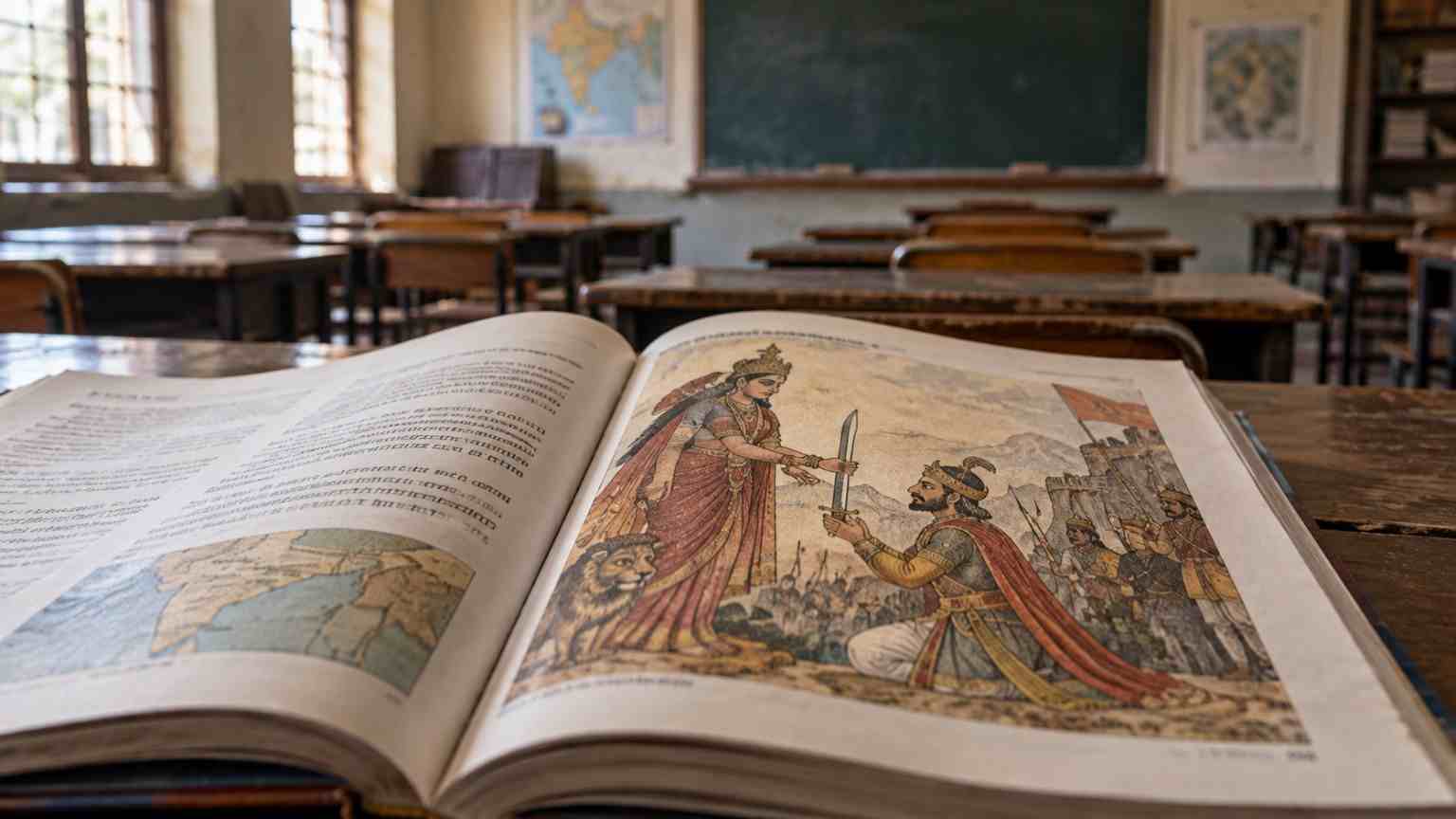
NEW DELHI — A new NCERT Class 9 Social Science textbook has brought stories of goddesses, swords and religious resistance directly into the classroom, describing traditional accounts in which Indian rulers received divine weapons before fighting invading forces.
The book, Understanding Society: India and Beyond – Part 2, includes a chapter titled “Resistance and Resilience”, which traces invasions and the resistance they faced across the Indian subcontinent. It covers the period from around 1000 to 1700, while referring to invasions beginning in the seventh century.
One section describes how rulers invoked Kali, Durga, Bhavani and other forms of Shakti during warfare.
The textbook gives several examples. Annamaraja of Bastar is traditionally believed to have received his sword from Manikyadevi, associated with Danteshvari. Kumara Kampana of Vijayanagara is linked to a goddess-given sword in the campaign against the Sultanate at Madurai. The book also refers to the traditional belief that Chhatrapati Shivaji received a sword from Tulja Bhavani.
The chapter does not stop with religious traditions. It puts several episodes of resistance together, covering the Rajputs, Ahoms, Vijayanagara Empire, Marathas, Sikhs and Jats, along with conflicts involving Arab, Turkish, Mughal and European forces.
The Battle of Saraighat and Ahom resistance, Maharana Pratap’s opposition to Akbar, the Maratha idea of Swarajya and Sikh resistance are among the subjects included in the chapter.
The book also records periods of cooperation and political alliances. Its discussion includes the relationship between the Kachwahas of Amber and the Mughals, while another section examines the Bhakti tradition and religious changes between the 11th and 17th centuries.
The book describes these as traditional beliefs, using phrases such as “traditionally believed” when referring to the goddess-given swords.
The revised Class 9 Social Science book forms part of NCERT’s curriculum changes under the National Curriculum Framework for School Education, 2023, and the National Education Policy, 2020.