TURA — A story about a lost Garo script, traditional food and knowledge passed orally across generations is now becoming a research subject at NEHU’s Tura Campus.
The campus on Tuesday launched an Indian Knowledge Systems (IKS) Research Centre under its Department of Agribusiness Management and Food Technology, with a mandate to document Garo food traditions, indigenous practices and knowledge held within local communities.
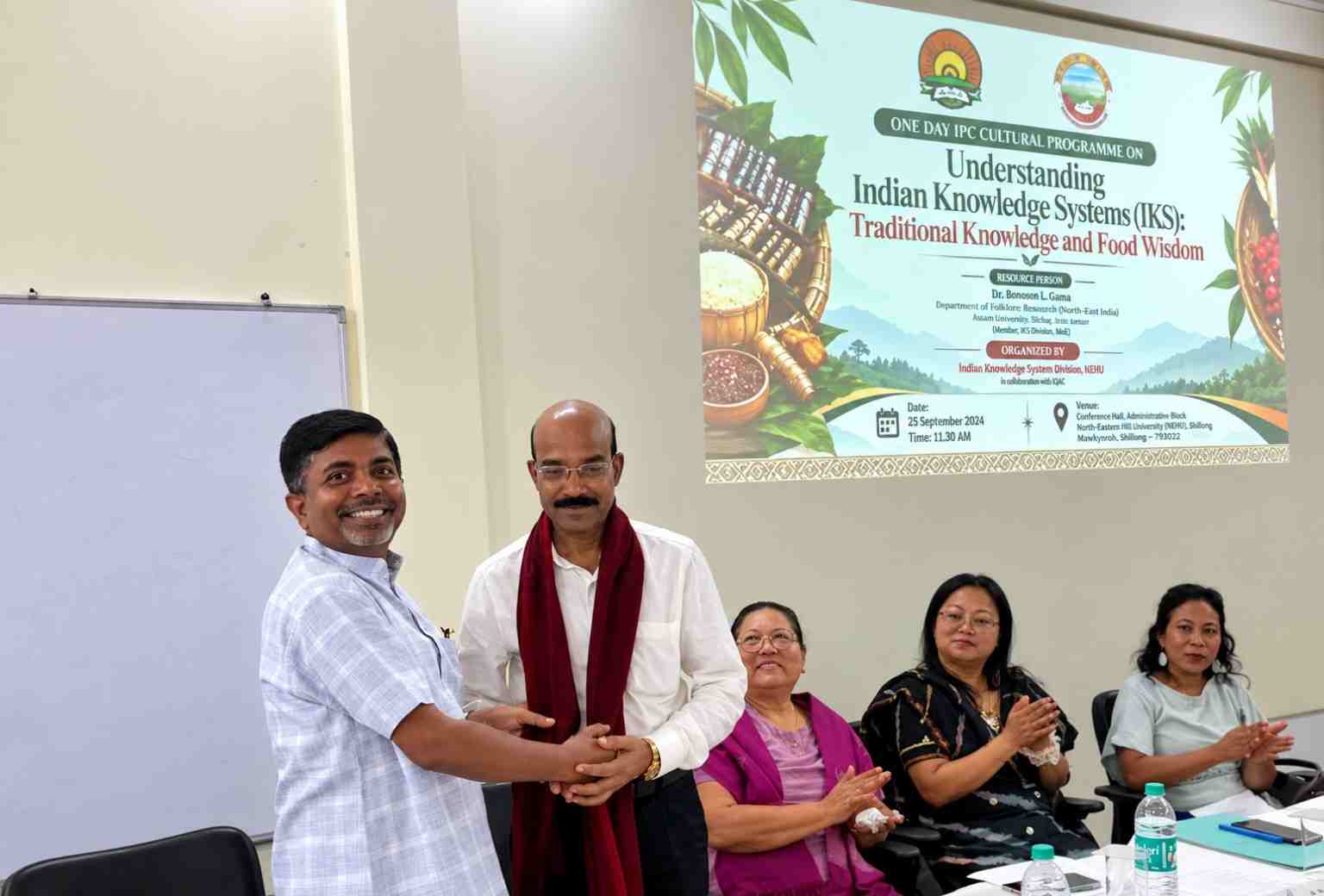
The Centre has been sanctioned by the Indian Knowledge Systems Division under the Ministry of Education. Its first programme, “Understanding Indian Knowledge Systems: Traditional Knowledge and Food Wisdom,” brought together around 70 students, research scholars, faculty members and staff.
The research will go beyond recording names of traditional dishes. Researchers plan to document preparation methods, ingredients, seasonal use, cultural and ritual associations, and how such knowledge moves from one generation to another. Nutritional and scientific studies of traditional foods are also part of the Centre’s work.
Dr Gino A. Sangma, Co-Principal Investigator, said the Centre would provide a platform for connecting traditional knowledge with contemporary research while bringing NEHU closer to communities in Garo Hills.
Dr Sheena Haorongbam, Principal Investigator, said traditional food knowledge includes the ingredients, techniques, seasons and cultural occasions surrounding food, rather than recipes alone. The cultural dimension came into focus during Dr Fameline K. Marak’s presentation on Garo traditional knowledge and cultural heritage. Marak, a professor in NEHU’s Department of Garo and former Pro-Vice Chancellor of the Tura Campus, discussed the significance of wa.ge, a bamboo associated with sacred traditions in Garo folklore.
Prof J.U. Ahmed, Campus-in-Charge of NEHU Tura, spoke on Dharma, Artha, Kāma and Moksha and their place within Indian Knowledge Systems.
But the most striking account came during the concluding session, when Tangringchi S. Momin, Lecturer at Tura Polytechnic and Co-PI of the Centre, shared a traditional account of Garo migration from Tibet to Meghalaya. According to the account, a Garo script was written on leaves during the journey, but the leaves were later eaten during a period of hunger, resulting in the loss of the script.
That story gives the new Centre’s work a sharper context. Knowledge that survives only through memory, oral transmission and community practice can disappear with the people carrying it. NEHU Tura is now setting up a formal research effort to record some of that knowledge before more of it is lost.
The Centre will undertake research, mentoring, educational programmes, outreach and documentation involving students, researchers, traditional knowledge holders and local communities.