SHIMLA – Two government datasets, both current, both official, and they disagree on Himachal Pradesh’s literacy rate by more than ten percentage points. That gap isn’t a rounding error. It’s the entire story here.
Himachal Pradesh reported 99.55 percent literacy under the Centre’s ULLAS programme on International Literacy Day, moving up from 99.3 percent in September 2025, when the state was first declared fully literate under the New India Literacy Programme. That puts it second nationally, just 0.15 percentage points behind Goa’s 99.7 percent, and comfortably clear of the 95 percent threshold ULLAS sets for a state to be certified “fully literate.” Education Minister Rohit Thakur collected the national award in New Delhi for it.
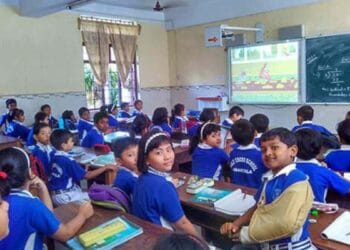
Here’s what that number actually measures, though, and it matters: ULLAS targets people aged 15 and above who were specifically identified as non-literate, a defined, narrow population, not the state’s entire adult population. Himachal has enrolled 94,930 learners under the scheme and trained 19,232 volunteer teachers across its 12 districts.
Three rounds of the programme’s Foundational Literacy and Numeracy Assessment Test, covering reading, writing and basic numeracy, have tested 61,542 of those learners so far, with 59,896 passing, a 97.3 percent pass rate. That’s a real, measurable achievement for the people who went through the programme. It is not, however, a measurement of Himachal Pradesh’s actual literacy rate.
Compare it against the Periodic Labour Force Survey 2023-24, which places Himachal’s literacy rate among people aged seven and above at 88.8 percent, a full 10.75 percentage points below the ULLAS figure. The same PLFS dataset puts Kerala at 95.3 percent, Mizoram at 98.2 percent, Nagaland at 95.7 percent, and Meghalaya at 94.2 percent, all considerably ahead of Himachal on this particular measure. Go back further and the numbers scatter even more: Himachal’s own Economic Survey recorded 93.3 percent under NFHS-5 for 2019-21, up from 82.8 percent in the 2011 Census.
Line them up and Himachal Pradesh has produced four different official literacy figures in roughly fifteen years: 82.8%, 93.3%, 88.8% and 99.55%, with each figure coming from a different dataset and measurement framework.
None of these numbers is necessarily fabricated. They’re measuring different things, ULLAS tracks a specific cohort of enrolled adult learners passing a specific test; PLFS surveys the broader population using its own self-reported literacy criteria; the Census and NFHS use their own separate methodologies again. But when a state government stands in New Delhi holding a national award for 99.55 percent literacy, on the same day a separate national dataset says its actual literacy rate sits closer to 89 percent, that’s not a footnote. That’s the headline the press release didn’t include.
The government has now set 2026-27 as its target for full literacy, which, going by the ULLAS figure alone, means Himachal needs to close a gap of just 0.45 percentage points. Going by the PLFS figure, it needs to close one closer to 11 points. Both claims can’t be the state’s real literacy rate, and only one of them is likely to still be true the next time a fresh national survey checks.