
The PHE Department wants credit for 5.47 lakh connections. It has not explained why only 71.74 per cent of villages meet its own water adequacy benchmark.
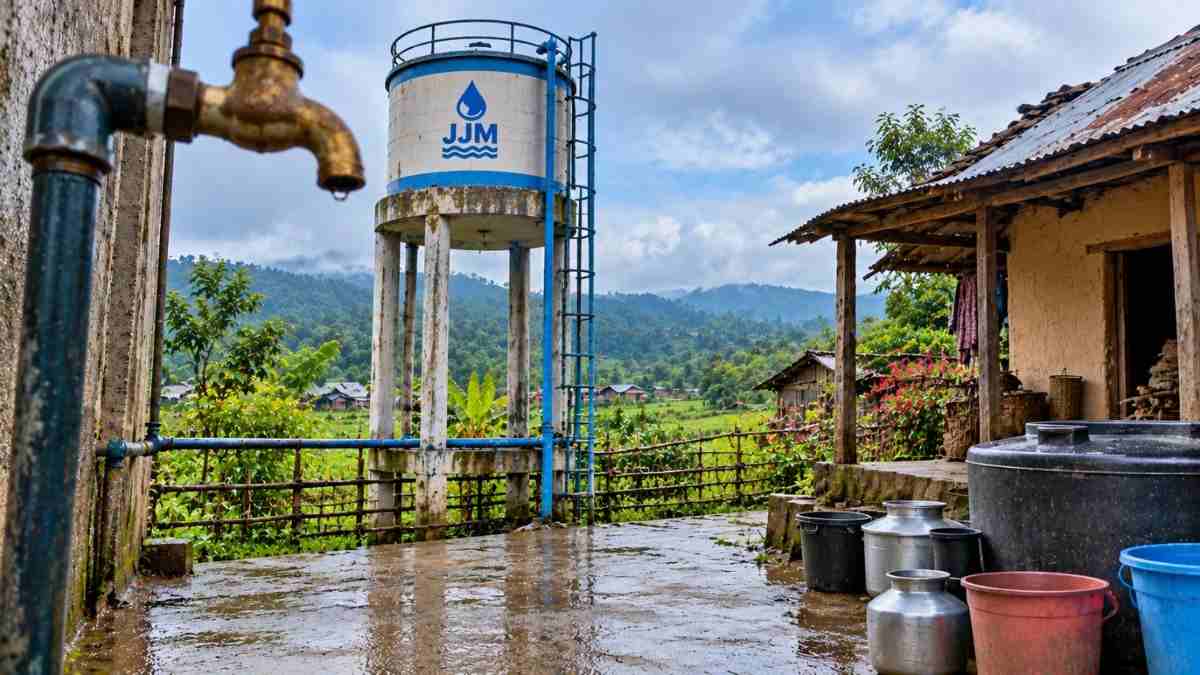
The Meghalaya government has a number it likes very much: 84 per cent. That is the share of rural households the PHE Department says now have tap-water connections under the Jal Jeevan Mission. The department puts the number at 5.47 lakh households, with 6,195 of 7,795 schemes physically completed. It also celebrated 75 schemes under Jal Arpan across the state on October 1 and 2.
The department’s own August review gives the number a harder edge. It found 87.32 per cent of villages receiving regular water supply, while 79.23 per cent reported daily supply. Only 71.74 per cent met the prescribed adequacy requirement. The review also identified 322 villages requiring focused intervention to improve household water supply.
That leaves a basic question for PHE: what exactly is being counted as a functional household tap connection? The department’s own figures show that reported household coverage and actual service levels are not the same measurement. A tap can be counted as a connection while regularity and adequacy of supply remain separate tests.
PHE is now saying much the same thing itself. A September review said the next phase would focus on the functionality of completed schemes and whether infrastructure translates into regular, adequate and safe drinking water. Ground-level assessments are being carried out to identify gaps in tap availability, regularity and adequacy, alongside repairs, operation and maintenance and source sustainability.
There are complaints outside the department as well. In West Jaintia Hills, the Jaintia National Council( JNC) has alleged that several villages have tanks and pipelines but are still waiting for household water supply. The allegation requires scheme-level verification. But the underlying issue is not new. A national functionality assessment of Meghalaya’s JJM works recorded complaints involving irregular supply, inadequate duration, low pressure and pipeline leakage. The Union government’s JJM portal continues to maintain separate functionality assessments for Meghalaya, underlining that connection coverage and service delivery are measured separately.
District figures also show why the statewide percentage cannot tell the whole story. Meghalaya’s Socio-Economic Review for 2023-24 recorded functional household tap connections at 55.63 per cent in East Jaintia Hills and 88.75 per cent in East Garo Hills. Those figures predate the current 84 per cent statewide claim, but the gap between districts remains relevant when statewide coverage is presented as a single achievement.
Then the source itself. PHE has made source sustainability part of JJM 2.0, alongside repairs and maintenance of completed schemes. The department’s own September statement says infrastructure must translate into sustained household-level water supply.
The 5.47 lakh figure tells us how many household connections the state reports. It does not tell us how many households receive water every day, how many receive it intermittently, how many fall below the adequacy benchmark or how many schemes are currently non-functional.
PHE should publish the scheme-wise data behind the statewide figure: daily supply, intermittent supply, adequacy status, non-functional schemes and the condition of their water sources.
The government has counted its taps. It has not yet shown that it has counted the water.