Fresh tensions have once again intensified in parts of Manipur following the killing of three church leaders in Kangpokpi district, an incident that quickly triggered shutdowns, protests, competing accusations and renewed fears of ethnic escalation across the already volatile state.
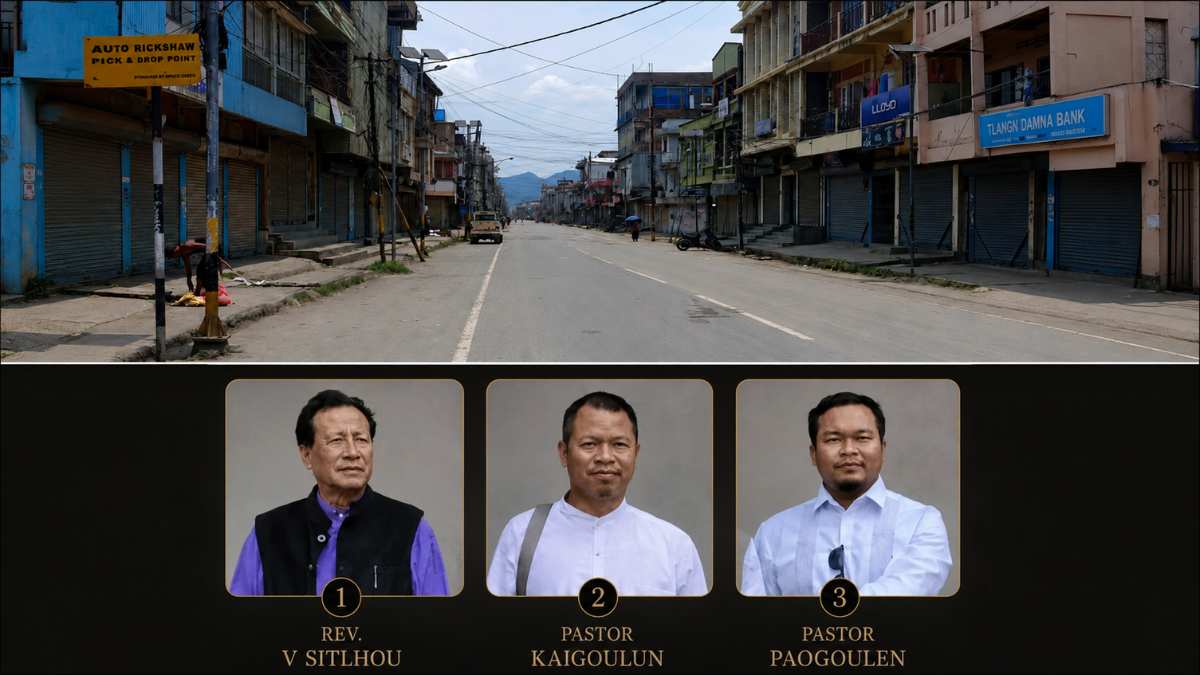
What first emerged as reports of an ambush involving religious leaders soon developed into a wider crisis involving allegations against armed groups, public mobilisation, hostage-related claims and growing mistrust between different communities and organisations.
The latest unrest, however, did not begin overnight. Even before the killings, Manipur had already been witnessing sporadic violence, shutdowns, armed tensions and increasing anxiety in several districts in recent weeks. For many observers, the incident reflects not only the continuing instability in Manipur but also the growing difficulty of rebuilding trust between communities nearly three years after ethnic violence first erupted across the state in 2023.
The Ambush That Shocked Manipur
The incident took place in Kangpokpi district when three church leaders linked to the Thadou Baptist Association were reportedly ambushed while returning from a peace-related gathering.
The victims were identified in different reports as Rev. Vumthang Sitlhou, Pastor V. Kaigoulun and Pastor Paogoulen Sitlhou.
Initial reports stated that unidentified gunmen opened fire on the group while they were travelling through a sensitive area already affected by tensions linked to the wider Manipur conflict. The killings immediately generated strong reactions because the victims were not ordinary civilians but well-known church leaders associated with religious and peace-related activities within their communities.
Why the Killings Triggered Strong Public Anger
The deaths created widespread shock across several tribal Christian communities in Manipur and the Northeast because attacks involving church leaders carry deep symbolic and emotional significance. In many conflict-hit areas, churches are often viewed not only as places of worship but also as centres of social support, mediation and humanitarian assistance during periods of unrest. The fact that the church leaders were reportedly returning from a peace-related programme further intensified grief and public outrage.
Several organisations later described the incident as especially disturbing because religious leaders are generally viewed as non-combatant figures even during periods of ethnic conflict.
Shutdowns and Protests Spread Across Kuki-Zo Areas
Soon after news of the killings spread, shutdowns and protest demonstrations were organised in several Kuki-Zo inhabited areas.
Groups including the Kuki Students’ Organisation (KSO), Kuki Inpi Manipur and other civil bodies publicly condemned the killings while demanding justice and stronger security measures. Public gatherings and demonstrations were reported in different areas, while roads remained tense amid fears of further escalation.
The incident quickly moved beyond a criminal investigation and became part of the wider ethnic and political tensions already affecting Manipur. For many residents, the concern was not only about the killings themselves but also about the possibility of retaliatory violence and renewed instability.
Allegations Against Armed Groups Added to the Crisis
As tensions escalated, several organisations publicly alleged the involvement of armed groups in the ambush. The Kuki Organisation for Human Rights Trust (KOHUR) accused cadres linked to the NSCN-IM and the ZUF-Kamson faction of being involved in what it described as a “premeditated act of terrorism.”
The Committee on Tribal Unity (CoTU) and several other organisations also issued statements linking the killings to armed groups operating in the region. However, no independent authority had publicly confirmed the allegations at the time of reporting.
Despite the absence of official confirmation, the accusations significantly intensified tensions because they introduced a dangerous ethnic and political dimension into the incident.
New Delhi Protest and Demands for Separate Administration
The killings also triggered reactions outside Manipur.
On May 16, members of the Kuki Students’ Organisation staged a protest at Jantar Mantar in New Delhi demanding justice for the slain church leaders.
During the protest, demonstrators accused the Tangkhul-led NSCN-IM and the ZUF-Kamson group of targeting members of the Kuki-Zo community. The organisation also renewed its demand for a separate administration for the Kuki-Zo people, arguing that continuing violence and insecurity had increased fears among civilians.
The protest reflected how the incident had rapidly evolved into a larger political and ethnic issue extending beyond Manipur itself.
Hostage Allegations Deepened Fear and Uncertainty
The situation became more alarming after reports emerged regarding the alleged abduction of civilians linked to different communities.
Kuki organisations claimed that 14 civilians from Taphou Kuki Village in Senapati district were allegedly abducted on May 13 by SDSA members along with cadres linked to the NSCN-IM.
According to community leaders, the whereabouts and condition of the missing civilians remained unclear for several days, deepening anxiety and anger among local residents.
Meanwhile, the Zeliangrong United Front (ZUF) later issued a statement condemning a separate ambush involving Naga civilians and demanded the immediate release of alleged hostages from the Zeliangrong Inpui community. The developments highlighted how multiple accusations, counter-statements and competing narratives were rapidly worsening the already fragile security situation.
The Sensitive Kuki–Naga Tension Angle
One of the most sensitive aspects of the situation was the growing tension involving sections of Kuki and Naga groups.
Following the killings, accusations and counter-accusations began circulating publicly, raising fears that the violence could trigger wider instability between communities already affected by years of distrust and territorial disputes.
The situation became even more complicated after debates emerged regarding “Kuki” and “Thadou” identity classifications while discussing the victims and the larger conflict. The episode once again highlighted how questions involving ethnicity, identity and territorial politics in Manipur remain deeply fragmented and politically sensitive.
At the same time, several Naga civil society groups appealed for calm and condemned the killings.
Reactions Emerged Across the Northeast
As tensions intensified, church bodies, political groups and civil society organisations across the Northeast issued statements condemning the killings.
In Meghalaya, the Khasi Jaintia Presbyterian Synod described the killings as a barbaric act and stated that violence against religious leaders represented an assault on society itself.
The Meghalaya BJP also organised a prayer meeting in memory of the slain church leaders, where party leaders appealed for peace, communal harmony and justice.
Several Christian organisations and rights groups called for restraint while warning that inflammatory rhetoric and retaliatory mobilisation could further worsen the already fragile situation in Manipur.
The widespread reactions demonstrated that the incident had generated concern far beyond Kangpokpi district alone.
Related : Meghalaya BJP holds Prayer meeting for Church Leaders killed in Manipur
The Violence Revived Old Fears From 2023
The latest tensions unfolded against the backdrop of the larger ethnic violence that first erupted in Manipur in 2023. Since then, the state has witnessed large-scale displacement, armed confrontations, destruction of homes and places of worship, buffer zones and prolonged mistrust between communities.
Although security operations and peace efforts have continued over the past several months, tensions in many areas remain fragile and unresolved.
Many residents felt , the killings became a painful reminder that the deeper divisions inside Manipur continue to remain unresolved despite repeated appeals for peace and reconciliation.
Social Media and the Battle of Competing Narratives
As with many incidents linked to the Manipur conflict, social media quickly became flooded with competing claims, accusations and emotional narratives following the killings.
Different organisations interpreted the incident through sharply different political and ethnic perspectives. Some groups framed the attack primarily as an ethnic assault, while others focused on the involvement of armed groups and security failures.
The rapid spread of unverified claims online complicated the situation further because misinformation and inflammatory rhetoric have repeatedly contributed to tensions during the Manipur conflict over the past several years.
Questions That Still Remain Unanswered
Several important questions surrounding the incident remain unresolved.
Authorities have yet to publicly establish who carried out the ambush, whether armed groups were directly involved and whether the attack was part of a larger coordinated operation.
Questions also remain regarding the hostage allegations, the possibility of further retaliation and the effectiveness of ongoing peace efforts in preventing another wider escalation.
While investigations continue, many communities across Manipur remain tense and uncertain about what may happen next.
A Fragile Peace Still Under Pressure
The killing of the three church leaders has once again exposed how fragile the situation in Manipur remains nearly three years after ethnic violence first shook the state.
What began as an ambush involving religious leaders quickly evolved into shutdowns, public protests, ethnic accusations, hostage-related claims and renewed political tensions. The developments also demonstrated how deeply interconnected religion, ethnicity, armed conflict and community identity have become within the wider Manipur crisis.
As investigations continue and organisations across the Northeast call for peace and accountability, the latest incident has reinforced one difficult reality: despite periods of relative calm, the deeper fractures that emerged during the Manipur violence remain far from resolved.
Editorial Note:
The developments discussed in this article involve evolving events, public claims, organisational statements and conflict-related allegations emerging from multiple sources.
Information was compiled from publicly available reports, press releases, official statements and regional media coverage available at the time of writing. As the situation continues to develop, additional information, responses, clarifications or official findings may emerge.
The Shillong Daily may update the article when further verified details become available.